
As I was writing this series that is unintentionally turning into a “women photographing war” series, I’ve been thinking about Catherine Leroy. She’s a French photographer I heard about a very long time ago when I was a kid, and I was vaguely aware of her career. Mainly because she worked for Paris Match, a weekly news magazine that can be seen as a more trivial French Life Magazine.
She arrived in Saigon in 1966. she was twenty-one years old. She had bought a one-way ticket from Paris, with no intention of coming back any time soon. A hundred and fifty dollars in her pocket, a Leica M2, and three words of English. She went straight to the Associated Press office and asked for a job.
Dickey Chapelle‘s photograph was on the wall. Chapelle had been the first American woman war correspondent killed in action, in Vietnam the year before, on patrol with the Marines. Her picture hung there like a question and a warning: are you sure about this?
Leroy was sure.
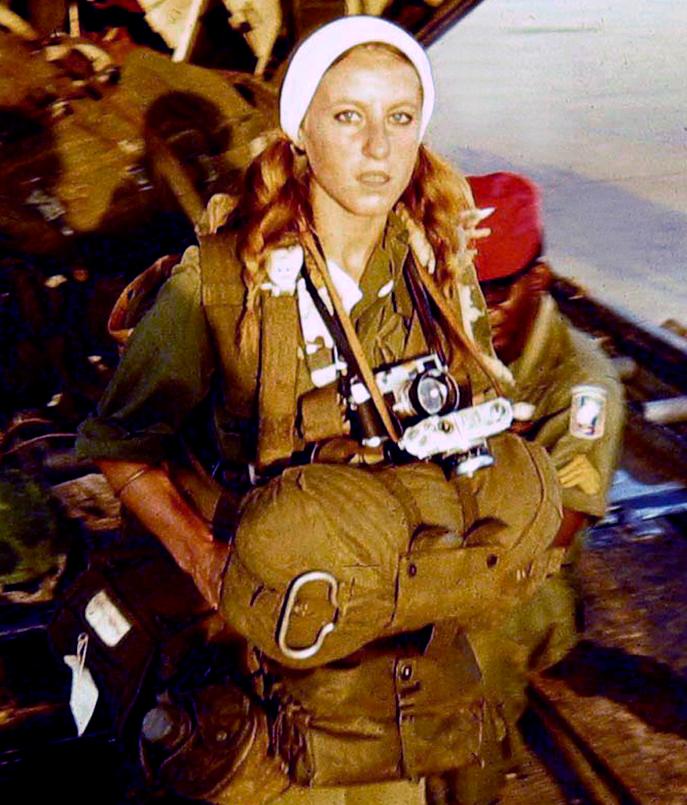
Horst Faas, the AP bureau chief, sized her up and gave her the same test he gave every newcomer. Three rolls of black and white film, and the offer: “If you can get anything I can use, I’ll pay you $15 a picture.”
She’d never been anywhere near a war. Her closest encounter with combat was the pictures in Paris Match, the magazine she’d learned to read as a girl. “I wanted to be a war photographer, but I had never heard a shot fired in anger”. She had no idea what she was walking into, but she went anyway. In a way she took her place in a line From Lee Miller, to Dickey Chapelle, to Anja Niedringhaus, who knew what they wanted and didn’t take no for an answer.
Her first patrol with the 101st Airborne in the Central Highlands brought her face to face with what she’d signed up for: dead soldiers being lod,ed into body bags. “I didn’t look like them, they did not accept me”, she said later. But she got the pictures. Scarcely six weeks into her career, Horst Faas selected two of her negatives, and Catherine made her first freelance sale to an American wire service. Three rolls of film shot by someone who’d never been near a war, and the rest of her life followed.
Her first real combat came in September 1966, with Operation Thayer, a search-and-destroy mission in the Crow’s Foot area of the Binh Dinh province. She was terrified. Anyone who tells you they weren’t terrified in their first firefight is either lying or a dangerous psychopath. But she kept shooting, keeping her head down, advancing with the troops and winding the film as she went along.
She was born in August 1944 in the suburbs of Paris as bombs were still falling all over France from the Allied campaign pushing Germany East. She was born into a world at war, and it set the theme for her whole life. She grew up in Catholic boarding schools, restless, rebellious, the kind of girl who gets told “no” a hundred times and only hears the first one as information and ignores the others. At eighteen she got a parachute licence. By all accounts, it was to impress a boyfriend. That parachute badge became the thing that set her apart.
On February 23, 1967, Leroy became the first accredited journalist to make a combat parachute jump with American forces. Operation Junction City, the 173rd Airborne Brigade. She was so small they had to weigh her down with extra gear so she wouldn’t float off course! Five feet tall, maybe eighty-five pounds. A half portion for the soldiers around her.
Imagine what it felt like: you’re twenty-two years old and French. You jumped out of a plane for the first time because you liked a boy, and now you’re falling into a jungle full of people who want to kill you, surrounded by soldiers armed to the teeth, with a camera around your neck. Bravery doesn’t even start to cover it. It’s something entirely different. It’s a fundamental miswiring of the survival instinct, the same miswiring you find in every volunteer war photographer. Robert Capa had it. Don McCullin had it. It’s the thing that makes you run towards the sound of gunfire instead of away from it like any sane person would. It’s the thing that makes the danger feel like the only place you’re fully alive. “It’s the biggest high of all”, Leroy said later. “A massive rush of adrenaline. The high you experience in times of great danger is a high that you cannot experience anywhere else”. That’s the miswiring talking.
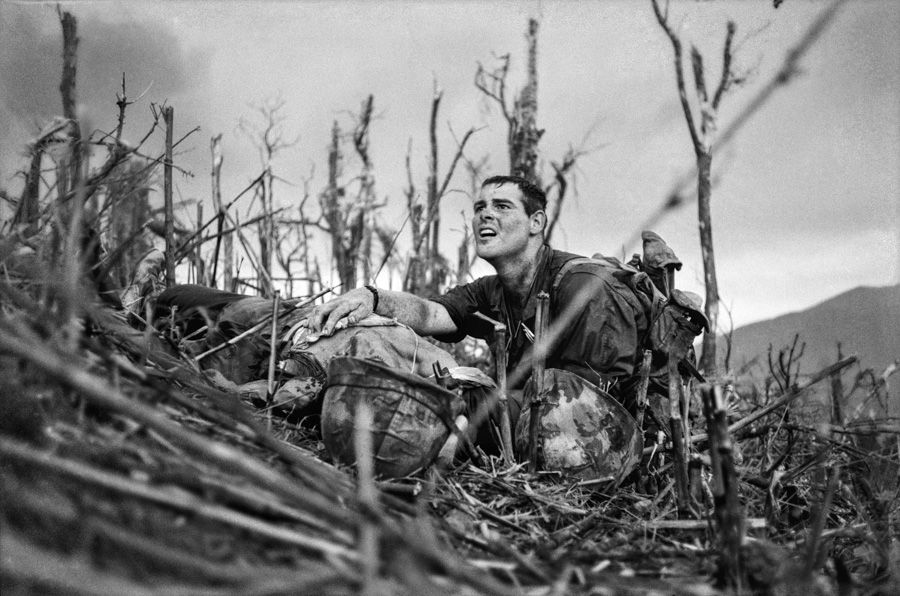
A few months later, in May 1967, she was on Hill 881 near Khe Sanh. The battle was brutal. Marines were dying on a slope in the tall grass, smoke everywhere, the sound of mortars hitting so close you feel it in your teeth. Leroy was right in there with them, shooting with her camera.
© Dotation Catherine Leroy
She photographed a sequence that became her most famous work. A Navy corpsman named Vernon Wike crouching over a mortally wounded Marine. Look at that frame. Wike’s face is twisted in anguish. The Marine’s body cuts diagonally across the foreground, already becoming something other than a person, strangely oriented downward. Tall grass and branches frame them both, and the horizon isn’t clear because in that moment everything was off. There’s no grand battle in the background, no helicopters, no distant smoke, no explosions. Just two men on a hill, one living and one dying, and Leroy so close she’s practically on top of them (I’m assuming she used a standard 50mm lens). That proximity is the image. She isn’t observing from a safe distance. She’s right there, inside the event, breathing the same air.
Life magazine published it as “Corpsman in Anguish”. Six pages. The image became one of the defining photographs of the Vietnam War.
Leroy said later: “The pictures I took of the Navy corpsman leaning over his dead buddy on 881 summed up for me my fifteen months of war”.
She was wounded on May 19, 1967, by a mortar round that lodged thirty-five pieces of shrapnel in her body. Her cameras took the worst of it. One piece hit her Nikon and stopped, and if the camera hadn’t been there, it would’ve gone through her chest. “I took a couple of pounds of shrapnel in my eighty-five-pound frame”, she told Life.
The same miswiring that made her jump out of that plane sent her back into the field after a medevac to the USS Sanctuary. She wasn’t dead. With her cameras opened and her film handed to a marine information officer who promised to get it to AP, she held the cameras tightly that had saved her and lost consciousness. She recovered, and she went back.
General Walt, the Marine commander, visited her in hospital. He brought her a manicure kit. The gesture was totally absurd and touching at the same time. She was a twenty-two-year-old woman covered in shrapnel wounds, and a three-star general brought her nail polish. That was the war she was fighting as well: the one where men couldn’t decide whether she was a colleague or a girl who needed protecting, so they treated her as both.
In early 1968, she won the George Polk Award for the photographs she’d taken the year before, the first freelancer and the first woman to win it. Two years after her arrival in February 1966, she’d jumped into a combat zone, been shot, and produced the image of a battle. A good year’s work.
Then came Tet.
The Tet Offensive erupted in January 1968, and Leroy was in Hue, the old imperial capital where the fighting was heaviest. North Vietnamese Army regulars overran the city, and she was captured with a French colleague, the AFP journalist François Mazure, and taken into a courtyard, surrounded, with weapons pointed at her.
They talked. In French, then whatever English they knew, they explained they were French journalists, not Americans and not the enemy. Mazure did most of the talking, playing the indignant professional, while Leroy kept her nerve. Somehow it worked. The soldiers took them to their command post, and instead of executing them or keeping them prisoner, they let Leroy photograph them.
This was the first time anyone had photographed the North Vietnamese Army behind their own lines. These were the invisible enemy. You saw Viet Cong in the press, you saw ARVN and American troops, but you never saw the PAVN. They were the shadow that killed you from the treeline. And here was this tiny French woman walking around their command post, shooting portraits.
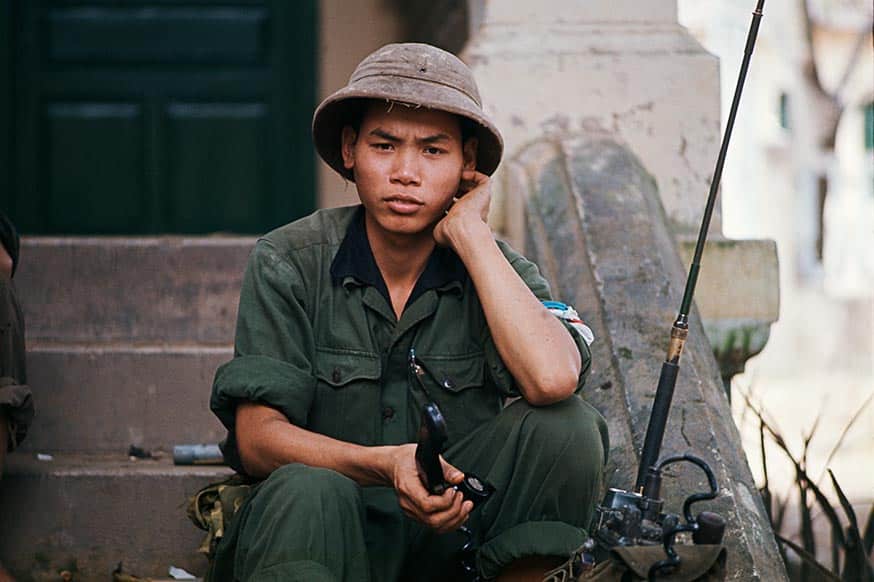
Look at this photograph. A young Vietnamese soldier fills the frame, looking directly at the camera, not at Leroy but through the lens, meeting your eye across decades. The light catches his face, young and tired and uncertain. His uniform is indistinct, the background nothing, the rifle visible but not prominent. What you see is a person, not a propaganda monster or a shadow from the treeline or a body count. Just a person.
“This was the first time, suddenly, that their humanity was in front of me”, she said. Nobody had tried to make the other side look human like her. How can you not relate to the soldier?
But her most important photograph was the one Life selected to run as front cover.
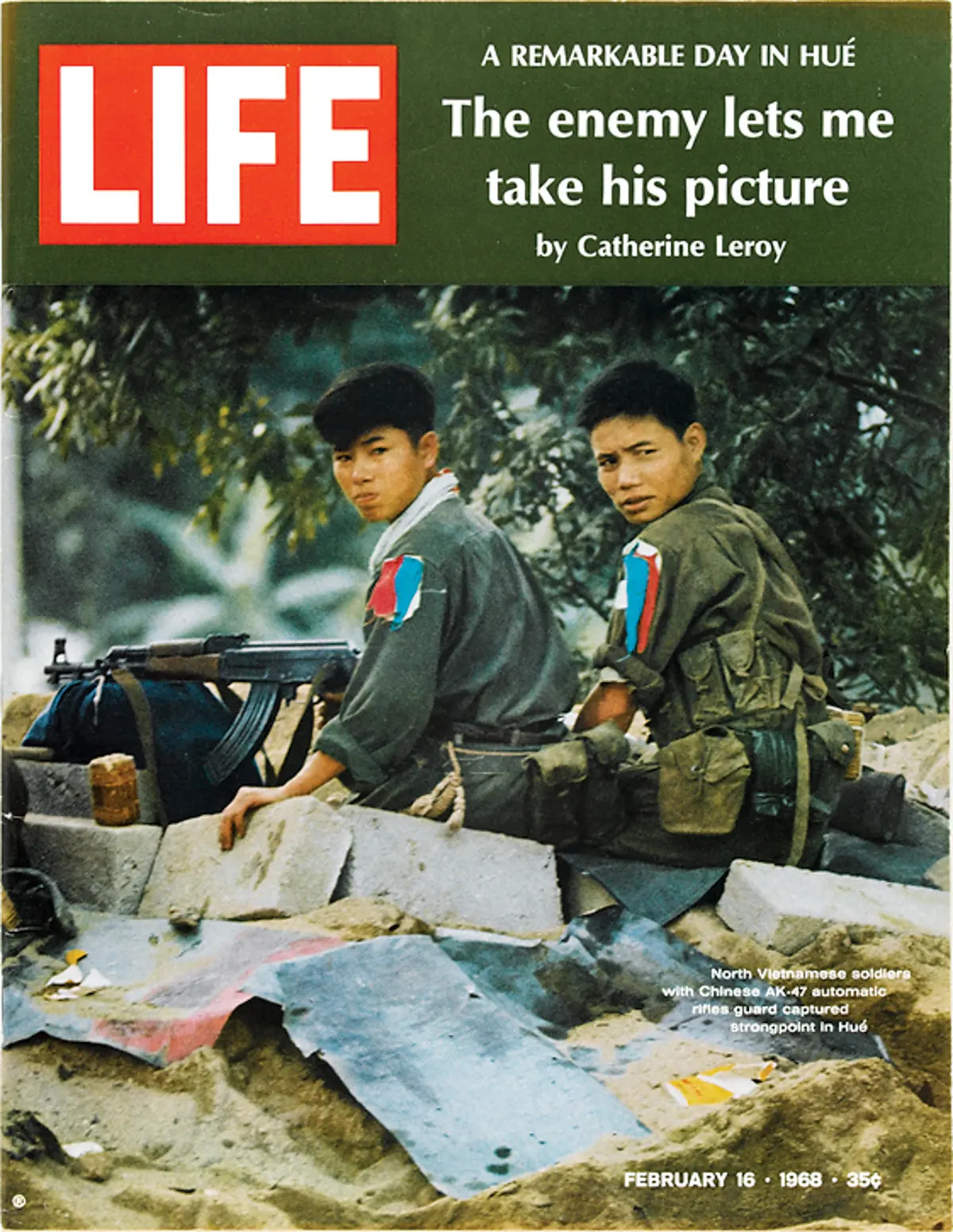
Look at that photograph. Two North Vietnamese soldiers sitting behind a captured strongpoint, turning to look over their shoulders straight at the camera. It’s in colour, which if important at a time when most war photography was black and white: the green of the foliage, the olive of their uniforms, the red and blue of their sleeve patches. One rests his hand near an AK-47 propped against a bag. Their faces are young, tired and wary. What you see is people, not a propaganda monster or a shadow from the treeline or a body count. Just people.
Life magazine ran one of her photos as a cover story. “A Remarkable Day in Hue: The Enemy Lets Me Take His Picture”. Eight pages inside. The cover showed that young NVA soldier staring into her lens, not as a propaganda image but as a person. That cover changed how Americans saw the war.
Leroy didn’t shoot from a distance to capture the grand panorama of battle with the smoke and helicopters and distant explosions. She got close, physically close, the camera at eye level with her subjects whether they were American Marines or Vietnamese regulars or wounded civilians. Her black and white images are grainy and dense, often shot in terrible light, composed with an intimacy that puts you right there.
Not interested in the architecture of war, she was interested in the face of it. “What I did was to give war a face”, she said. That’s not just a quote, it’s her philosophy, and it sounds simple but it’s not. Giving war a face means you don’t photograph the battle, you photograph the person in the battle. The corpsman and the dying Marine, the NVA teenager who’s been told the Americans are monsters and now he’s looking at a French woman with a Leica and he’s not sure what to think, the Palestinian girl with the missing arm and the glittery heart headband.
That last one is from Lebanon. After Vietnam, Leroy didn’t stop. She went to Northern Ireland, to Cyprus, to Iran and covered the civil war in Lebanon, publishing a book called “God Cried” with journalist Tony Clifton in 1983. The book documented the siege of West Beirut by the Israeli army, a brutal book about a brutal conflict. Her coverage of Lebanon earned her the Robert Capa Gold Medal in 1976, and she was the first woman to win it. The Capa Medal is awarded for “best published photographic reporting from abroad requiring exceptional courage and enterprise”. She earned it in Lebanon, but really she’d been earning it since the day she landed in Saigon.
That’s where the Chapelle thread completes. Chapelle kicked the door open. Leroy walked through it and never looked back. Two women, both parachute-qualified, both refusing to be told that war was no place for them. Chapelle died in the attempt. Leroy made a career of it. The common thread is the refusal to take no for an answer.
But the cost was enormous. The adrenaline high that kept her going through the sixties and seventies had a comedown that lasted decades. “We were never sure we’d survive, or be able to translate it all into photographs that would have meaning”, she said. “Yet there was no other place in the world we wanted to be. It mattered as if our lives depended on it. It did”.
“I always felt that it was a great privilege to be with the soldiers”, she said. “But I could leave any time, and they couldn’t. To me, it was as if I was a deserter”.
After years of covering conflict, she struggled. “I wasn’t exactly well in my skin. I was extremely shell-shocked. It took years to get my head back together, because I was filled with the sound of death, and the smell of death”.
She moved to Los Angeles and opened a vintage clothing store called Piece Unique. A war photographer opening a vintage shop sounds like a plot twist but makes sense as something gentle after years of brutality. She continued taking assignments when they came and edited “Under Fire: Great Photographers and Writers in Vietnam” in 2005, a book that collects the work of the journalists who covered the war. It’s a testament, an obituary, a memorial. Many of the people in that book were dead by the time it was published.
Her last assignment came in 2005. Paris-Match sent her to Arizona to reunite with Vernon Wike, the corpsman from Hill 881, thirty-eight years after the photograph that made her name. I can’t imagine what that meeting was like. Two people, both old now, looking at a photograph of themselves when they were young and the world was on fire. When Wike first saw the pictures back in 1967, he’d asked her, “But where were you? I didn’t see you”. She’d been that close.
She died on July 8, 2006, in Santa Monica. Lung cancer, diagnosed just one week earlier. She was sixty-one years old. A single week between diagnosis and death, and that’s how fast it took her. She always did things quickly.
I think about the white headband she wore in Vietnam. It was probably a practical thing, kept the sweat out of her eyes in the jungle heat. But it became a signature. It reminds me of my mother at the same age at the same time. You look at a picture of a tiny woman in the middle of a war, white headband, Leica in hand, and you know exactly who she is. She made herself hard to miss and hard to forget.
Leroy didn’t just photograph war but stood in the middle of it holding a camera while people died around her, refusing to treat any of it as abstract. Every frame caught a person worth seeing. She gave war a face, and she gave herself one too.
Sources:
1. Book Close-Up on War: The Story of Pioneering Photojournalist Catherine Leroy in Vietnam by Mary Cronk Farrell (2022)
2. Liberation obituary “Catherine Leroy quitte le front” (July 10, 2006)
3. Liberation “Femmes photographes de guerre, du pareil aux mecs” (April 2022)
4. Wikipedia (for fact-checking)
5. The Guardian obituary by Tony Clifton (July 21, 2006)
6. Dotation Catherine Leroy official biography
7. The Darkroom Rumour, professional biography
8. “Catherine Leroy Female Combat Photographer”, veteran’s blog (COM250 PHOTO, March 2012)
#Photography #PhotographerFocus #Opinion #CatherineLeroy