The number of women war photographers is incredible. I wasn’t expecting to fins so many. I’m only going to cover some of them in this series.
I’ve never been to a war zone. The closest I’ve come is a photography exhibition in the Jardin du Luxembourg, where someone else’s images of conflict hang on metal frames and you walk past them with a coffee in your hand. It’s not the same thing, and I don’t pretend otherwise. I take photos of beaches in Scotland and my cat in window light. But there’s one photo I keep coming back to, and I can’t fully explain why.
It’s a colour photograph taken in Fallujah, Iraq, in November 2004. A US Marine walks through rubble on a destroyed street, past hollow buildings. Dust hangs in the air. And tucked his bag, with its head poking out, is a GI Joe figure wearing desert camouflage, just like his own. The Marine is carrying this absurd thing through hell, and that’s the image that won the Pulitzer Prize.
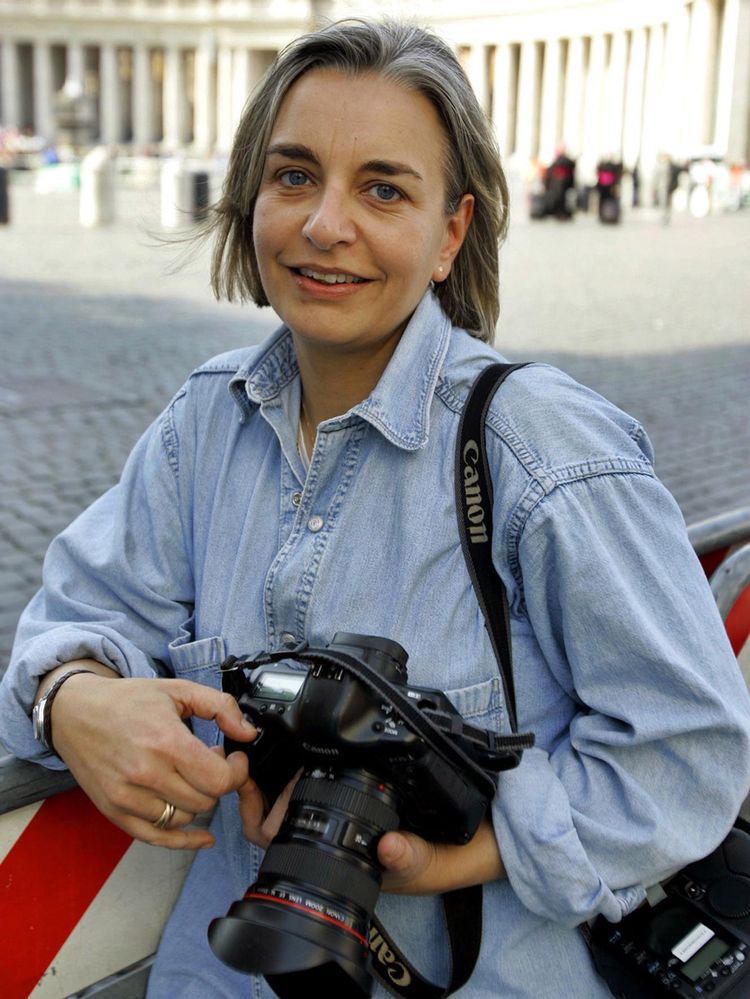
The photographer was Anja Niedringhaus.
I can tell you the facts. She grew up in a small town called Hoxter in Germany, with two sisters. Their father loved motorcycles and was, as they put it, “really reckless,” riding through rings of fire while the girls got burns on their calves from the exhaust pipe. This was normal. The three girls were treated like boys. “Nobody ever said you can’t because you’re a girl,” her sister Elke remembered. They called Anja “Arno” because she had a technical side and wasn’t interested in girly things. She loved motorcycles the most. That detail matters. It tells you something about the kind of person who would later spend years in Sarajevo and Fallujah.
She started photography at 17, still in school, working for a local newspaper. When she applied to the German Press Agency, she sent a photo of herself in a helmet inside a silver mine. Her sister thought it was a terrible idea. The head of photography looked at it and asked: “Are you the woman with the helmet?” They offered her a job at the European Pressphoto Agency on the spot, telling her she didn’t need a traineeship. She was the first woman EPA had ever hired.
But the editors didn’t really know what to do with her. They wanted to protect her. She had to fight for two or three months just to convince them to let a woman go to Sarajevo, even though it was the job she was hired to do.
On her first day in Sarajevo, her welcome present was a sniper’s bullet hitting her flak jacket. It didn’t kill her, fortunately, it just grazed the vest, and she kept going. She stayed in the region for a decade!
In Croatia in 1991, a Bulgarian colleague asked her: “What are you doing here as a woman?” It wasn’t curiosity, it was a dismissive comment. Then he didn’t talk to her for hours, probably thinking she’d see sense and disappear. She stayed anyway and showed him she was good. They became lifelong friends.
Like Lynsey Addario, she brings her own personal sensitivity to the table. She sees things slightly differently from her colleagues who report on war. Anja says that she “still can’t name what kind of tank or gun I’m looking at,” she’s “not interested in that”. What she sees is people. A colleague who worked with her said: “She could show terrible things too, she wasn’t sugarcoating. But she was a very human photographer”.
Like Addario, she shot mostly eye level. She placed herself inside the frame as an equal, not an observer above the scene. She tended to frame her subjects off centre to capture the surroundings and let that context tell the story of what was happening. She didn’t boost the colours in her images, she wanted to show the grim reality. And she was patient. She waited for the unguarded moment, the instant when someone forgot the camera was there.
Here is an example: the photography shows a German soldier sitting on the edge of a bunk bed on the side of a hill with only dry grass as vegetation. He’s sitting next to burning candles and is celebrating his 34th birthday alone, before a patrol in Yaftal e Sofla, Afghanistan in September 2009. It’s poignant to see him alone in his celebration, but you know that all around him is war and death. You know he’s going ton patrol in moment and might not come back. It tells you something about what war costs, and the human factor in it.
Something she said in 2011 gets at this better than any analysis could: “I can’t pull immediate remedies from my camera bag. My duty is to talk about war”. Understanding the limit of a photograph, she said later: “I thought our photos could achieve something, but nothing happened in NATO policy. That’s when I realised it wasn’t what I imagined”. A photo can witness, a photo can show the world what is happening, but it can’t stop a war.
She joined the Associated Press in 2002 and covered the aftermath of 9/11 in New York, then Afghanistan for three months covering the fall of the Taliban, then Iraq. In 2004, she embedded with Marines for the first time during the Second Battle of Fallujah and slept on floors in abandoned houses. The Marines didn’t know what to make of her at first, but she carried her cameras, stayed out of the way, and took the picture.
And then there is the Pulitzer prize.
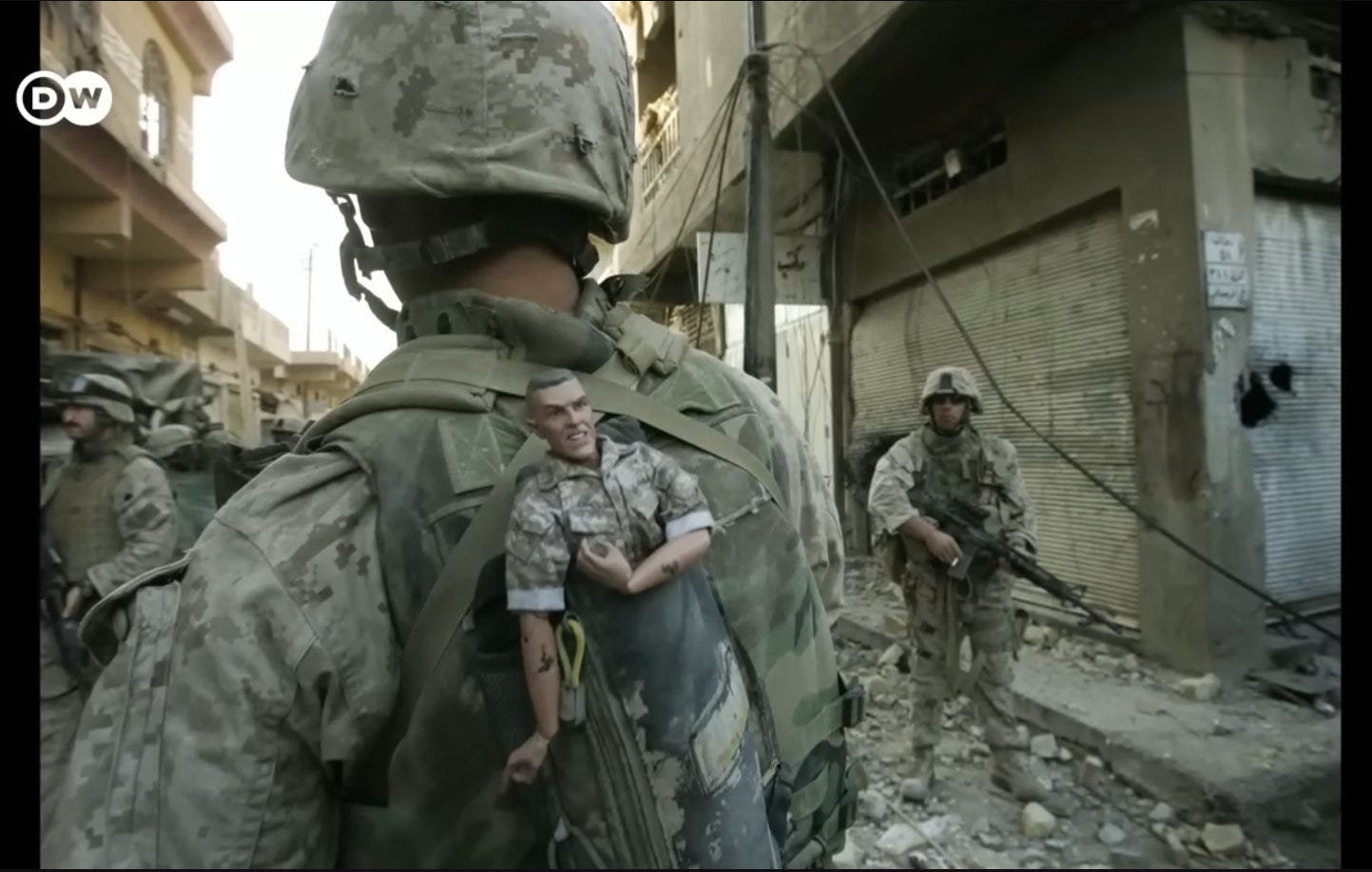
It’s not a technically complicated photograph. The composition is straightforward, with the Marine centred and walking through the frame while the rubble frames him on both sides. Flat light and hanging dust soften everything. It could be a snapshot, but it isn’t. The power of the image is in the juxtaposition. Here is the most serious business in the world, the urban warfare of Fallujah, on foot, one of the bloodiest battles of the Iraq War. And a soldier is carrying his platoon’s mascot through it. “In all the madness,” Anja said, “a soldier who’d gone to the trouble of carrying his little mascot through the rubble. It was really something.”
She never knew it would win a Pulitzer and said that with characteristic modesty. Awards were never the point. She shot because she wanted to see what was happening and to show other people. The Pulitzer was the team award for the AP’s Breaking News Photography coverage of the Iraq War. She was the only woman on that team of 11 photographers. And she was the first German photographer ever to win one.
There is a direct line from Lee Miller who talked her way into Vogue’s war coverage and walked into Hitler’s bathtub, to Dickey Chapelle, whose assignment to photograph nurses on a hospital ship off Iwo Jima didn’t stop her from going ashore to photograph the battle, to Lynsey Addario who got herself kidnapped twice, to Anja Niedringhaus who had to argue for months with her editor to be sent to Bosnia. These are all women that refuse to take no for an answer, who understood that permission is something you take, not something you wait for. They know that the world needs to see what’s happening and that they can show it. Anja’s prize was a milestone in the progression of women’s contribution to war reporting.
Anja herself said: “I think the women I know who went to war had a slightly different take on war. And I think the work is different”. the difference with classical war reportage is where you decide to look.
But Anja wasn’t focused on war only. She covered nine Olympic Games. “I should never take war as normal”, she said.
After the Pulitzer, she became a Nieman Fellow at Harvard. She lived with her partner in an old forestry office in the woods, where they kept horses and didn’t talk about assignments when she was home. “We have horses, there’s always something to do”. Her phone calls from conflict zones were vague, pretending she wasn’t in a war zone and asking how the family was doing. Like everything was normal The partner recalled: “She radiated confidence. She always made me believe she’d come through everything unscathed”. Two days before she died, she called her partner from Afghanistan. They’d agreed to buy a horse together for Hella, someone they knew.
She died on April 4, 2014, at 48 years old, in Afghanistan covering the presidential election alongside her colleague, AP reporter Kathy Gannon. She wasn’t even covering a war. That makes the futility of it worse. She wanted a photo of people coming down from the mountains to vote, a panoramic view of Afghanistan. She didn’t want to stay in Kabul. “I don’t care where we go as long as it’s not here”, she told Kathy.
An Afghan police commander named Naqibullah walked up to their car, shouted “Allahu Akbar” and opened fire on the two women in the back seat. Anja was killed instantly. Kathy survived with multiple bullet wounds. Naqibullah was convicted and sentenced to death, but Anja’s family opposed the death penalty because she didn’t believe in it. They asked for life in prison instead. On appeal, the sentence was reduced to 20 years, and then Naqibullah was released as part of a peace deal.
So futile.
In a letter read at Anja’s funeral, Kathy Gannon wrote that she closes her eyes and sees Anja smile, hears her laugh. “We were a hell of a team”, she wrote, “and I remember some of your last words: ‘I am so happy'”.
She once said her goal was always the same: to do good work. That’s all. She never claimed that she wanted to change the world. But you can’t talk about war photography without talking about her. She changed what the camera looks at in a war zone and proved that the softest detail can have the highest impact.
Her war photography confirms to me that documentary photography is the most important form of the craft. It confirms to me that women like Anja Niedringhaus are indispensable to understand the world around us.
Sources:
- YouTube Documentary “Die Bilderkriegerin / Anja: Life on the Frontline”, www.youtube.com/watch?v=JypsVh6iAtM
- Wikipedia (for fact-checking)
- Libération “Anja Niedringhaus, une vie pour dénoncer la guerre”
- Anja Niedringhaus official site (anjaniedringhaus.com/vita)
#Photography #PhotographerFocus #Opinion #AnjaNiedringhaus