
I’m into deep dives at the moment and I think I’ll make this a regular feature.
I first came across Dickey Chapelle by accident. I was reading about war photographers, having arrived on the subject via Lee Miller. Someone mentioned a woman who wore pearl earrings into combat and whose last photo was recovered from her camera after she was killed. I had to find out who she was.
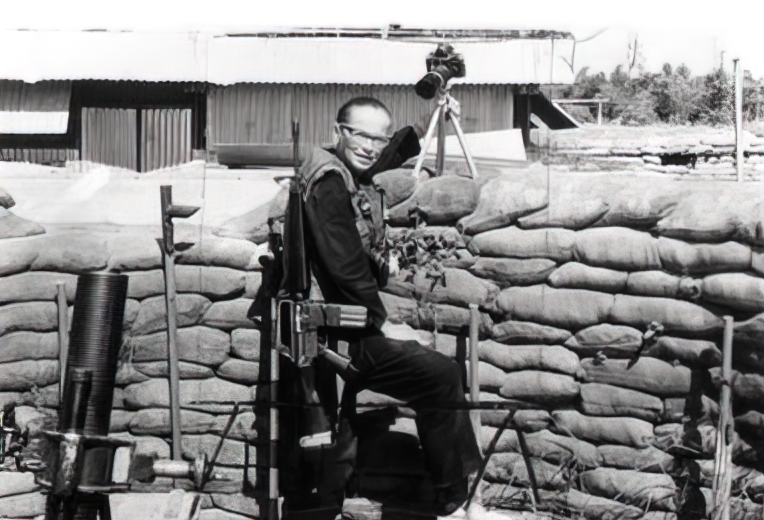
The image people usually show is her standing next to some Marines in Vietnam, wearing her signature Australian bush hat and those huge Harlequin glasses. She looks like someone’s aunt who showed up at the wrong party, but she was exactly where she meant to be.
Her real name was Georgette Louise Meyer. She grew up in Milwaukee and taught herself photography as a teenager. By sixteen she was valedictorian of her high school and had a full scholarship to MIT for aeronautical engineering. She was one of only very few women in her class (three to seven depending on sources). But she flunked out because she skipped a flight dynamics exam to cover a flood-relief airlift. She ran across the tarmac, shouted up at a pilot, and hitched a ride on a supply plane to Worcester. That’s such a perfect early indicator of who she’d become that it reads like something you’d invent for a movie. But it’s real.
From MIT she went to a Miami air circus, and somehow ended up in Havana writing about a pilot who crashed and died in front of her. She filed the story to The New York Times from a phone booth. At twenty, she’d already done more than most journalists manage in a decade. A TWA publicity chief heard about her through a fellow reporter and offered her a job in New York City, where she took a room the size of a prison cell in Brooklyn and felt right at home.
In New York she signed up for photography classes with a man named Tony Chapelle, a World War I veteran and TWA’s publicity photographer. He was more than twice her age, charismatic and controlling in equal measure. Tony replaced her horn-rimmed glasses with red lipstick and formfitting clothes, draped her in expensive jewellery, and photographed her like a model. She thought she’d hit the lottery when he proposed, a man who seemed to see her as no one else had. At twenty, she couldn’t see past the version of her life he’d promised, the one where she was his partner and collaborator.
What should have been a partnership turned dark. As Dickey found her footing as a journalist, Tony became verbally abusive and manipulative. He dictated what she wore, who she talked to, and what jobs she took. When she tried to leave, he threatened her with a gun outside her apartment door. The divorce took years and left her broke, taking work at CARE and the International Rescue Committee just to survive. She never had a serious romantic partner again. But her career flourished.
There’s a through-line from Lee Miller to Dickey Chapelle, and it runs through the refusal to take no for an answer. When Miller arrived in Paris in 1929 and walked into Man Ray’s studio, he told her he didn’t take students or apprentices. “You do now,” she said. Chapelle had the same instinct. In 1942, she spent months trying to get credentialed by the Navy to cover the war in Panama, sending in paperwork and waiting while winter turned to spring and nothing came back. In a last-ditch attempt she took a bus to Washington and talked her way into the office of Colonel Dupuy at the Coast Guard headquarters. “I presume you realise, Mrs. Dickey, that troops in the field have no facilities for women?” he asked. “I’m sure the Fourteenth Infantry Regiment has solved much tougher problems than that”, she replied, “and they’ll probably think of a way to lick this one, too”. A few moments later he gave her signed press credentials, and she shipped out to the Pacific to cover Iwo Jima and Okinawa with the Marines. She was one of the first women to do it.
After the war she kept going. Korea, Algeria, Lebanon, Cuba, the Dominican Republic. She crossed the Hungarian border fifteen times in the winter of 1956, guiding refugees through frozen cornfields under Soviet tracer fire alongside the novelist James Michener, who later wrote her into his book The Bridge at Andau under a fictional name. On her fifteenth crossing, Soviet border guards captured her and threw her into Fö Street Prison in Budapest, the most dreaded jail in Hungary. She was held in solitary confinement for five weeks. Her cell had a blanket with the colours of the Hungarian flag with the bloodstains of the previous inmate still visible on it. They told her she’d be hanged. Twice. To keep time, she scratched marks into the whitewash with her fingernail.
She survived, emerging deaf in one ear and carrying the weight of what she’d been through. Her family helped her recover in less than a year, and then she went straight back to work. She became the first Western journalist to gain accreditation with the Algerian National Liberation Front, then marched with Castro’s army into Havana and became the first female reporter approved to parachute with US troops, making six jumps. From there, she covered covert special forces in Laos and photographed Fidel Castro’s army entering Havana on New Year’s Day 1959. The night before, she’d patrolled the Soviet border with the Turkish infantry.
Her approach wasn’t recklessness dressed up as bravery but something calculated. She put herself in danger, but she never forgot what the danger was for. Her own words: “You’ve got to survive to get the pictures and the story out to the world. If you get killed, it’s all for nothing.” That complicates the picture of the fearless war photographer. She was afraid, and she managed it.
The reason why she was known as the pearl earing photographer was that she decided to wear them so nobody would mistake her for a Marine. She stayed acutely aware of being a woman in a man’s world, and she used it because pretending that being female didn’t matter wasn’t her style, so she navigated it.
On Iwo Jima, she stood exposed on a ridge during heavy shelling. A Marine lieutenant screamed at her for being visible for ten minutes straight. She told him she hadn’t noticed, that she thought the wasps buzzing past her head were insects. They were bullets. I’ve never been shot at, and reading that makes me feel like I don’t know the first thing about concentration.
She won the George Polk Award in 1961 (which she received in April 1962) and the NPPA Photo of the Year in 1963. They’re photography prizes proving she was a great photographer, if there was any need for that.
At some point in Vietnam, she watched Marines mistreating Viet Cong prisoners. According to her friend and fellow correspondent Joe Galloway, “She looked at that and went berserk.” She drew herself up to her full height and confronted the gunnery sergeant in charge. “Are you sure you have good enough control of these dangerous prisoners?” she asked, sarcasm dripping. “Don’t you think you should get some more wire and tie their feet together?” When Galloway asked her later why she had reacted so strongly, she told him she too had been a prisoner of war and that America would lose if it continued down this road. She was more supportive of the military than she was of the war. That’s a distinction she understood and one worth considering.
There’s a photograph she took that I think about, from Iwo Jima with Marines moving under fire, the frame cluttered with bodies, equipment, and smoke. The kind of image you only get when you’re right there, in the same dirt, breathing the same air, taking the same risk. What makes it her photograph is that she saw something in the middle of it and held the camera steady enough to catch it. Plenty of photographers have been in dangerous places and struggled to bring back anything memorable. Clarity under pressure, that’s the skill, and her real method was proximity. She ate what the Marines ate, slept where they slept, took the same risks. But her philosophy went deeper than just getting close. In the 1950s, working on a documentary for Save the Children in the Mergellina caves of Naples, she’d confronted the ethics of this kind of proximity. The cave dwellers were the poorest people in Western Europe, and every photographer and film crew who had come before had promised them help that never arrived. She watched a fistfight break out over a quart of water she’d left next to a man she was interviewing, and realised then that the only ones who benefited from this kind of reporting were the reporters themselves. It changed how she thought about her work. From then on, she made sure her reporting served the people she covered, not just her career.
That’s a different philosophy from the detached observer, the one who floats in and out. She was committed to being there. Easy to stay back and use a long lens and tell yourself you’re being objective. Much harder to be in the middle of it, with the smell and the noise and the fear, and still see clearly enough to frame a shot.
Her commitment is one of the things I admire the most about her. I take pictures of landscapes and buildings in good light, while she took pictures of war with people shooting at her. But the lesson applies at any scale. You get better pictures when you’re closer. The work improves when the people you photograph know you’re not going to abandon them for a better story.
Her impact on war photography is still visible. The war correspondents she trained or worked alongside, like Joe Galloway, remembered her as someone who never had to be taken by the hand. Jackie Spinner, who covered the Iraq War for the Washington Post, wrote the foreword to a book of Chapelle’s photographs and said she found herself wondering what Chapelle would have made of the new dangers of war reporting, the fear of being kidnapped and beheaded. The standard she set, that a war photographer goes where the troops go, eats what they eat, shares their risk, was remarkable enough when men did it. The fact that she was doing it in a bush hat and pearl earrings, at a time when women were actively discouraged from even setting foot in a combat zone, made it undeniable. Like Lee Miller, she decided what her place was and just took it.
In the spring of 1965, she wrote to the Marine Corps commandant, General Wallace Greene, pitching an article called “Love As an Infantry Tactic.” She’d just returned from covering the 82nd Airborne in the Dominican Republic, where she had watched them hand out medicine and food to local children and build schools between firefights. Compassion as a military strategy, that was her argument. Greene, who had pinned his own Marine insignia to her bush hat, believed in her enough to help get her visa approved when the press office tried to block it.
She was forty-six years old when she returned to Vietnam for her final assignment. On November 4, 1965, she went on patrol with the First and Third Battalions of the Seventh Marines near Chu Lai during an operation called Black Ferret. She had told people she wanted to die on patrol with the Marines. When the lieutenant walking in front of her kicked a tripwire, a mortar shell with a hand grenade wired to the top exploded. The shrapnel hit her in the neck and severed her carotid artery.
She died on the ground. Henri Huet, another photographer who was there, took the last picture of her being carried away. Her own camera was recovered with the film still intact, and the last frame shows Marines wading through a rice paddy taken moments before the explosion.
The Marines gave her a full military burial at Forest Home Cemetery in Milwaukee. At her funeral, the reverend read a poem by Rabindranath Tagore that began, “Where the mind is without fear and the head is held high.” The Hungarian Freedom Fighters sent a dozen red roses. The 82nd Airborne staged a mass paratroop jump over the Dominican Republic in her honour and named their drop zone after her. The Marine Corps put a memorial marker near the site of her death. It reads: “She was one of us and we will miss her.”
In 2017, more than fifty years after her death, the Marine Corps declared her an honorary Marine. That’s unusual for a journalist, and it tells you something.
She’s got two biographies now. But what stays with me isn’t in any book. It’s the fact that every photographer who followed her, every woman who walked into a war zone with a camera, walked through a door she kicked open. She was the first American female journalist killed in combat, but she wasn’t the first female combat journalist. For a long time, she was one of the only ones, and she made that look like a choice, not a limitation.
She was forty-six. Her last photographs survived. That’s a better legacy than most of us will leave.
Sources:
- “First to the Front” by Lorissa Rinehart (2023)
- YouTube documentary, https://youtu.be/axPz5xIBwnc
- Lee Miller research (web search)
- Wikipedia for fact-checking
- CJR / Washington Post / Vice / Milwaukee Journal Sentinel articles for supplementary context and fact-checking
- Vice piece about “Dickey Chapelle Under Fire” book (Jackie Spinner foreword details)
#Photography #History #DickeyChapelle