
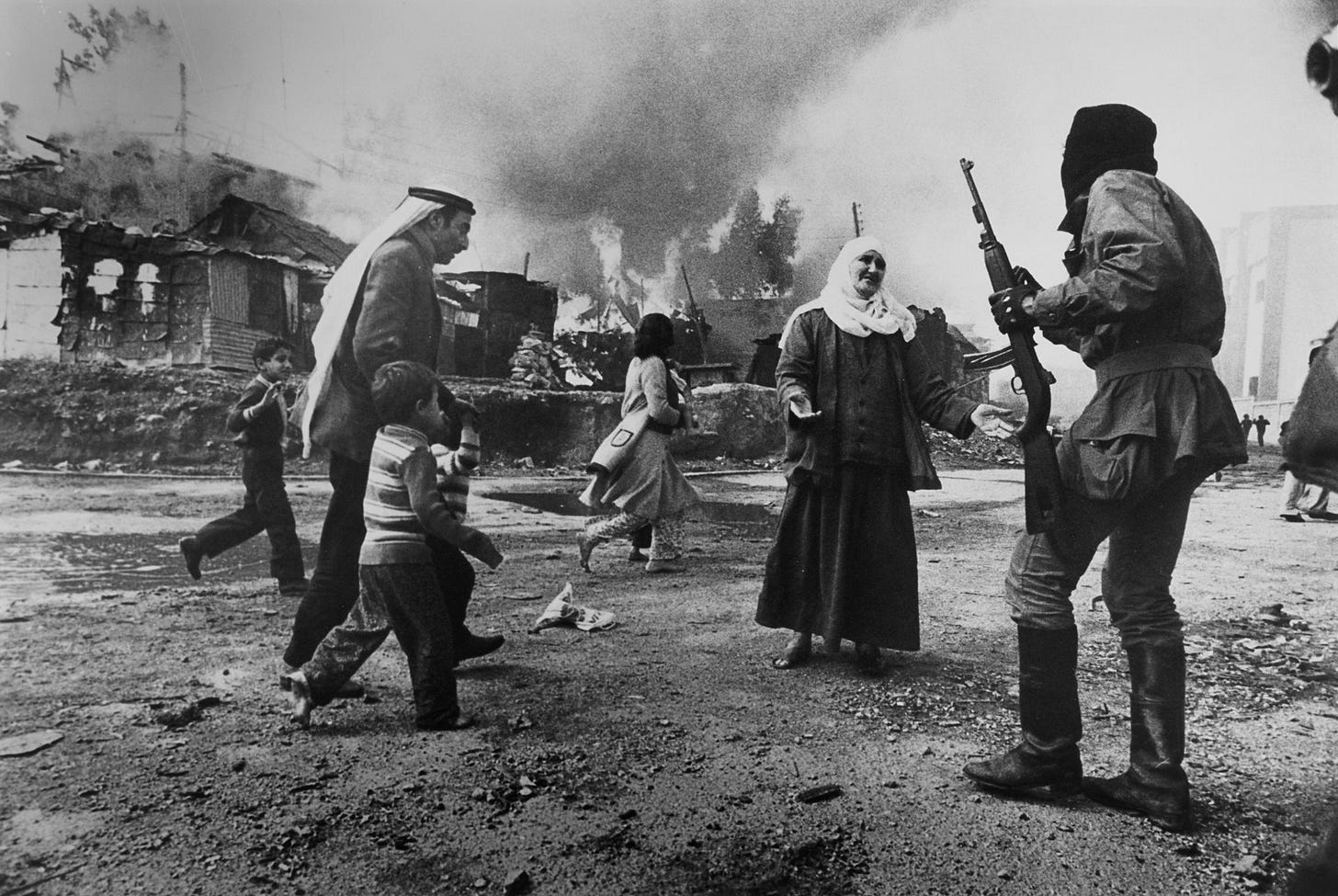
At Ajou, a hamlet in Normandy, the coffin was covered with red and black kaffiyeh headdresses, the kind of scarf a Palestinian fighter wears. They were surrounded by roses. Against the altar, there was a black and white photo taken thirty-two years earlier in Beirut: a woman with a scarf over her head, hands raised in supplication, pleading with a masked gunman holding a Second World War rifle.
Françoise Demulder took that photograph and it was at her funeral.
I came to Demulder from the deep dive I did on Catherine Leroy. Leroy tends to be the famous one because she went to Vietnam during the war and took iconic photos there that ended up on the cover of Life. But Demulder was the first woman to win World Press Photo of the Year.
The two of them were contemporaries. Both French, both in Indochina, both working for the Paris picture agencies in the golden age of the photo magazines. Horst Faas, the Associated Press photo chief in Saigon, said that Leroy was une boule de feu, bruyante et agressive. A fireball, noisy and aggressive. Demulder, he said, parlait peu, était presque timide. Spoke little, was almost shy.
Roland Neveu, who met her in Cambodia in 1975, said: “C’était une femme qui savait mieux que personne convaincre les gens de l’emmener sur le front”. She was a woman who knew better than anyone how to convince people to take her to the front.
The reason why Demulder was kind of forgotten? Thames and Hudson’s Women Photographers series lists Demulder and Christine Spengler as “Contemporaries” and Catherine Leroy as a “Pioneer”, even though they worked the same wars in the same years. Leroy gets a different status from the others: the first one, the one that broke barriers, the trailbrazer. Damulder? She just followed through the door. As often, the loud one is the one that gets remembered.
She was born Françoise Annie Demulder on 9 June 1947 in the twentieth arrondissement of Paris, the daughter of an electronics engineer. She studied philosophy. She did a brief stint as a model, checked press proofs on the side. Nobody handed her a camera and told her this was her calling. Colleagues called her Fifi, all the way to the end. She never married.
She got to phorography via a love affair and it started her career. She travelled to Vietnam in early 1970 with Yves Billy, her companion, a photographer who later became a documentarian. They travelled on a tourist ticket. He said abut it: “was not a romantic choice, but a means of survival. It was war, and images were currency”.
She confirmed this in a Dutch 1977 interview, quoted in her World Press Photo biography: “The only way to earn a living was to make photos. I was not a photographer by any means, but there was a great need for photos from Vietnam. I sold about four photos a day to a press bureau, because they were the only ones who paid cash. There has never been as much work as there was then in Vietnam.”
Four photos a day, that’s pretty good. There was a lot of competition. She learned in the field, she and Billy riding a motorbike around Saigon or hitching lifts on US Army Hueys, then dropping the film at the Associated Press office for maybe twenty dollars a frame. Faas remembered her arriving, tall, extremely thin, always in a loose blouse, French trousers and combat boots, riding around Saigon covered in dust.
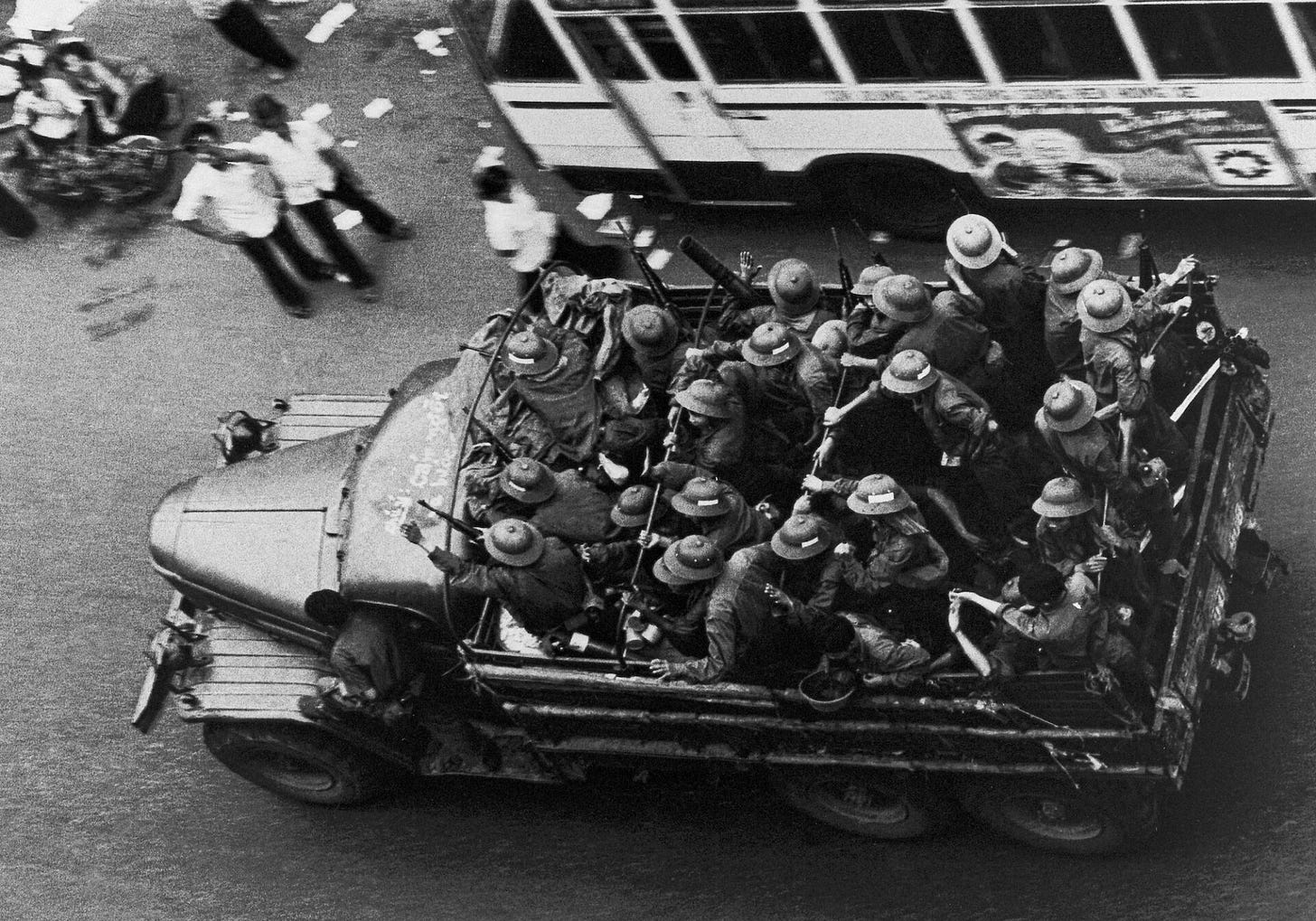
She covered Vietnam for roughly three years. Then she did the crazy thing that should have made her a household name: on the 30 April 1975, as Saigon fell, nearly every American and foreign journalist was pulled out. She stayed. She got inside the presidential palace, the Independence Palace, and she was the only photographer to capture the North Vietnamese tanks coming in. Le Monde said: posted in the presidential palace, she was the only photographer to seize the instant the Vietcong tanks entered the city.
Catherine Leroy photographed the fall of Saigon that same day. Demulder got the tank at the gate. Two Frenchwomen, one event, but history only remembered one of them.
Then Beirut. She went to the Gamma agency shortly after Saigon at twenty-eight years old, and on the morning of 18 January 1976 she was in the Karantina district of Christian East Beirut, also known as La Quarantaine, when Phalangist militiamen moved through it. They evicted the largely Palestinian refugee population, set the homes alight, bulldozed the shantytown. It became known as the Karantina massacre. Hundreds died by most counts; some accounts put it around a thousand.
That’s where she took the woman pleading at he top. Its power, as described in the Johanna blog, is not in sensationalism but in the distance between the photographer and her subject. Demulder is just far enough away not to disturb the scene, yet close enough to convey the intensity of it. The composition is clearly structured, the pleading woman and the masked gunman in the foreground, the barefoot children and the burning shantytown held in the plane behind them. It feels like she thought about it.
She said that she was founted by that image for years afterward. What she called the haine dementielle of the hooded killer during what was a boucherie stayed with her. She said: “Désormais, il n’y avait plus les bons chrétiens et les méchants Palestiniens ; les phalangistes ne me l’ont jamais pardonné”. From then on there were no longer the good Christians and the wicked Palestinians. The Phalangists never forgave me.
Her own account of the frame, given for the television series Les Cent Photos du siècle, is that only the mother and her baby in the background survived, and that the militiaman killed himself playing Russian roulette.
The photograph was made during the Karantina massacre on that January morning in 1976; the world came to know it as the picture of a different one. Jean-Pierre Filiu argued in Le Monde in 2022 that it only became world famous after another massacre seven months later, the siege and killing at Tel al-Zaatar on 12 August 1976, when around fifteen hundred Palestinians and Lebanese Muslims died. His title was un massacre pouvait en cacher un autre, one massacre could hide another. As a result, the photo is ofter misattributed.
But the story of the photo doesn’t stop at misattribution. The film went via taxi and courier, via Damascus or Jordan, onto a flight to Paris, and reached the Gamma office about two weeks later. The editors ignored it. they found it too hard to read and complex. That’s nearly unbelievable. Demulder came home, found it in the file and rescued it. So the most famous picture of her career was lifted from the discard pile by its own author, late. Incredible.
When you think about it, many photos that came to be known as amazing have escaped death by the skin of their teeth. Even the first known photo nearly disappeared several times.
She was the first woman to win the World Press Photo of the Year in 1977. not bad for a discarded photograph. When she won, she said that she hates war and she felt compelled to document how it’s always the innocent who suffer while the powerful get richer and richer. Sounds familiar?
Arafat, after Karantina, became a friend. She covered his exile. She visited him. Christian Poveda, who knew her for twenty-eight years, remembered the two of them running into each other’s arms. She went to Tripoli, followed the departure by sea in 1983, visited him in Tunisia. A friendship with a man much of the Western press treated as a monster, taken by her as simply a fact of the world she was reporting.
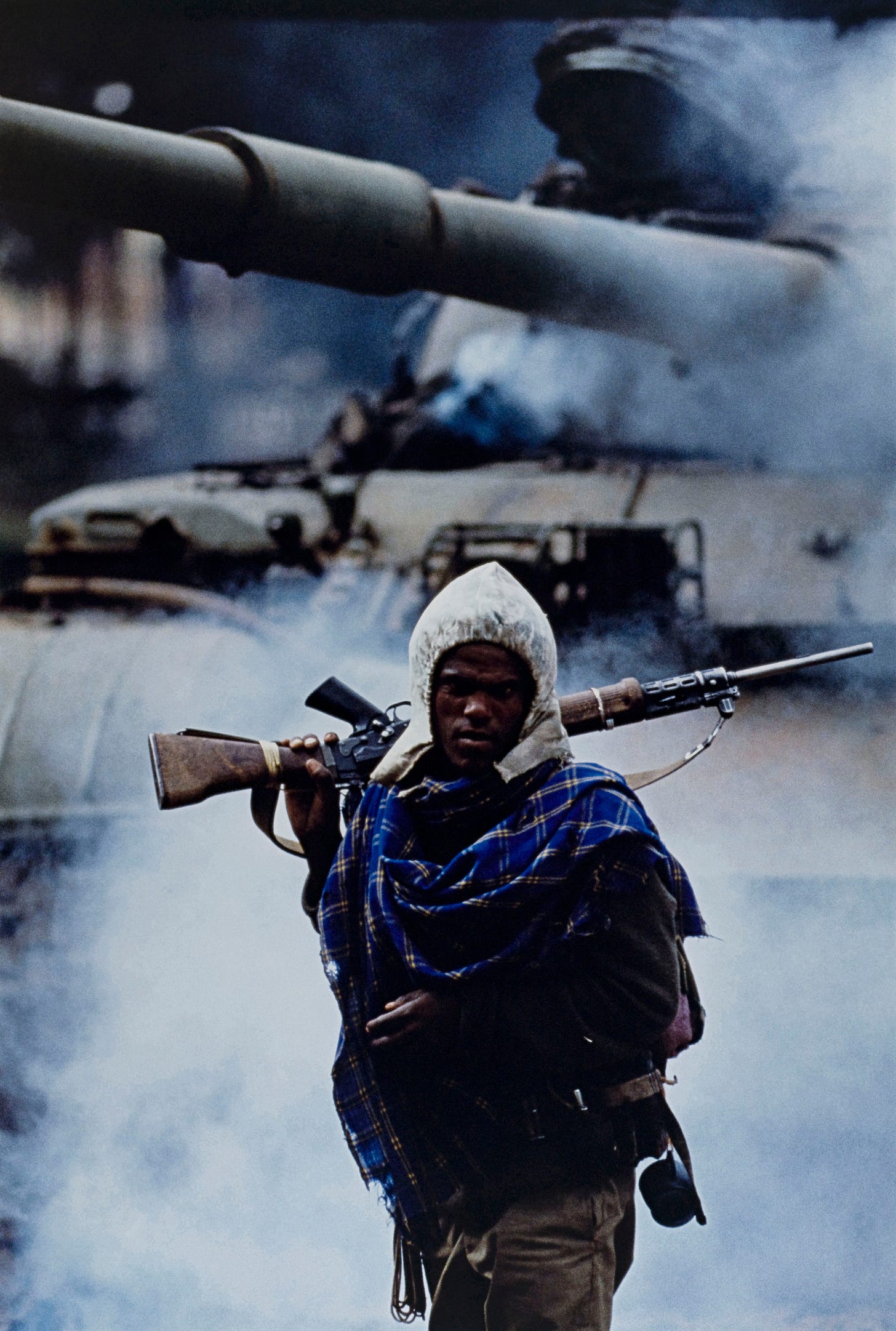
Her career after that was essentially a map of where death and misery happened in the world: Angola, Cambodia, El Salvador, Ethiopia, Pakistan, Cuba, the Iran-Iraq war. The Khmer Rouge war and the Vietnamese invasion, the refugee camps, Phnom Penh, the destroyed villages. Gamma, Sipa, Sygma, Corbis. Time, Life, Newsweek, Paris Match, Stern, the British Sunday colour supplements. Sygma, Gamma and Sipa were the three Paris agencies that made Paris the centre of world photojournalism in the last golden age. At the start of the 1991 Gulf War she was one of the very few journalists in Baghdad under the bombing.
Among all this, she photographed penguins in Antarctica. She had a soft spot for animals. I guess, after you’ve spent years of your life surrounded by death and suffering, you want something less violent.
War didn’t get her. Unlilke Camille Lepage. What got her was leukaemia, diagnosed in the early 2000s. A medical error left her paralysed, wheelchair- and mostly bed-bound from 2003. She had no social security cover and no money. Having essentially lived abroad for most of the life, she never contributed to have social security cover. So on 29 October 2003, at the Galerie Vu in Paris, there was a solidarity auction. More than three hundred prints, donated by photographers around the world, including Philip Jones Griffiths, Eric Bouvet, Reza and Luc Delahaye. It raised a hundred and seventy-one thousand euros to help pay her medical costs. Her own prize-winning photograph sold for eleven thousand euros to Yann Arthus-Bertrand.
In a final years, a friend gave her two cats for company.
She died on 3 September 2008, aged 61, of a heart attack, in Levallois-Perret on the edge of Paris. Christine Albanel, the culture minister, called her a remarkable woman, an artist and a witness of our time.
Christine Spengler was at the funeral, and her most famous photograph was propped against the altar, the picture outliving the woman who made it.
The legacy goes beyond her photos. Since 2020 the Ministry of Culture and Visa pour l’image have given two production grants to women photojournalists, and in 2022 they renamed them the Prix Françoise Demulder, in honour of the first woman to win World Press Photo of the Year. Two grants of eight thousand euros each. The 2022 laureates were Nanna Heitmann and Adrienne Surprenant.
She ended her life without a penny, but her photos had a huge impact on the world. That’s more than most of us can hope for.
Sources
1. “Françoise Demulder”, Wikipedia (EN), https://en.wikipedia.org/wiki/Fran%C3%A7oise_Demulder
2. “Françoise Demulder”, Wikipédia (FR), https://fr.wikipedia.org/wiki/Fran%C3%A7oise_Demulder
3. “Françoise Demulder”, World Press Photo, https://www.worldpressphoto.org/francoise-demulder
4. “1977 Françoise Demulder WY”, World Press Photo collection, https://www.worldpressphoto.org/collection/photo-contest/1977/francoise-demulder/1
5. Jonathan Randal, “Françoise Demulder” (obituary), The Guardian, 18 Sept 2008, https://www.theguardian.com/artanddesign/2008/sep/18/photography.women
6. Alan Cowell, “A pioneering photographer who chronicled and survived war reaches final rest”, The New York Times (IHT), 12 Sept 2008, https://www.nytimes.com/2008/09/12/world/europe/12iht-letter.1.16095188.html
7. Nora Boustany, “Pioneering Photographer Françoise Demulder”, The Washington Post, 10 Sept 2008, https://www.washingtonpost.com/wp-dyn/content/article/2008/09/09/AR2008090903434.html
8. Michel Guerrin and Claire Guillot, “Françoise Demulder, photographe”, Le Monde, 5 Sept 2008, https://www.lemonde.fr/disparitions/article/2008/09/05/francoise-demulder-photographe_1091880_3382.html
9. Jean-Pierre Filiu, “The story of the 1976 photo used to depict the wrong Lebanon massacre”, Le Monde, 30 Aug 2022, https://www.lemonde.fr/en/international/article/2022/08/30/the-story-of-the-1976-photo-used-to-depict-the-wrong-lebanon-massacre_5995209_4.html
10. “French war photographer Francoise Demulder dies”, Reuters, 4 Sept 2008, https://www.reuters.com/article/us-france-photographer-idUSL422031020080904/
11. “War photographer Demulder dies aged 61”, France 24, 11 Sept 2008, https://www.france24.com/en/20080911-war-photographer-demulder-dies-aged-61-france
12. Prix Françoise Demulder, Ministère de la Culture, https://www.culture.gouv.fr/actualites/Photojournalisme-le-prix-Francoise-Demulder-distingue-deux-parcours-d-exception
13. “April 1975, Phnom Penh – Saigon”, The VII Foundation, https://theviifoundation.org/report/exhibitions/april-1975-phnom-penh-saigon/
14. Johanna, “Françoise Demulder: The Courage to Keep Looking”, Blogs by Johanna, 5 Jan 2026, https://blogsbyjohanna.com/2026/01/05/francoise-demulder-the-courage-to-keep-looking/
15. Josh Solomon, “Women at War – Three Pioneering Female Combat Photographers – Part 2”, Casual Photophile, 18 Nov 2019, https://casualphotophile.com/2019/11/18/female-war-photographers-part-2/
#Photography #LensOfTime #FrancoiseDemulder