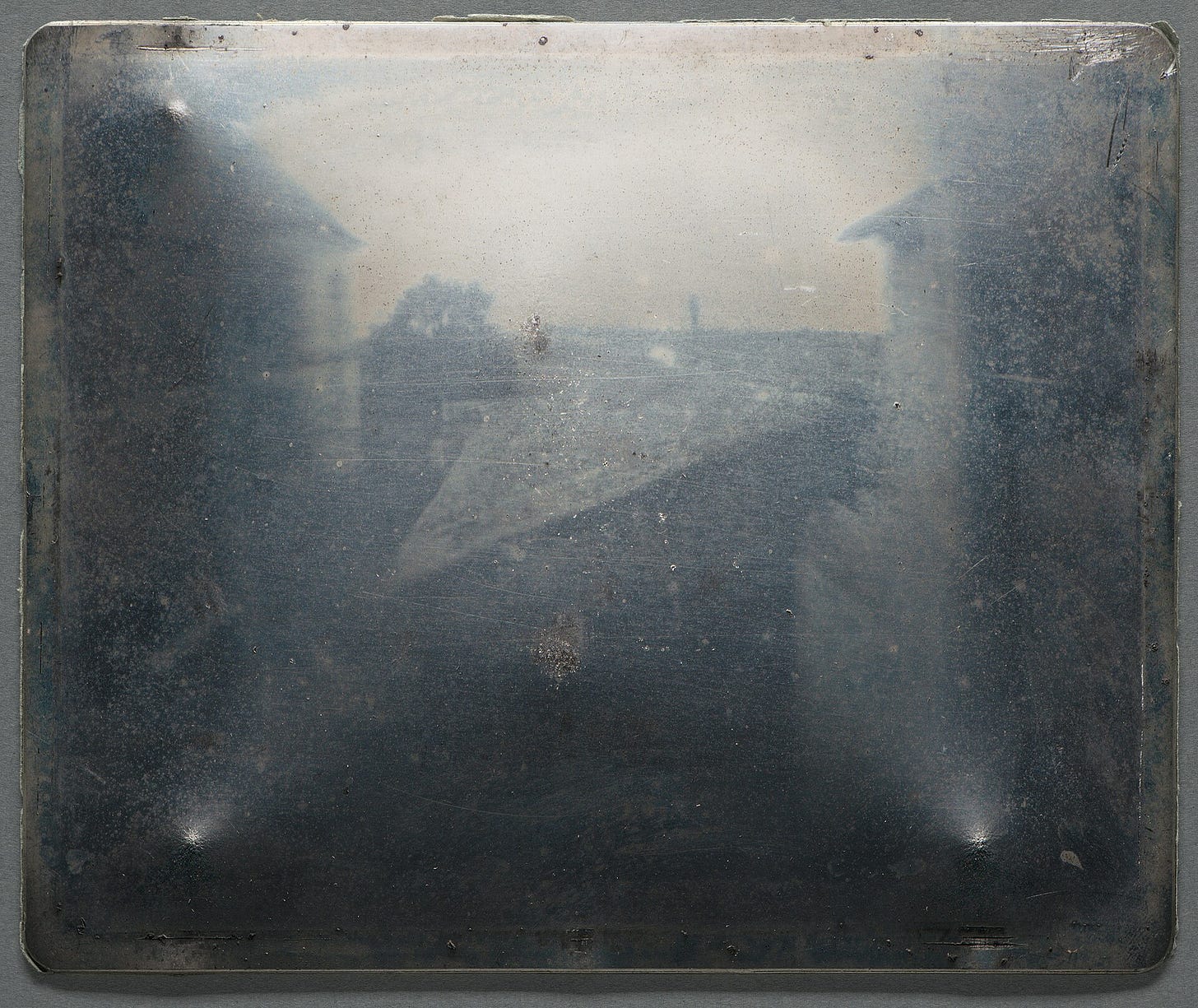
The image the world calls the first photograph is nearly invisible, undecipherable. Looking at it, most people can’t see anything clearly identifiable. And it hasn’t been in France for over a century.
The photo is a pewter plate, about sixteen by twenty centimetres, coated with bitumen of Judea. Joseph Nicéphore Niépce (which can only be pronounced “Nièpce”, BTW) coated it, then put it in a camera obscura at an upstairs window of his family house in Saint-Loup-de-Varennes in Burgundy, and pointed it at the courtyard. The exposure lasted several days. The sun crossed the sky so many times while the plate sat there that daylight ends up hitting the buildings from opposite sides, which is why when you look at it closely as a photographer it doesn’t seem to make sense (see the buildings left and right in the photo, both illuminated like the sun is in-between them).
Clément Chéroux, the photography historian who has looked at it, described the experience in a 2019 book, and Libération reprinted his testimony: the image “ne se donnait évidemment pas au premier regard”, doesn’t give itself up at first glance. The polished pewter plate is mirror-like. “Il fallait la chercher, s’incliner lentement, tourner la tête à droite puis à gauche. Après quelques contorsions, elle apparut soudainement : mi-positive, mi-négative, un peu floue, mordancée par endroits et passablement vaporeuse. J’en fus très ému”. My translation: “you need to hunt for it, bend slowly, turn your head right then left, until after a few contortions it suddenly appears: half positive, half negative, slightly blurry, mordanted in places and thoroughly vaporous. I was deeply moved”.
If you’ve seen the famous image, the crisp and grainy one with the white background and the clear rooftops, you haven’t seen the plate. You’ve seen an enhanced and heavily reworked copy. More on that later.
The French Ministry of Culture announced this week (at time of writing) that the plate is coming home. Its owner, the Harry Ransom Center has agreed to lend the “Point de vue du Gras” to the musée Nicéphore Niépce in Chalon-sur-Saône, the town where Niépce was born in 1765. It will be shown in France for the first time in its existence, inside the exhibition “L’empreinte d’Hélios. 1826-1827, Niépce invente la photographie !”, which runs from 20 March to 20 June 2027. The plate itself goes on display from 26 April. I’d go, but with such a short two months window, it’s going to be heaving.
It’s part of the official Bicentenaire de la Photographie, a state-sponsored birthday party running from September 2026 to September 2027, with 182 projects in France and about thirty other countries. The Grand/Petit Palais and various other venues in Paris have already run a number of photography exhibition this year ahead of schedule.
The plate’s trip took two years of negotiation. The display case is oxygen-free (filled with argon, people who worked in datacentres will know what that does) and monitored around the clock. The plate is so delicate that the case travels with it. Dominique de Font-Réaulx, who chairs the bicentenary’s scientific committee and negotiated the loan, told Libération that the plate is less a eureka than a process, and that treating it as the beginning of photography runs against some known facts.
Niépce wasn’t a scientist. He was a landowner with a military past and an obsessive streak, a gentleman scientist, as PetaPixel puts it, like we no longer have.
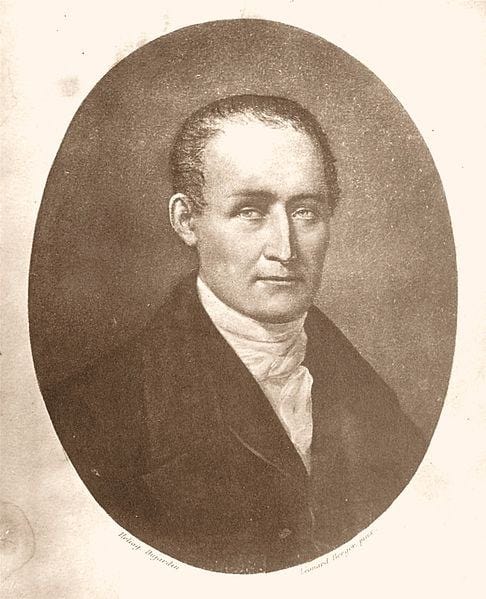
He’d been discharged from the revolutionary army, of all things, for poor eyesight. Ironic for the man who made the first photograph.
With his older brother Claude he spent years and most of the family fortune trying to commercialise the Pyréolophore, one of the first internal combustion engines, patented in 1807 and meant to propel boats up the Saône river. The brothers also worked on oil pastel, sugar beet, and an early bicycle. Their engine never paid off. But the research left behind a bag of bitumen of Judea, a natural asphalt, and Niépce noticed it had a strange property: it hardened with light.
He started trying to fix camera images in 1816, just before his fifty-first birthday. His first results were pictures on paper coated with silver salts. He called them points de vue. The Harry Ransom Center describes them as legible but fleeting. He wanted positives and couldn’t get them to stay. The trail of what he did next only exists in letters because Niépce kept no lab notebook and published nothing. His main documentary legacy is his correspondence, now edited in full: around 700 documents collected from more than fifty archives, half of them never published before, including letters mostly to family. According to their editor, they contain his failures, his mistakes, his doubts, as well as his hopes.
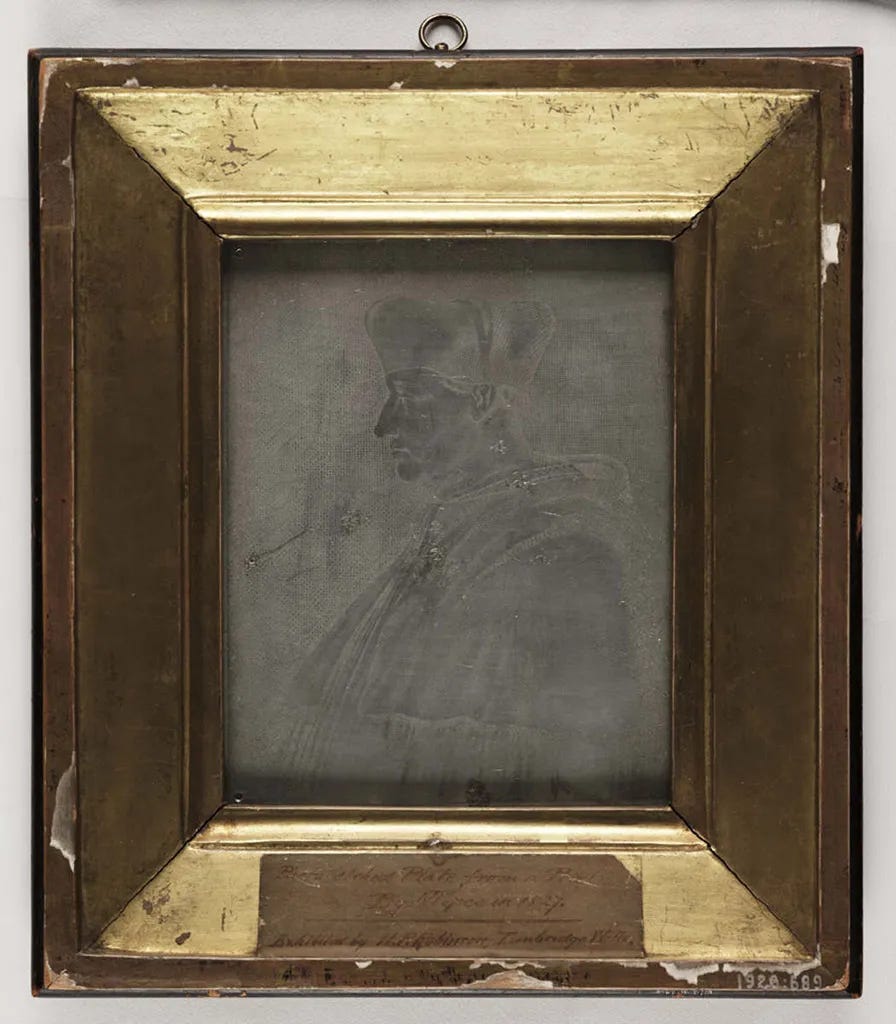
By 1822 the bitumen was working as a copying process. He was reproducing engravings by contact, on plates, with light doing the drawing. Then on 16 September 1824 he wrote to Claude and described something new: a view from life, taken with the camera obscura, not copied from an existing image. The exposure, he told his brother, had been four to five days, and the image was barely visible: those details come down to us through photography historian Michael Pritchard, reprinted in Amateur Photographer. He called the result a heliograph, sun writing. Emmanuel Hermange, who has read the 1816 letters closely for the journal Romantisme, makes the point that the oldest surviving print became, ipso facto, “the first obtained”. The letters tell the reality: years of images that didn’t survive.
In Libération, Besson describes how the correspondence follows him around the house: he starts at one window, then moves to his brother’s bedroom because it has the better light, sheltered from the weather. “Il fait beaucoup de points de vue. Un seul est parvenu jusqu’à nous.” He made many such views; only one reached us.
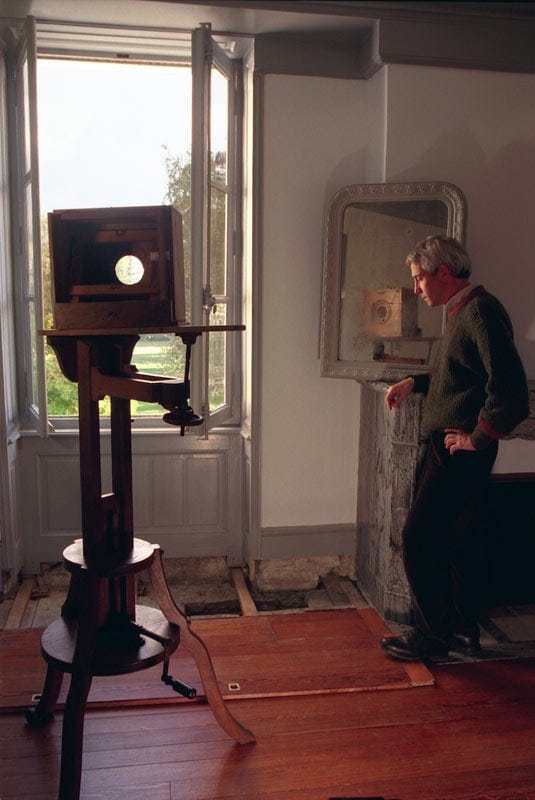
That’s the rate of success behind the first photograph. One survivor. Every other view he took from a window is gone.
In May 1827, writing to his cousin Alexandre du Bard de Curley (yep, that posh), Niépce compared himself to Columbus on the edge of the discovery: “Je suis comme Colomb lorsqu’il pressentait la découverte tardive, mais certaine d’un nouveau monde… nous avançons la sonde à la main, sur notre nacelle aventureuse, et bientôt l’équipage s’écriera avec transport… Terre ! Terre !”. He is like Columbus, he says, certain of a new world he can’t reach yet, sounding ahead in his adventurous little craft, waiting for the crew’s cry of land! land!
The birthday party has a problem, though: if the photograph was taken in 1826, the bicentenary falls in 2026. Many scholars lean 1827. Helmut Gernsheim, the historian who found the plate, first dated it 1826, then switched to 1827, which is what’s inscribed on the back. Wikipedia gives a creation window between 4 June and 18 July 1827. The French write-ups are honest about it: institutions and the bicentenary say 1826, a number of historians since Gernsheim and Jean-Louis Marignier say 1827, and the polite formula is “vers 1826-1827”. So the French government decided to go halfsies: the birthday party will run 2026-2027.
In fact, not only the plate that’s being moved to France was most probably taken in 1827, but it was also probably taken at a window in a house six kilometres from the museum where it will be next spring.
The plate’s biography is pretty strange and it took a long list of lucky events to get to us. Niépce took it to London in September 1827. He had two reasons: firstly, a botanist named Francis Bauer saw the heliographs and urged him to present the process to the Royal Society. Niépce wrote the paper but refused to disclose how it worked, and the Royal Society rejected it under its rule against undisclosed processes. Secondly, his brother Claude, who had spent two decades chasing engine money in London, had come apart. Libération says he was “devenu fou à force d’échecs”, driven mad by failure, and had just died. Niépce abandoned the plate there, in the middle of arranging to ship his brother’s body home.
The memoir and the specimens stayed with Bauer, and Niépce went back to France. He never came back for them, and he died in 1833, of a stroke, at 68, while still experimenting. Daguerre, the Parisian optical-painter he’d gone into partnership with in 1829, kept going, and in 1839 the daguerréotype took the spotlight.
After Bauer died in 1840 the plate moved through a series of owners, and it was exhibited now and then as a curiosity. The trail goes cold at the turn of the century: the standard history has it last shown in public in 1905, one account puts the loss of the trace back in 1898, and either way the plate then vanished into private storage. Nothing, for roughly half a century.
In 1952 Helmut Gernsheim, a German-born photo historian who had spent years hunting for it, was contacted by the widow of a man named Gibbon Pritchard. She’d found a plate in her late husband’s things. Gernsheim verified it was the Point de vue, acquired it, and in doing so put Niépce’s name back at the top of photography’s history. The Harry Ransom Center’s own account credits his detective work with returning Niépce “to his rightful place as the inventor of photography”.
When you think about it, it’s a crazy part of the story: a widow going through her late husband’s things found a plate, contacted the right person who was looking for it (how did she know?), then he acquired it from her. There are so many points in that story where the plate could have been thrown away and gone forever, sold to the wrong person, or lost/stolen once identified as valuable. But it made it.
And then Gernsheim had a copy made at the Kodak Research Laboratory, and it was so hard to photograph the plate faithfully that he took a brush and retouched one of the copy prints, cleaning it up, making it clearer. For decades he allowed only that enhanced version to be published.
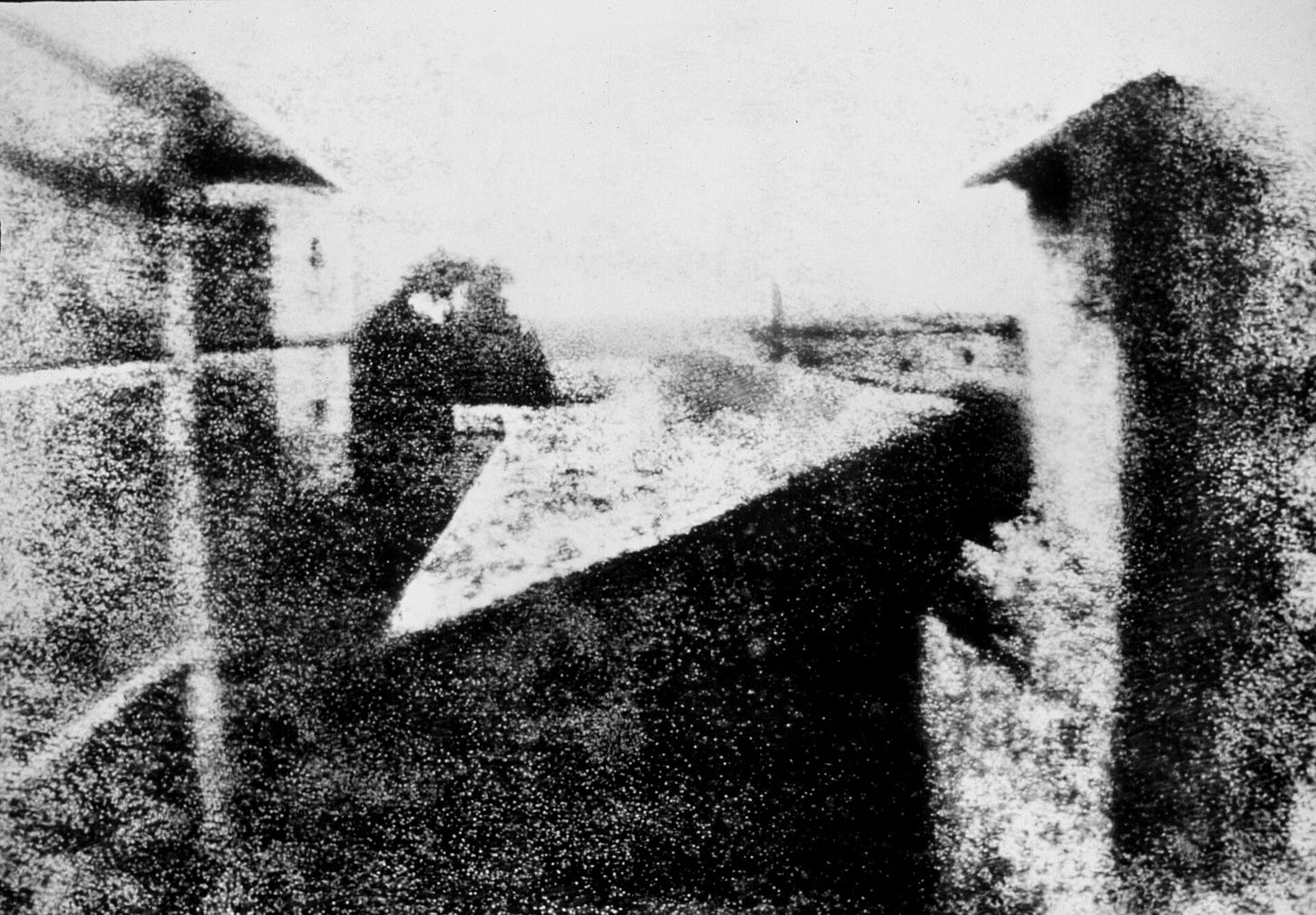
The image of the first photograph as you know it, the one in every textbook, is Gernsheim’s partly hand painted interpretation of a plate most people can’t read. Well, that’s a disappointment.
In 1963 Harry Ransom bought the Gernsheim collection for the University of Texas at Austin. Over 35,000 images, then the largest photography collection in the world. Gernsheim donated the plate itself. The Getty Conservation Institute studied it in 2002 and 2003, confirmed the bitumen on pewter, and built the argon case it still lives in. In 2012 it left Texas once, for a Gernsheim exhibition in Mannheim, Germany, its first time back in Europe in fifty years. It has been on display in the Ransom Center lobby since 2003, next to the Gutenberg Bible.
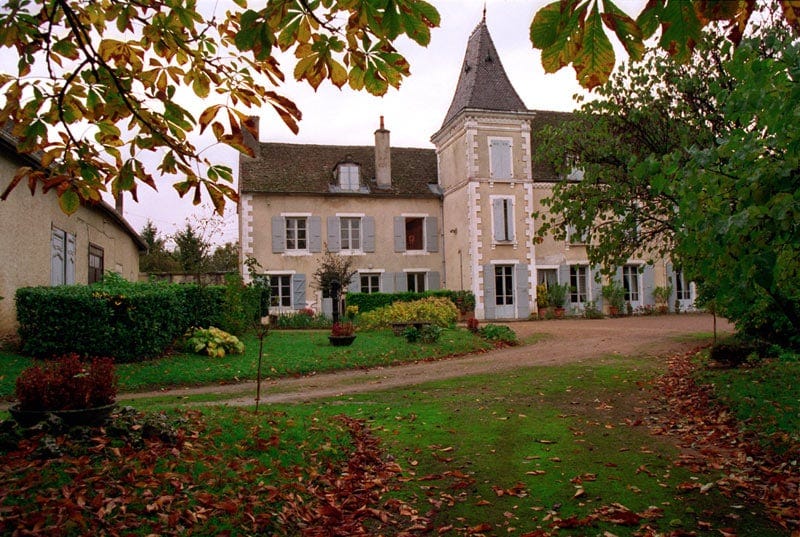
Since the plate is nearly invisible, a large part of the experience is its interpretation. The standard elements, identified in Gernsheim’s own drawing: a pigeon house on the upper left, a pear tree, a slant-roofed barn, a bakehouse with a chimney, another wing of the house on the right. Most of those buildings are gone now from the ancestral home as you can see in the photo above. Libération’s describes it as: a building on the left, one on the right, a mysterious triangle of light in the centre, and beside it a dark shape that the eye wants to see as a human figure in a black cape, “tel Nosferatu”, leaning over the void.
There’s a quote in French newspapers this week that puts the myth around that photo in its place. Clément Chéroux told Libération in January: “C’est une image extraordinaire parce que c’est la première photo. On se dit alors que c’est une photo magique. Mais en fait, pas vraiment. La première photo est une photo ratée.” Extraordinary because it’s the first photograph (that we still have), but not because it’s any good. The first photo is a failed photo.
And he’s right. The plate is underexposed despite the several days exposure, barely visible to the naked eye, unreadable head-on. A technical failure. Its exposure time made it useless for anything but immovable subjects, and its maker couldn’t repeat it reliably. He called it himself, in December 1827, whilst writing about his process, “the first uncertain step in a completely new direction”. Uncertain is the inventor’s own word for this landmark.
I like to picture April 2027: in a museum six kilometres from that window, people leaning and crouching and tilting their heads, exactly as Chéroux describes, trying to catch the light off a piece of pewter. Most will see almost nothing. The ones who persist will see rooftops, a tree, a courtyard, and the accumulated sunlight of days. A failed two hundred years old photo that outlasted everything else its maker made. That’s a fine afterlife for a photo that failed.
Sources:
- Le Figaro / AFP, the ministry announcement wire.
- Le Journal de Saône-et-Loire (Tristan Aubry), “La première photo de l’histoire revient sur ses terres”.
- Libération, “Bicentenaire de la photographie : le premier cliché de l’histoire va faire son retour en France”.
- Le Monde, “« Point de vue du Gras » de Nicéphore Niépce, première photo de l’histoire, revient en France pour le bicentenaire de la photographie”.
- L’art de la photographie, “Bicentenaire de la photographie : 200 ans après Niépce, ce que célèbre 2026”.
- Harry Ransom Center, “The Niépce Heliograph”.
- Harry Ransom Center press release, 26 June 2012, “First Photograph To Travel To Europe For First Time in 50 Years”.
- Bonnet & Marignier (eds), “Niépce, Correspondance et papiers” (Maison Nicéphore Niépce, 2003).
- Michael Pritchard, Amateur Photographer, “200 years of photography: Celebrating pioneer Joseph Nicéphore Niépce”.
- Emmanuel Hermange, “Langage et genèse de l’image, ou Niépce en 1816”.
- Wikipedia, “View from the Window at Le Gras”.
- PetaPixel (Harald Johnson, updated 10 July 2026), “The First Photo: Nicéphore Niépce’s ‘View from the Window at Le Gras’”.
- PhotographyTalk, “View from the Window at Le Gras: The First Photo Ever Taken”.
Images:
- The plate, 2020: Wikimedia Commons,_Ni%C3%A9pce_1827_%E2%80%94_HRC_2020_(cropped).jpg), public-domain reproduction, Gernsheim Collection, Harry Ransom Center. The Center also offers high-resolution recto and verso TIFF downloads on the same page.
- The famous enhanced copy: Wikimedia Commons, public domain.
- Berger’s 1854 portrait: public domain, via PetaPixel; also carried by Libération, credited to the Musée Nicéphore Niépce.
- The workroom and courtyard photographs: Raphael Gaillarde/Gamma, courtesy Pierre-Yves Mahé/Spéos, via PetaPixel.
#Photography #LensOfTime #Niepce #History