
The more I look into little unknown women photographers that have risked or lost their lives to show what was happening in the world, the more I’m in awe of them. One such photographer was Camille Lepage.
She worked as a photojournalist for about three years. In those three short years, she made about sixty thousand photos. Mainly from Sudan, South Sudan and the Central African Republic. Of those sixty thousands, she curated herself about a thousand before she was killed in May 2014 at twenty-six.
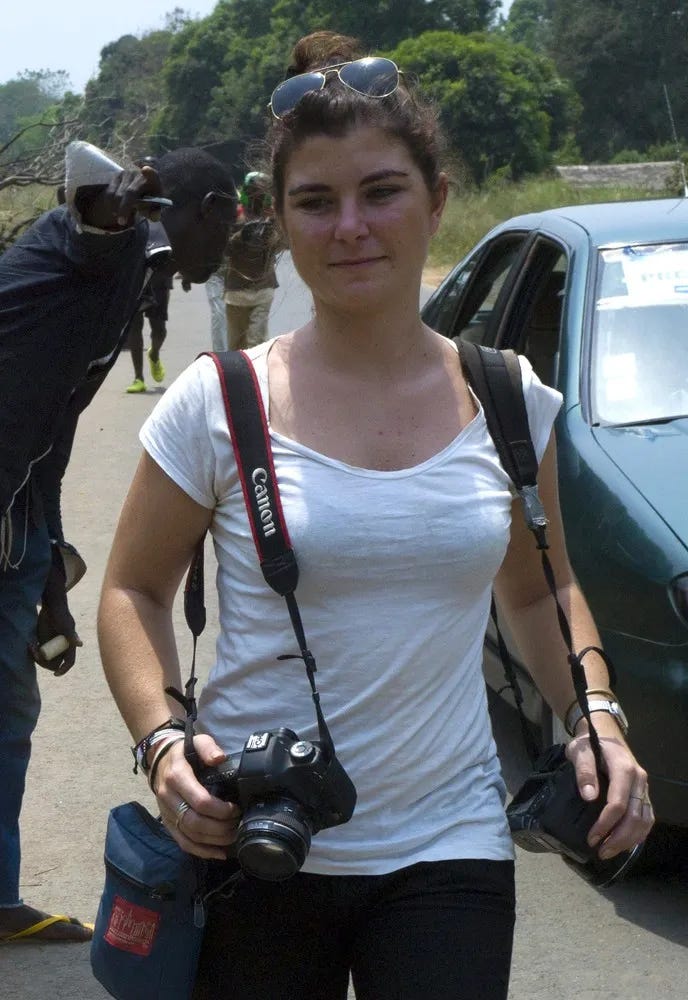
Some are damaged, most are without captions, dates or places. Orphan.
She was born in Angers, in Western France, on 28th January 1988. Primary school at La Blancheraie, then high school at Lycée Saint-Martin in Angers, then journalism at Solent University in Southampton, an Erasmus year split between Utrecht and Aarhus, a first internship at Rue89 in Paris, a second in Cairo at Al-Masry Al-Youm in the summer of 2011. She also took a two-month photojournalism course in Chicago.
It was during her final university year that photography took over. In an interview with the photography site PetaPixel, published in October 2013, she said she had given herself five years to find out whether she could get good at it and make a living. Asked about her favourite moments in the job so far, she said: “Not sure I can talk about my ‘career’ just yet, I’m still just getting started!”.
Then she explained why she chose the stories she chose: “Since I was very little, I’ve always wanted to go and live in a place where no one else wants to go, and cover in-depth conflict related stories”.
Following the South Sudan independence process closely, she was shocked, she said, by how little coverage it got, and by the pessimism around it. Then she found the conflict in the Nuba Mountains, on the border between Sudan and South Sudan, and was angry that almost nobody was talking about it. South It would be a dangerous place for a first long assignment. She started inside a structure: in July 2012 she moved to Juba, the capital of the world’s youngest state, and got a job as a reporter at The Citizen, the country’s largest independent newspaper.
Her pictures followed the beginnings of the new nation in July 2012 and the fighting in the Nuba Mountains. Her living conditions weren’t great: “I live in a local house in local neighborhood, with no electricity and little comfort, so I don’t see myself as being very different from them”, she told PetaPixel. The director who later made a film about her, Boris Lojkine, said that detail was what attracted him: she lived far from the “expat villas, the expat compounds, the expat fancy restaurants”.
Her two long-term South Sudan projects were called You Will Forget Me and Vanishing Youth. The Vanishing Youth series is the one that shows what she meant by going deeper than the news cycle. It was shot in two parts. The first was in a hospital in Bor, where young Lou Nuer fighters lay wounded. “At first I remember that I was taking pictures like those young men were patients suffering from diseases”, she said in the PetaPixel interview. Then she stood back and realised what she was looking at. They were killers, all of them, but “almost fragile below their strong and warrior-looking bodies”.
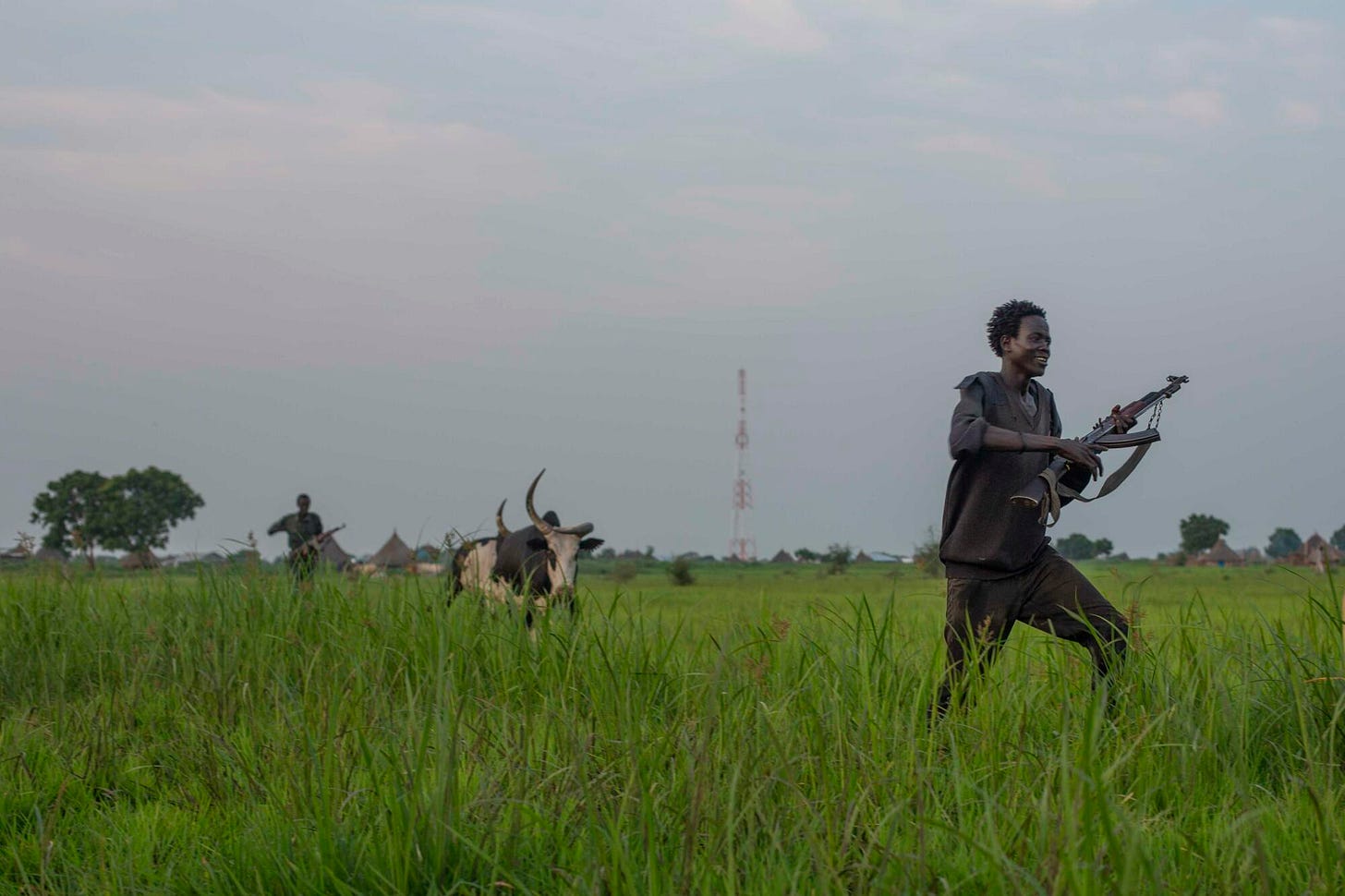
Look at the frame above and what it shows: the rest of the youth, the ones who hadn’t been wounded, coming back to their village with “mixed feelings: happy to be home, shocked and weaken by the war, and sad to have lost some of their brothers”. That picture of coming home is also a picture of the cost of war. She said so in the same interview: they don’t have a choice, they can’t go to school because the war has taken the schools, and their only option is to go and fight to protect the cattle.
In the series she wanted her viewers to feel what the people were going through “[…] rather than seeing them as another bunch of Africans suffering from war somewhere in this dark continent”. She was angry about what she was seeing. She wanted her viewers to ask why those people were living in hell and why no one was doing anything about it.
She photographed women from the Murle tribe waiting for emergency food aid in Pibor. One of her Jonglei photos was chosen for the cover of a Human Rights Watch report.
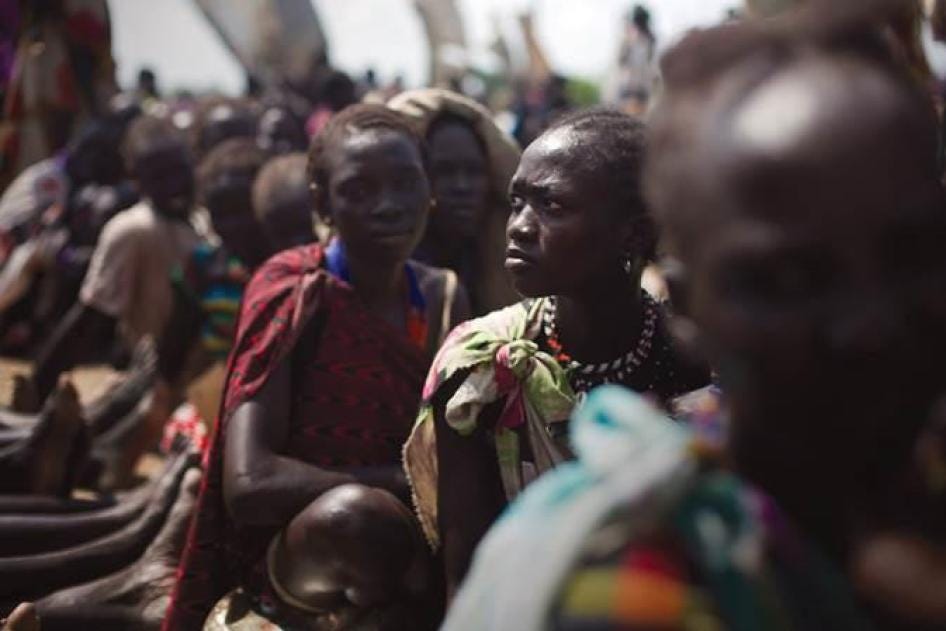
She wasn’t naive about the market. “It’s so frustrating to be covering something so tragic, that no one wants to publish and that can’t see the public light apart from social media”, she said. “I can’t accept that people’s tragedies are silenced simply because no one can make money out of them”. And she kept going, and her work kept being published. By twenty-six she had appeared in The New York Times, The Guardian, Le Monde, The Washington Post, Der Spiegel, Libération, The Sunday Times, The Wall Street Journal, Vice and Al Jazeera, among others, and had worked for Amnesty International and Médecins Sans Frontières. Her tutor at Solent, Andy Chatfield, said: “She was interested in people who were voiceless and powerless rather than the great and powerful”.
In October 2013 she moved to Bangui, the riverside capital of the Central African Republic (CAR). The previous March, the country entered a new phase of its history when the mainly Muslim Séléka rebel coalition overthrew President François Bozizé. As a response, a Christian self-defence militias, called the anti-balaka, began attacking Muslim civilians. The UN warned the country risked descending into genocide. France sent in Operation Sangaris, the UN Security Council organised the African peacekeeping mission MISCA. In December 2013 the anti-balaka attacked Bangui itself: at least 105 people killed in one day, many of them civilians, the wounded and the dead reaching the Hôpital Communautaire where Médecins Sans Frontières staff worked.
Christians sheltering by the tens of thousands in the bishop’s compound in Bossangoa, having fled their villages. The wounded and the dead at the Hôpital Communautaire. A woman weeping. Lepage’s was there.
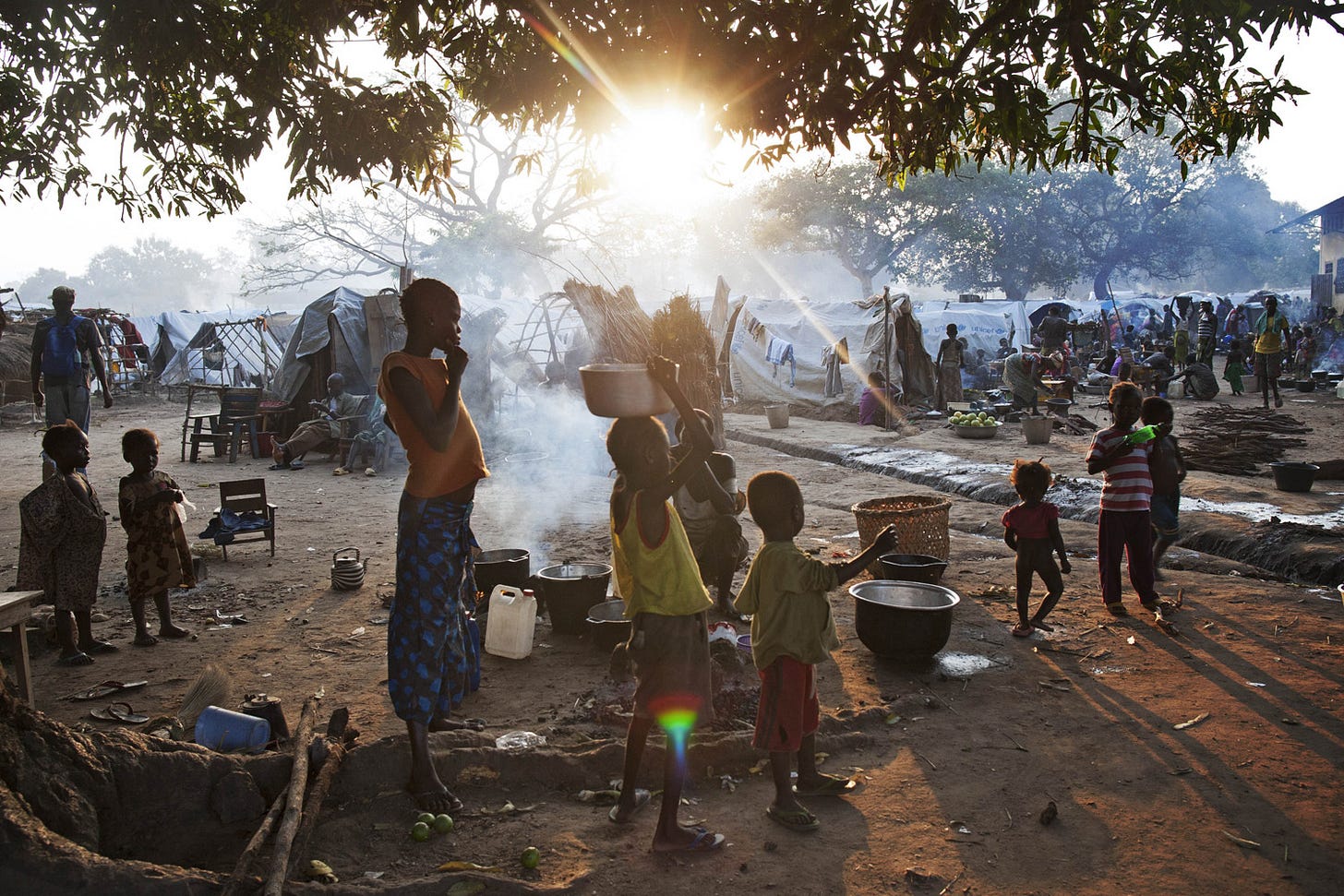
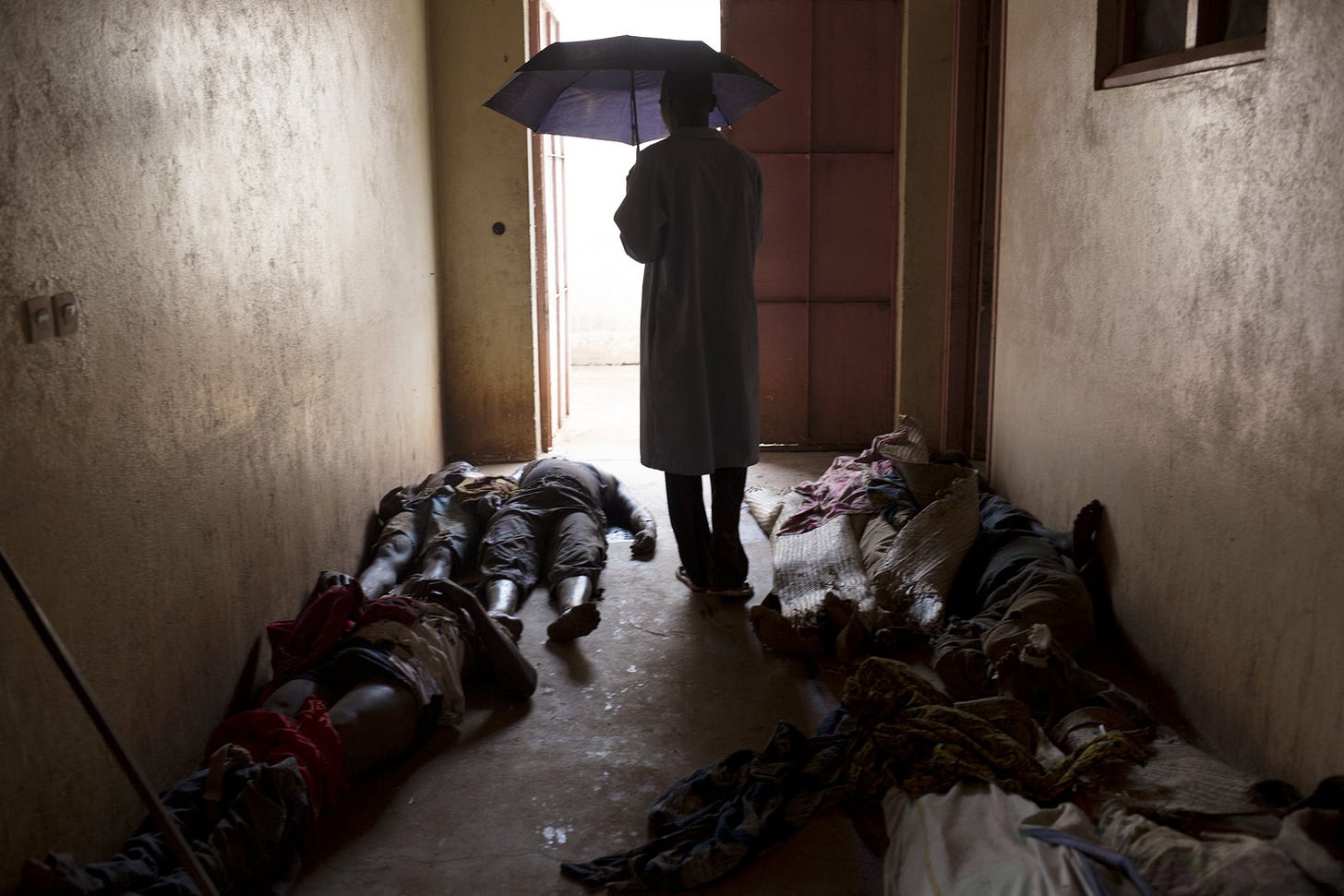
Her method was the same as in Juba. She stayed, she learned the codes. The French photographer William Daniels met her in Bangui and they went to Bossangoa together. “She was very active, very patient, very passionate about this work”, he told TIME. “In Bangui, everybody knew her. Everybody liked her”. Lewis Mudge, the Human Rights Watch researcher who was working in the capital then, remembered being struck by her unflinching determination to get to where the suffering was the greatest. As Mudge later put it: “As people were fleeing, Camille went in”. She sounds like Catherine Leroy.
Her final tweet was posted on 6 May 2014, six days before she died. She wrote that she was travelling with the anti-balaka to Amada Gaza, about 120 kilometres from Berbérati, where 150 people had been killed by the Séléka since March. An anti-balaka colonel called Rock was sending his men to patrol round the village and bring home those who had fled into the bush. She rode with them.
“We left at 3.30am to avoid the Misca checkpoints and it took us eight hours by motorbike as there is no proper roads to reach the village”.
She was with a militia on the jungle tracks in the West of the Central African Republic because nobody else was covering it. On 12th May 2014 the group was ambushed near Bouar, not far from the Cameroon border. Her body was found the next day by French Sangaris troops, in a vehicle driven by anti-balaka fighters, accompanied by the bodies of four villagers. The French presidency announced it that evening. It called it an assassination, a word choice that showed Paris believed she had been targeted on purpose.
“All necessary means will be deployed to shine light on the circumstances of this assassination and find the killers of our compatriot”.
Camille Lepage was the first Western journalist killed in the Central African Republic conflict. President François Hollande (France) promised that everything would be done to uncover the circumstances and track down whoever murdered her. Irina Bokova, the UNESCO director-general, said: “I condemn the killing of Camille Lepage, whose only desire was to show, through her work, the fate of marginalised populations”.
She called her CAR project On est ensemble. We are together. It was a phrase she used in Sango, the local language, and it became the title of the book of her work that came out after she died, and the name of the association her mother built in her memory. The last line of her PetaPixel interview, months earlier, had been about that project she was starting at the time: “I’m currently in the Central African Republic, working on a new photography project there for a few months before heading back to South Sudan and Sudan”.
She had already won second prize in the portrait category at Pictures of the Year International in early 2014 for Vanishing Youth. In July 2014 she received the Manuel Rivera-Ortiz Foundation Award of Excellence in Arles, posthumously. Then, in October, at the Prix Bayeux-Calvados war correspondents’ festival, her name was added to the Mémorial des reporters, the memorial stone for journalists killed in 2013 and 2014, alongside Ghislaine Dupont, Claude Verlon, Anja Niedringhaus, Sardar Ahmad and James Foley. A reader of Le Figaro wrote after her death that her commitment to the facts already placed her with Capa, McCullin and Schoendoerffer.
Her mother, Maryvonne Lepage, founded the Association Camille Lepage – On est ensemble in September 2014. The association created the Camille Lepage Award, given each year at the Visa pour l’Image photojournalism festival in Perpignan, worth eight thousand euros and funded by the French collecting society SAIF, to support a photojournalist committed to a long-term project. Robin Tutenges won the 2026 edition for his work in Myanmar. In a circular loop, the work she thought was the most important still gets funded under her name.
Two books followed: République Centrafricaine: On est ensemble, published in August 2014, months after her death, and Pure colère in 2017. In 2019 her life became the film Camille, starring Nina Meurisse, shot in the Central African Republic with a crew that included ten young Central African filmmakers Lojkine had trained; it won the public prize at Locarno. That same year, on World Press Freedom Day, a square in Paris was inaugurated as the Place Ghislaine Dupont – Claude Verlon – Camille Lepage, honouring the three reporters killed in Mali and the Central African Republic.
The assassination was never solved, unfortunately. Four years later, Reporters Without Borders reported that the murder case file had disappeared in Bangui (!). A trial initially scheduled for January 2018 had to be postponed. No investigation had been carried out at the scene, no crime re-enactment done, even though it’s compulsory in murder cases. The file eventually turned up, but the investigation crawled. It’s nearly like some people didn’t want to find out. Human Rights Watch marked five years in 2019, and ten in 2024. By then they felt that impunity as a driver of abuse, and “little movement on bringing her killers to justice”.
Her mother kept working at it. “Even if we cannot put a name to the person whose finger was on the trigger, it is essential that we at least identify the group that carried out the attack”, Maryvonne Lepage told RSF. She said pursuing it to the end could help other families progress with their own investigations, and put other forgotten cases back on the agenda.
In 2024, ten years after her death, the association put on an exhibition called Hommage, curated by Lorenzo Virgili. It picked from the raw archive, the fifty-nine thousand unedited frames, and showed seventy of them: thirty-five from the Central African Republic, thirty-five from Sudan and South Sudan.
What the Hommage exhibition did was finish an edit she never got to make.
Camille Lepage was a twenty-six-year-old who refused to let silence win and she paid with her life.
Sources:
PetaPixel interview with Camille Lepage, 22 October 2013
The Independent obituary, 23 May 2014
Human Rights Watch, 11 May 2019
Human Rights Watch, 17 May 2024
Reporters Without Borders, 11 May 2018
Association Camille Lepage – On est ensemble
Visa pour l’Image, Camille Lepage Award
Variety interview with Boris Lojkine, 2019
#Photography #LensOfTime #IMayBeWrong #CamilleLepage #WarPhotographer