
I wasn’t aware of Sabine Weiss until she appeared in one of my deep dives about humanist photographers.
One of her most known photographs was taken it in 1952, Porte de Vanves. To be honest, I don’t recognise the area, even though I went to engineering school not too far, the area changed a lot. The horse is out in the snow, kicking up its heels. There’s no drama in the frame, just an animal having a moment on a patch of waste ground. It became the most reproduced of the pictures she took, and sold at auction for nearly $3,500 at Christie’s.
In an interview with the Guardian, late in her life, she said about it: “That one, to me, is a portrait of solitude. My world, as a photographer, has to be about loneliness. And so it is I’ve learned to love solitude as well as all the rest”.
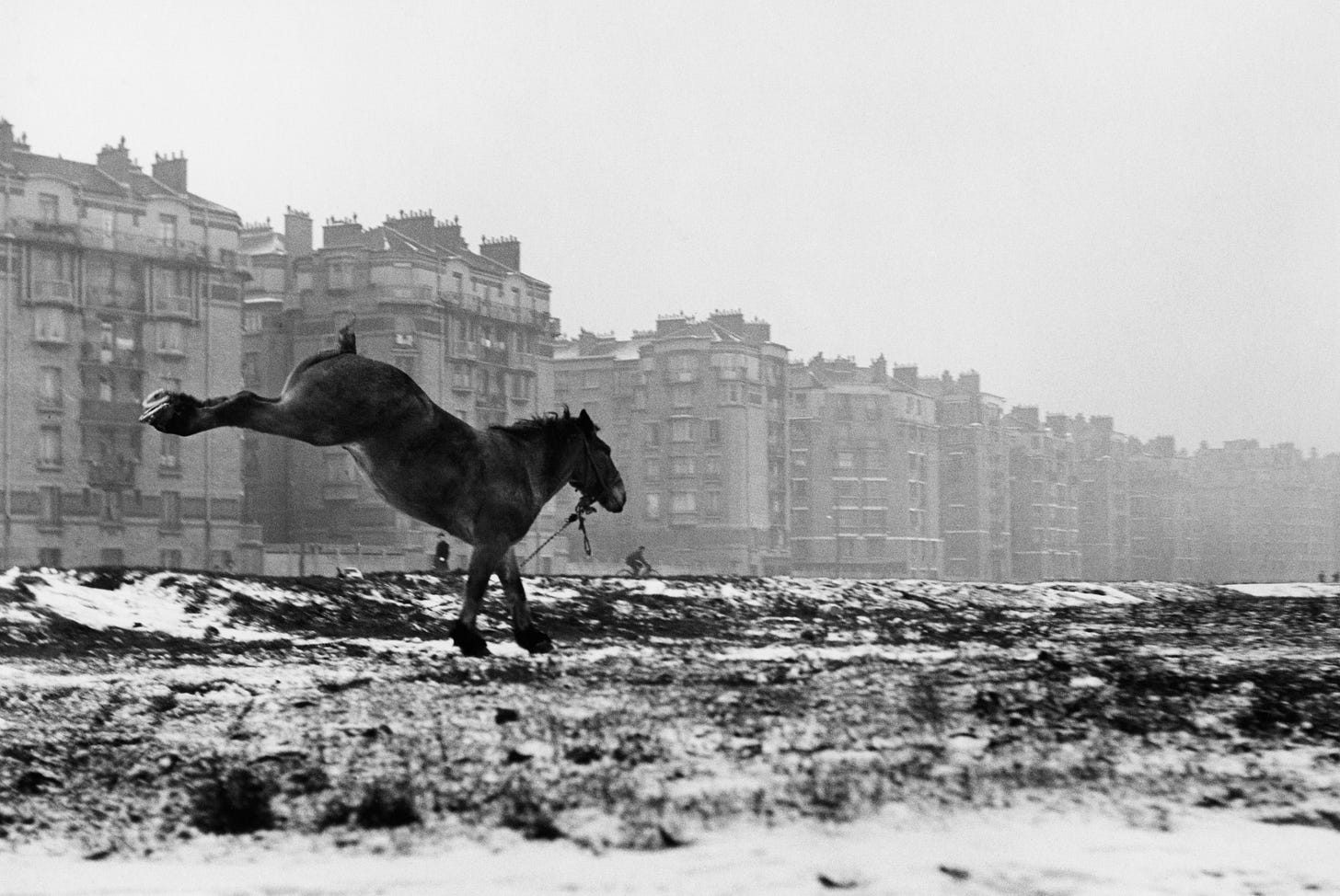
I can understand what she means about solitude. To me, photography is also a act of isolation, a way to deal with the world in your own. I spent countless winter mornings at the beach in Aberdeen taking the sunrise without a soul on the horizon. Weiss photographed her own neighbourhood, the Porte de Saint-Cloud, for decades. Same streets, same children, same light. She never lost interest.
Our brains filter out the habitual, the ordinary, the every day, which is why the familiar turns invisible. She spent decades proving that filter can be switched off, and her whole working life is an answer to the question of how you keep seeing the same place as if for the first time.
You can’t talk about French humanist photography without Sabine Weiss. Doisneau, Ronis, Boubat, Izis, Brassaï, and Weiss: she was the last of the school, the one who outlived the movement and watched it become history. She was also, for most of her career, the one the history forgot. The books got written, the retrospectives got mounted, the men got the credit, she got forgotten.
Sabine Weber was born in Saint-Gingolph, a village on the Swiss-French border, in July 1924. Her father, Louis Weber, was a chemical engineer who made artificial pearls from fish scales and, at one point, early vaccines for the army. The family lived next to the border post and left the village while she was still a child.
As a child she bought a Bakelite camera with her pocket money and made contact prints by laying the negatives on light-sensitive paper in the sun, printing-out paper, laid on the windowsill. Her first film dates to 1935. She said later that she realised from a young age that photography would be her means of expression, that she was more visual than intellectual. “I was not very good at studying. I left high school, I left on a summer day on a bicycle”.
A lot of origin stories in photography are about a gift, a teacher, or a lucky break. Hers is about leaving. She left school on a bicycle and went to Geneva, where she apprenticed at the studio of Paul Boissonnas from 1942 to 1945, son of the famous Frédéric. The Swiss professional certificate came in 1945, the first reportage in Geneva the same year, and she published her first photo report at 21. Not bad for 21.
In 1946 she moved to Paris and became assistant to Willy Maywald, a German-born fashion and portrait photographer. His studio was the first floor of a shed at 22 rue Jacob, no water, no telephone. “When I came to Paris, I was able to work at Maywald, whom a friend had recommended to me. I worked there in conditions unimaginable today, but with him I understood the importance of natural light. Natural light as a source of emotion”.
The way she describes the city she found in 1946 says a lot about her: “It was a beautiful period. We were between the end of the German occupation and the beginning of Americanization. People came out of a terrible ordeal and thought they could rebuild everything”.
In 1949, on a trip to Italy, she met Hugh Weiss, an American painter who had come to Paris the year before. They married in September 1950 (fast!), and that same year she opened her own studio, a house-studio in the west of Paris. She lived and worked there for the rest of her life. It started as a hovel without electricity or an indoor toilet, and when money ran out she traded portraits for vegetables at the local market.
Things started to move faster in 1952, at a meeting at Vogue, where she’d been invited by Michel de Brunhoff, the magazine’s director, to show her photographs. Robert Doisneau was there, and he praised her work and spoke of her to Raymond Grosset, the director of the Rapho agency. She joined Rapho, one of the few women there. Janine Niépce was the only other (yes you recognised the name, she was a distant relative of Nicéphore).
The recognition came early and then stopped. Steichen included her in Post-War European Photography at MoMA in 1953, when she was in her late twenties. She had a solo show at the Art Institute of Chicago in 1954 that toured the United States.
In 1955 Steichen put three of her photographs in The Family of Man: a child holding a sparkler, a church interior in Portugal with a child kneeling inside, and a village dance with a woman accordionist up on a table. The show toured the world and was seen by around nine million people. That’s a pretty good start of a career.
From there, it’s hard to understand how she got forgotten. It obviously wasn’t a problem with the institutions that were happy to exhibit her work. But somehow, she started to disappear from books. I can’t think the reason for it.
Look at some of her photos.
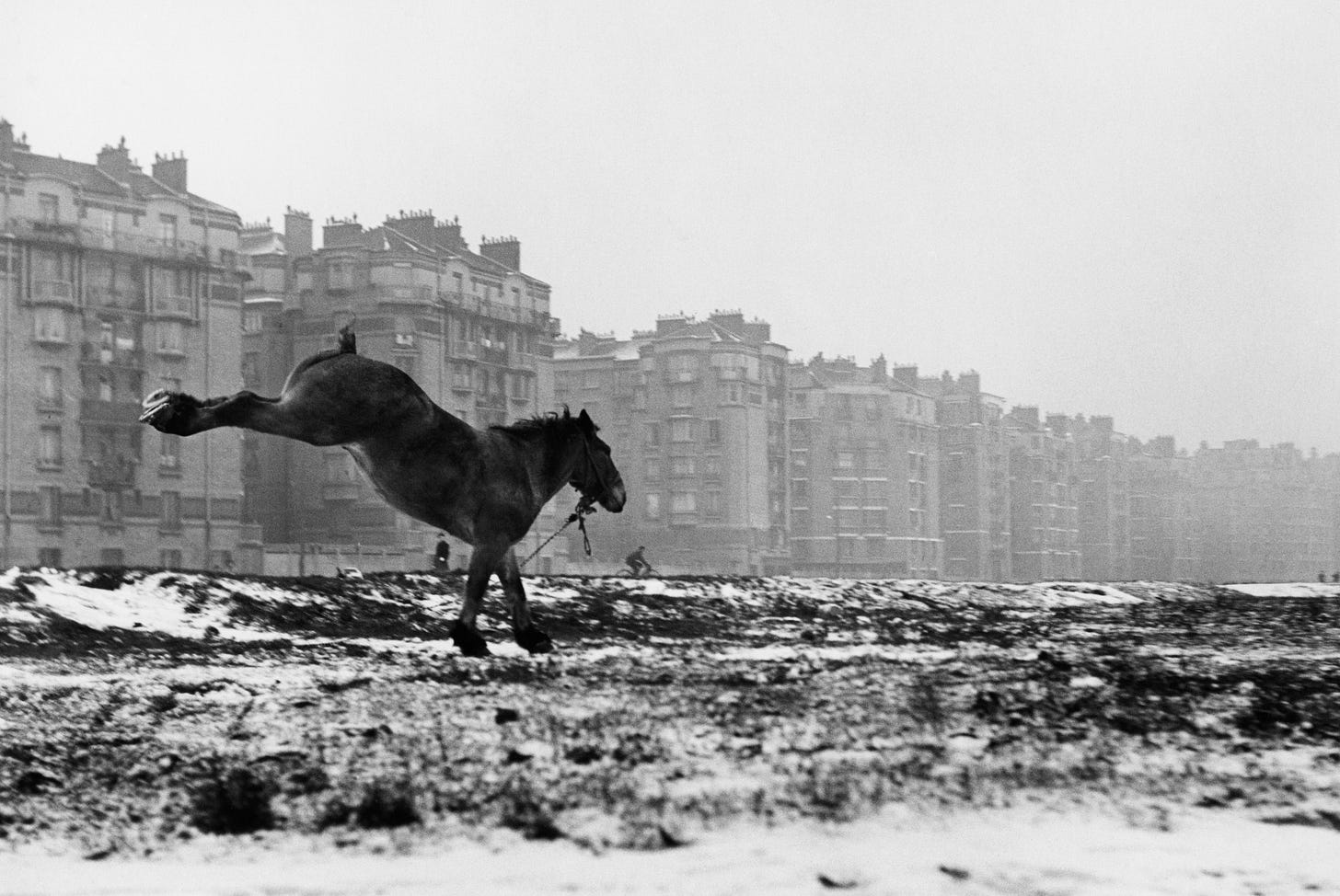
Take the horse again. The snow lying patchy over rough earth. It’s mid-buck: front legs planted, hindquarters thrown up high, almost level with its back. Nothing in the pose pays attention to the rope. Behind it a long row of apartment blocks stands in grey winter light, and the sky is the flat white of an overcast afternoon. The only people in the frame are tiny: a figure standing to the left, a cyclist passing far off to the right, both busy with their own errands.
Its dark shape against the snow owns the whole frame (I suspect a little bit of darkroom magic here), and Weiss pressed the shutter at the exact instant the hind legs were highest. A fraction of a second later it’s over, the hooves come down, and the snow is undisturbed. That’s everything: a burst of pure showing off in a cold landscape, for nobody who noticed.
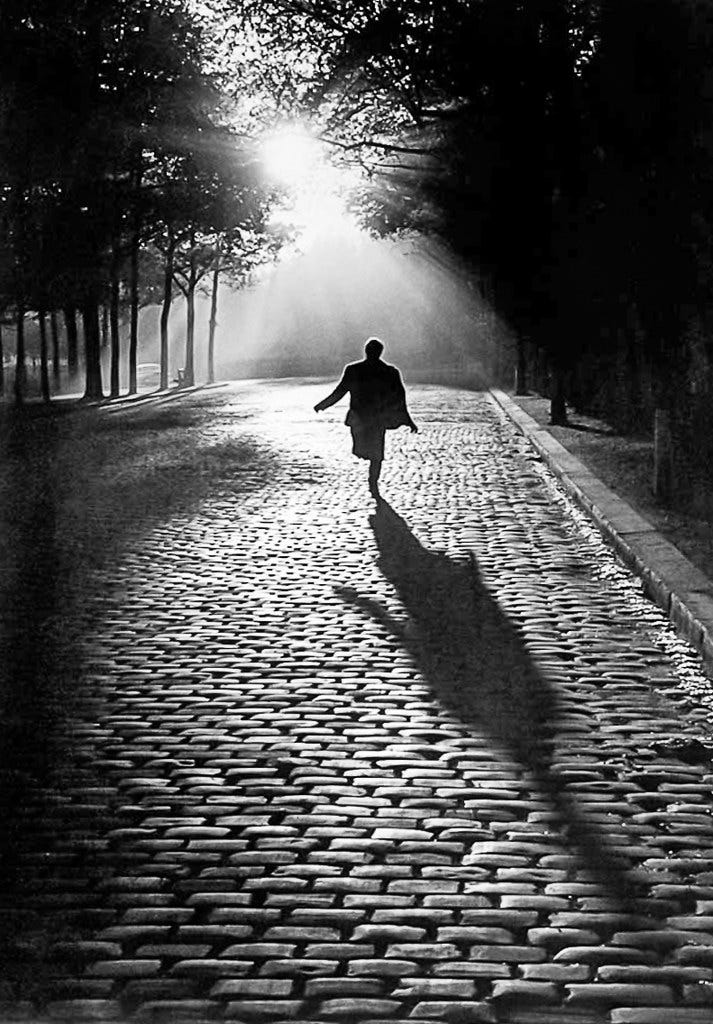
L’homme qui court, from 1953, shows a man running down a cobbled Paris street, contre-jour, the sun in the frame, his shadow stretched out long ahead of him as he runs into the light.
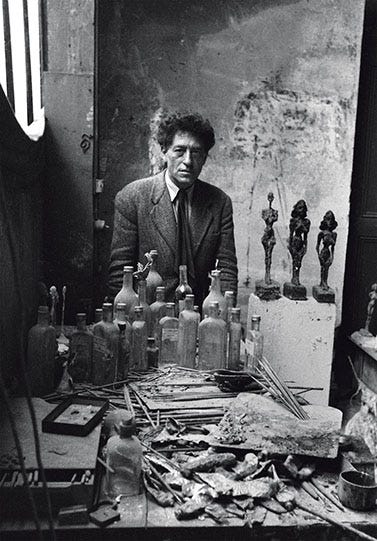
In 1954 she photographed Giacometti in his atelier. She’d known him since the pre-war years, back in Switzerland, and was friends with his wife, so the studio was familiar ground. He worked in a jacket and tie, kneading clay, and the pictures respect the strangeness of that: the formal clothes, the hands in the work.
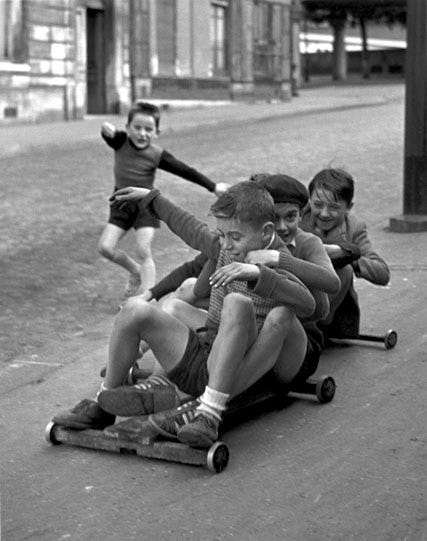
The children of the Porte de Saint-Cloud she photographed for years on the waste ground near her studio. She said children are an incredible challenge, because you can’t stage them; you catch their spontaneity or you get nothing. The pictures show kids at play, absorbed in the game, unposed and unconcerned by the camera.
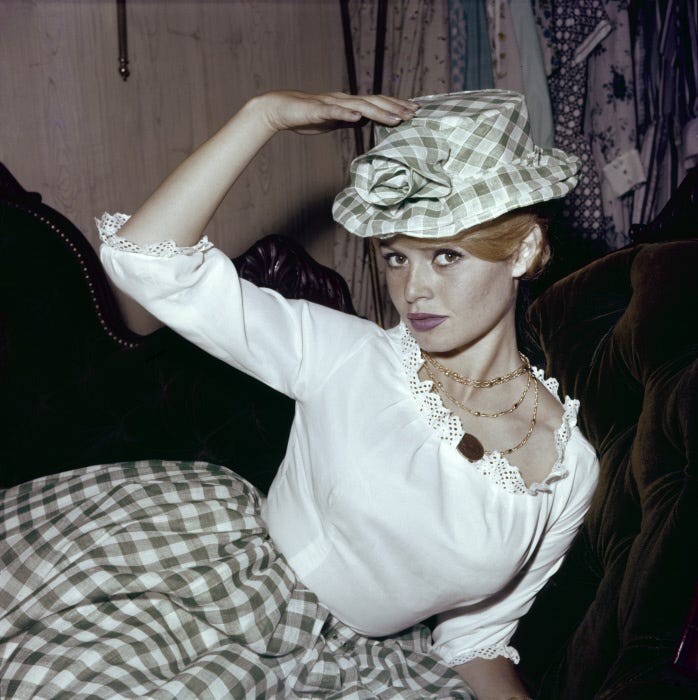
She worked in colour as well: Egypt, and Bardot at the height of her fame. The same unhurried respect applies to all of them, children, beggars, movie stars, sculptors. She gave everyone the same attention, and the attention is the style.
Her word for it was the instantané: never wait. A picture exists for a fraction of a second, so you don’t plan it, you’re ready for it. She described her way of working as a constant dialogue between herself, the camera and the subject, a conversation she said certain other photographers preferred to avoid by keeping their distance.
And the purpose was always the same. She told Figure Libre in 2010: “I photograph to preserve the ephemeral, fix chance, to keep in an image what will disappear: gestures, attitudes, objects which are testimonies of our passing”.
I’ve written before about the witness complex, the feeling that a photograph might be the last witness of a moment that will never happen again. That’s essentially the same idea.
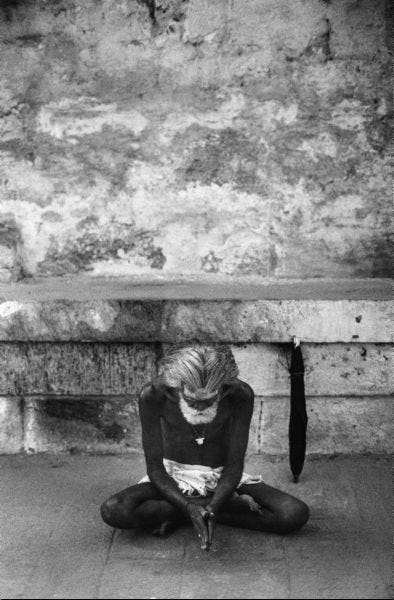
Then there’s the apparent exception, and it’s the key to her. In the film Jean-Baptiste Roumens made about her, she told the story of the one photograph she ever waited for. Madurai, in India: a man praying on a pavement while people walked past. She waited about an hour, by her own account, and seven children came and prayed with him. Behind him stood a wall of butter, thrown there in devotion, and she said it was the only photograph she ever waited for.
An hour of waiting sounds like the opposite of her whole life’s approach, but it isn’t really. She didn’t stage the scene or line up the children; she stood ready and let the moment arrive, which is exactly what the instantané was about. That day she didn’t break her rule: she applied it with more patience than she ever allowed herself. I may be wrong, but I think that’s the whole point of her: a lifetime of never waiting, and the one time she waited, she waited for a prayer.
Then came the long middle, the decades the history forgot. For money she worked a Vogue contract from 1952 to 1961, regular work for Holiday from 1954 to 1969, and assignments for Life, Time, Newsweek, Paris Match, NYT Magazine, Esquire, Picture Post and Town & Country. Every assignment went into a battered notebook she kept for decades, a working record of a life spent being ready. She photographed Stravinsky, Britten, Casals and Stan Getz; Léger, Giacometti, Rauschenberg, Dubuffet and Breton; Jeanne Moreau, Brigitte Bardot, Chanel. The commercial work funded the personal work, always, and she never pretended otherwise: “From the start I had to make a living from photography. It was never just about the art”.
She insisted on a word the art world doesn’t like, and she never strayed from it. In 2014 she told a French news agency: “It was a craft. I was a craftswoman of photography”. The same went for the labels other people tried on her: it never occurred to her, as she told a French newspaper, that what she was doing was humanist photography. She didn’t like those labels because what she did was to her obvious. I’ve made the same argument: I’m a technician, not an artist too. For Weiss, the work paid for the craft she loved.
She told a story, near the end of her life, of being waved aside at reportage jobs, told to step aside and let the photographers work. Yet she also said she never felt discriminated against in the practice of her work. Both things were true at once: the casual dismissal and the freedom to get on with it. Her male peers were canonised while she worked, written into the history of the school in real time. The art world spent didn’t know what to do with a woman who called her work a craft.
There was a life in there too. In 1957, with the painter Kees van Dongen and Hugh, she bought a small shed at Grimaud in Provence on impulse, a shack overlooking the castle ruins. They adopted a daughter, Marion, in 1964. In 1969 they enlarged the shed, and kept going back until Hugh died in 2007.
The magazines were only part of her work. A ministry scholarship took her to Egypt in 1983 to study the Copts; Hugh had wanted to go, and she said, “If you’re going to Egypt, I’m coming”. Another scholarship took her to Réunion in 1992. In 1984 she joined a long-term study of Carros-le-Neuf, a new town near Nice, with Jean Dieuzaide and Guy le Querrec, working with the sociologist Pierre Bourdieu and, briefly, Leonard Freed; the results were shown at the Rencontres d’Arles under the title “Urbain, Trop Urbain?”. She was naturalised French in 1995, nearly fifty years after arriving, and the state honoured her twice over the following years: Officier des Arts et des Lettres in 1999, Chevalier de l’Ordre national du Mérite in 2010 (highest civilian distinction).
The recognition, when it came, came late, and it came for the work she’d done for herself: the streets, the children, the archive. Not the magazines or the reportages. A retrospective at the Maison Européenne de la Photographie in 2008 opened the door, and the Jeu de Paume and the Château de Tours followed in 2016. Then the Centre Pompidou in 2018, under a title that sums her up: Les villes, la rue, l’autre. The city, the street, the other. In November 2020 she received the Kering Women in Motion award for photography, along with €25,000, in partnership with the Rencontres d’Arles, a year after the inaugural award had gone to Susan Meiselas, and a year later the same festival gave her a retrospective of her own, Une vie de photographe, which translates as a life of photography. She died in Paris on 28 December 2021, aged 97.
By then her archive had a home. In 2017 she gave everything to the Musée de l’Élysée in Lausanne: 200,000 negatives, 7,000 contact sheets and around 2,700 vintage prints. She solved the problem of what happens once we’re gone, when nobody recognises the faces any more: handing her life’s work to a museum while she was still alive to see it done. In 2024 a gallery in Paris, Les Douches, paired her with Vivian Maier in a show called Made in USA. The parallel is the archive: two women who spent a lifetime accumulating negatives that only got their reckoning late. Maier never lived to see hers. Weiss did.
Raymond Depardon said after her death: “I sensed in her a compassion, and much more besides: a tenderness and a delicacy that the men lacked”.
At the end of her life, she said the only honest thing a photographer is lucky to say at the end of a long life: “It was a very beautiful life. I regret nothing”.
Sources:
- Official estate site: sabineweissphotographe.fr
- English Wikipedia:
https://en.wikipedia.org/wiki/Sabine_Weiss_(photographer) - French Wikipedia:
https://fr.wikipedia.org/wiki/Sabine_Weiss - Guardian obituary (Amanda Hopkinson):
https://www.theguardian.com/artanddesign/2021/dec/31/sabine-weiss-obituary - Hugh Weiss official site: http://www.hughweiss.fr/
- Kering press release:
https://www.kering.com/en/news/kering-steps-up-its-commitment-to-supporting-women-photographers-with-its-women-in-motion-program/ - WWD (Mimosa Spencer):
https://wwd.com/feature/sabine-weiss-awarded-kering-women-in-motion-photography-prize-1234652490/ - Jeu de Paume / Château de Tours education dossier (PDF):
https://jeudepaume.org/wp-content/uploads/2021/04/DossierDocumentaire_SabineWeiss.pdf - Le Figaro interview (Valérie Duponchelle, 2018):
https://www.lefigaro.fr/arts-expositions/2018/06/24/03015-20180624ARTFIG00123-sabine-weiss-la-lecon-des-grands-photographes-ne-m-interessait-pas.php - Le Temps:
https://www.letemps.ch/culture/arts/sabine-weiss-naime-photographies-prises-rue - Le Devoir / Lense / RTL: Depardon’s posthumous tribute
- PhotoQuotes.com / Holden Luntz Gallery
- Economic Times / inkl:
- Flickr / PicClick / The Art Newspaper / The Photographers’ Gallery
- Les 1001 vies de Sabine Weiss (Jean-Baptiste Roumens, Photo Élysée): www.youtube.com/watch?v=dXVh6M40r6c
- Women in Motion — Camille Ménager (Kering): www.youtube.com/watch?v=nUcJ-rYOhvM
- The biography video:
youtu.be/hfMfVG9H5zo - Mon métier de photographe (NouvelObs)
#Photography #IMayBeWrong #Opinion #LendOfTime #SabineWeiss #PhotographerFocus