
She opens her TEDx talk talking about a blue vest.
It’s a flak jacket. Twelve pounds of Kevlar, in the specific shade of blue the UN adopted in 1947 for its flag. The colour that says: neutral press, not a combatant. When it’s 120 degrees in the shade and you’re running from mortar fire, she says, those twelve pounds carry all of your history and hopes and dreams.
She kept it after leaving Iraq. It sits in her office at Columbia College Chicago now. She lets her students try it on every January during her war stories class.
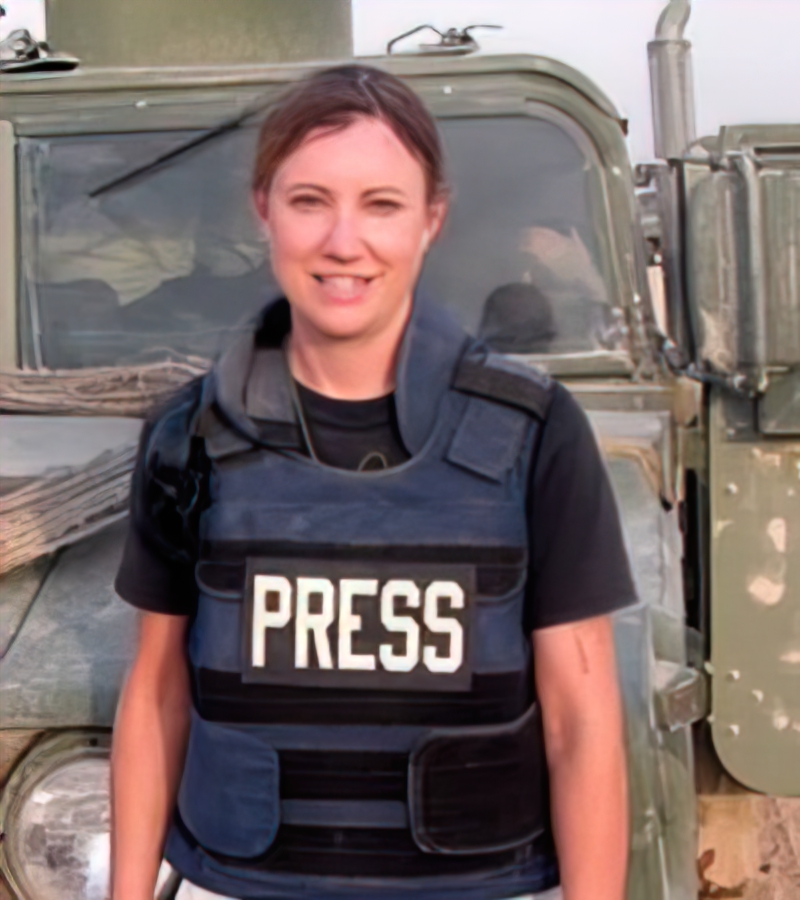
How heavy, she tells them every year. Can you imagine running with it?
But the woman who wore that vest didn’t start out in a war zone. Jackie Spinner grew up in Decatur, Illinois, a pipe fitter’s daughter. Her mother was a schoolteacher. Blue-collar, central Illinois, the kind of town where you don’t grow up expecting to go to Baghdad. Her parents met on a school bus at sixteen.
She got her start in journalism through a chance encounter between Little League moms. Not exactly the traditional war correspondent origin story.
She went to Southern Illinois University Carbondale for journalism, then UC Berkeley for a master’s. At Berkeley she studied under Neil Henry, a former Africa bureau chief for the Washington Post. Henry asked his students one question that stayed with her: “Did you count the bodies?”
She joined the Post in 1995, wrote about accounting policy. Spent years covering financial news from the comfort of the newsroom. And she was bored.
“I went to Iraq because I’m a journalist,” she wrote later. “We drive into hurricanes, not away from them.”
But the boredom with accounting policy wasn’t the real reason. The real engine was grief. Her father died of pancreatic cancer in 2001 (an experience I can relate to), sudden and devastating, and she watched a man too young take his last gasps of life. “Something told me to run,” she wrote in her book, “and I’ve been running ever since, running all the way to Baghdad.”
She wanted to see the country behind the contract stories she wrote from a desk in Washington. So she volunteered.
But she also needed a story big enough to get an editor to say yes. That story arrived via instant message about Sabrina Harmon, one of seven MPs charged with abuse at Abu Ghraib. Spinner had been messaging her for weeks when she broke the exclusive, and the story ran as a major Post front-pager. Sabrina’s lawyer was named Frank Spinner, no relation, and the courts-martial were coming, so her editor agreed to send her to Iraq.
Jeremy Sivits was the first soldier to stand trial, and he broke down on the stand. “I’d like to apologise to the Iraqi people and to those detainees,” he said. “I let everybody down.”
Before she left, Don Graham pulled her aside. The Post’s former publisher, now chairman of the company, talked to her like a parent. “No story is worth your life,” he said as he grabbed her hand, bent down, and kissed it. “Be careful.” He walked off.
She carried that with her to Baghdad.
Her return flight into Baghdad was a slow, stomach-churning spiral descent to avoid antiaircraft fire. The plane dropped like a stone towards the runway. She fell into the arms of Muhammed, the bureau’s security director, a former Iraqi army officer who betrayed Saddam and fought alongside the 82nd Airborne. Her first day she got locked out of the Green Zone during a protest and took a random taxi back to the Sheraton.
“You could have been kidnapped!” Muhammed said.
The Sheraton wasn’t the Sheraton you’re imagining. Her first room had a flea-infested bed, no air conditioning, and a blood-splattered wall of unknown origin. She hung an Iraqi flag over it to remind herself she was a visitor.
She was the most junior member of the Post bureau staff. Her flak jacket had “PRESS” written in masking tape. A photo from those early days shows her father’s blue hanky tied around her neck, helmet crooked, cheap Jackie O sunglasses.
“I’m playing a war correspondent,” she said.
The driver Omar 2 told the other Iraqis she wouldn’t last a month. She looked too delicate. They changed their minds when she baked them brownies. She also threw a baseball better than all of them, outshot them at hoops, and could outrun the bodyguard up the stairs during evacuation drills.
The Iraqi staff took special care of the female correspondents. She wrote that she had one brother in the United States and thirty-seven in Iraq.
There was Falah, a former Iraqi air force lieutenant colonel making thirteen dollars a month under Saddam. The Post paid him $1,450. He loved American rock and folk music. She’d made him a cassette tape back in college, and now they’d drive through Baghdad listening to Peter, Paul and Mary. “If I had a hammer, I’d hammer in the morning.” He had to lie to his neighbours about where he worked.
There was Abu Saif, the fixer. Former Iraqi Airways pilot who arrived in Tulsa, Oklahoma for aviation school in 1975. His mantra for postwar Iraq: “If you’re going to get raped, you might as well enjoy it.” As a fixer, he said, “I know my people.”
There was Little Naseer, the errand boy in his twenties who left school in sixth grade because his family couldn’t afford the teacher bribes. After Spinner taught him to say “The dinner is ready” in proper English, she sent him to the bureau chief Rajiv’s door. From down the hallway she heard: “The dinner is ready. You are welcome.” Silence. Then Rajiv screamed “Spin!” She’d ruined the ritual.
“If the Post closes its office here,” Little Naseer told her, “I can buy a taxi and work. Under Saddam, I couldn’t do this.”
Back in Decatur, her twin sister Jenny was writing letters, fifteen of them, one to open each Sunday. Their childhood ritual was to say “I love you” before sleep; “too” wasn’t allowed. The code: “Me, too” meant “I love you, you’re my world, never leave me.”
As eight-year-old twins, they once imagined their worst-case scenario. A man with a gun shooting them both. They debated who should die first. That game came back to Spinner in Baghdad. The worst-case scenario wasn’t a game anymore. It had a number attached. The insurgents put a $50,000 bounty on her head. A bit low to her taste.
She’d given a talk at the US embassy in Baghdad. An Iraqi journalist printed what she said on the front page of his newspaper. She had to leave the country for a few days.
Fifty thousand dollars. Somewhere in the city, men were counting that number and thinking about her. What it felt like to walk through a market knowing that, to sit in traffic and watch every car that lingered too long. She kept reporting, kept moving. The same instinct that made her argue with a childhood twin about who dies first. That’s how you survive. You keep playing the game out in your head so it can’t surprise you.
Being a woman in Iraq was a strange negotiation on top of all that. Her book opens with something called “A Short Guide to How Not to Be an American Woman in Iraq.” The rules: wear lots of lipstick, because Iraqi women love flashy lips painted in bright reds and oranges. Trade all your silver jewellery for gold. Don’t look happy. Never drink directly out of a water bottle even if it’s 120 degrees and you’re about to pass out. When walking down the street, never look a man directly in the eyes. “He’ll think you’re a whore.” Wear shirts long enough to cover your behind. If you’re invited to tea, drink it even if you question the water source, because only rude Americans wouldn’t accept an invitation to tea.
She wore long sleeves and long skirts and learned to lie about being married, about having children. Better to be a mother who left her child behind than no mother at all.
She survived mortar attacks, car bombs, the Battle for Fallujah, and a kidnapping attempt outside Abu Ghraib prison.
She survived by swimming. Not literally. She went once, long after dark, and the hotel staff came out to watch from the shadows. Creepy. Instead, the swimming was in her head. In the opening pages of her book, Tell Them I Didn’t Cry, she describes it: slow laps in the chilly waters of a long rectangular pool that exists only in her imagination. She called up that image to keep from drowning in the pressure and the fright.
That image, the imaginary pool, is the same kind of trick as the childhood worst-case scenario game. You build the thing in your head so the world can’t surprise you with it, rehearse the worst so you can stand in the middle of it and keep working.
There is another way she stayed awake late at night: she made cookies in the hotel. It helped her through the hours of waiting for foreign contractors to be beheaded. Literally killing time waiting for someone else to die. Her thinking was that if she was nice to Iraqi police guarding the hotel and kept them full of baked goods, when the insurgents came they’d protect her as one of the good ones. “Let the little one go. She made us cookies”.
That’s the kind of dark humour you develop when you’re living with a $50,000 bounty on your head. The kind of dark humour she saw on *M*A*S*H* on TV was now hers.
She left the Post in 2009 and spent the next few years doing what she’d always done, going where the stories needed telling. She was a Fulbright scholar in Oman. A founding editor of Iraq’s first independent student newspaper, and a literacy project in Belize.
She arrived at Columbia College Chicago in 2011 as an associate professor, tenured, overseeing the Photojournalism major. She teaches international reporting, advanced local reporting, and social and digital storytelling. She’s an advisor to the Student Veterans Organisation. She’s never left ‘s never far from war and its consequences.
She modelled her teaching on Neil Henry. “Did you count the bodies?” Her students don’t know her background. They don’t know she was a blue-collar girl from Decatur whose family relied on food baskets and a father who worked construction. They don’t know she was an intern at The Post who lived out of her car at a campground because she couldn’t afford rent. Her students called her the drill sergeant behind her back. The armour she wore in Iraq had followed her home. It had a different purpose now. It was hiding her from her own students. “I didn’t yet understand that the classroom would become a new kind of frontline,” she said.
And then she became a mother. She adopted three sons from Morocco. Her first son was diagnosed with autism at age two and the second received the same diagnosis at the same age. “Within weeks of taking my second baby home from an orphanage in Morocco, I was back in the classroom. Overwhelmed, exhausted, scared.” The university denied her maternity leave because she adopted, didn’t give birth.
War taught her to endure, not to ask for help. That’s an essential survival skill in Baghdad. You don’t stop or complain. You get on with things because stopping will get you killed.
But motherhood doesn’t work like a war zone. You can’t outrun a child’s needs. There’s no outshooting a health diagnosis. The coping mechanisms that kept her alive in Iraq, the keep-moving-deal-with-it-alone-never-show-weakness ethos, became barriers between her and the help she needed. She was a single mum with three boys, a full teaching load, and a lifetime of training in not asking. She was overwhelmed.
But slowly, she started sharing her life with her students. She told them about the blue-collar girl from Decatur who didn’t know which fork to use at a Washington Post dinner party. About the food baskets, the campground, the imposter syndrome that followed her through every newsroom and classroom she ever walked into. Also about the adoption, the diagnoses, the exhaustion. “I started to see them really as another mother’s child,” she said. “And it took me being a mother myself to get there.”
Her most recent project is called “Don’t Forget Me”. It’s a documentary about autism in Morocco. She was featured in a PBS Frontline documentary on reporting the war in Iraq. Her work has used by many TV channels such as MSNBC and NPR. She holds an honorary doctorate from Lakeland College. She’s a visiting scholar at the International University of Rabat in Morocco.
All of that is very impressive and most of us would be proud of accomplishing half of it. But what is important about Spinner isn’t photography in the strict sense. It’s the way she sees. A journalist’s eye, a photographer’s framing, a teacher’s patience. She collects stories. Every assignment, every documentary, every classroom, it’s all the same instinct: show me what’s really happening, don’t let me look away.
She still has the blue vest in her office and lets her students try it on, so they can feel how heavy twelve pounds is.
You can’t read about her life and forget about it the next day. It stays with you.
Sources:
- Tell Them I Didn’t Cry (Scribner, 2006)
- TEDx Talk, https://www.youtube.com/watch?v=4N2cCuSc_0M
- Wikipedia (for fact-checking)
- CV Page, https://www.jackiespinner.info/cv
#Photography #History #PhotographerFocus #Opinion