I first encountered the phrase deadpan photography around Youtube, of all places. I was watching one of Tatiana Hopper’s videos I think (I don’t remember which one). I didn’t think much of it at the time but I was intrigued by the term (file for later examination). Then I started seeing the term more and more, as if it was a new thing that was quickly getting traction online. The latest was Juliette’s post at the weekend on the subject. I had to find out more. And as usual, I went too far, so I thought I’d share here (I’ll include some of my sources for the curious, and the images I used I think are public domain since they’re obviously not mine).
Vanity Fair coined the term in 1927, smashing together dead and pan, the old slang for face, to describe a certain kind of comic delivery. The New York Times picked it up the following year and applied it to Buster Keaton. Deadpan meant a face that refused to react. It took photography another forty years to catch up to the concept, but when it did, it made perfect sense.
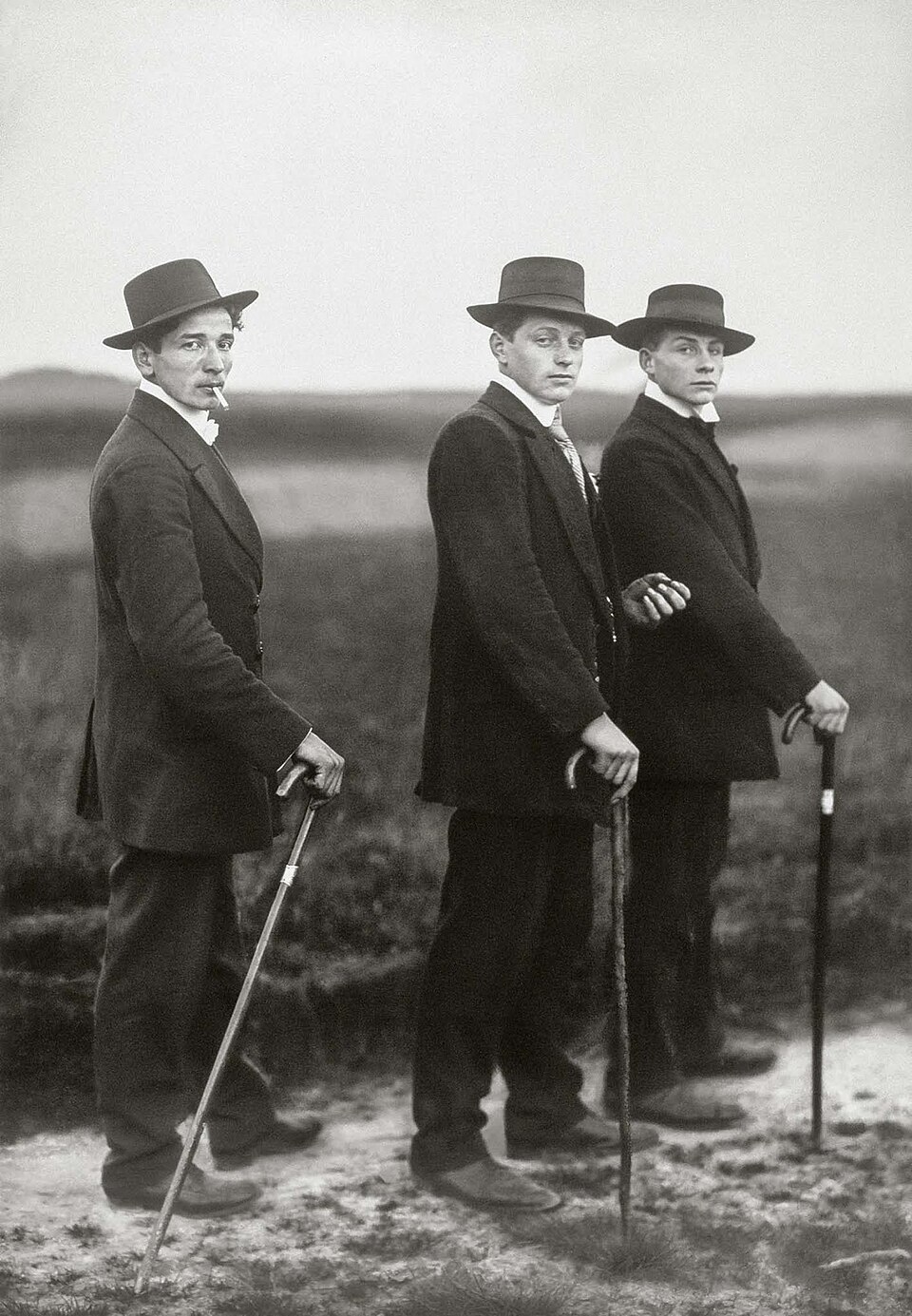
August Sander photographed three young farmers in 1914, on their way to a dance in the Westerwald. All three are dressed in their best suits, carrying canes, standing in a muddy field. They look directly at the camera with expressions that reveal nothing. There is no joy, no nervousness, no bravado. They simply are. Sander was working in the tradition of the Neue Sachlichkeit, the New Objectivity that swept through Weimar Germany. The movement, led by his friend the painter Otto Dix, advocated a return to unembellished realism and social observation after the subjective excesses of Expressionism (Aperture, August Sander: People of the 20th Century). Sander’s response was to categorise his subjects by occupation and class, producing a systematic typology he called a cultural work in photographs. Over four decades he shot farmers, bakers, artists, industrialists, the unemployed, and soldiers, each posed frontally against a plain background. His approach was straightforward, clear, and systematic. But what he really produced was the first coherent deadpan project, whether he knew it or not.

Everything that followed can be traced from that single intent gaze, or at least from the impulse that produced it. Sander’s typological method, which presented individuals as data points in a broader sociological study, became the direct template for the Bechers and, through them, the entire deadpan tradition. PhotoAnthology places Sander’s work in direct lineage with the deadpan aesthetic, listing it alongside New Objectivity and Straight Photography as foundational influences (PhotoAnthology, Deadpan Aesthetic).
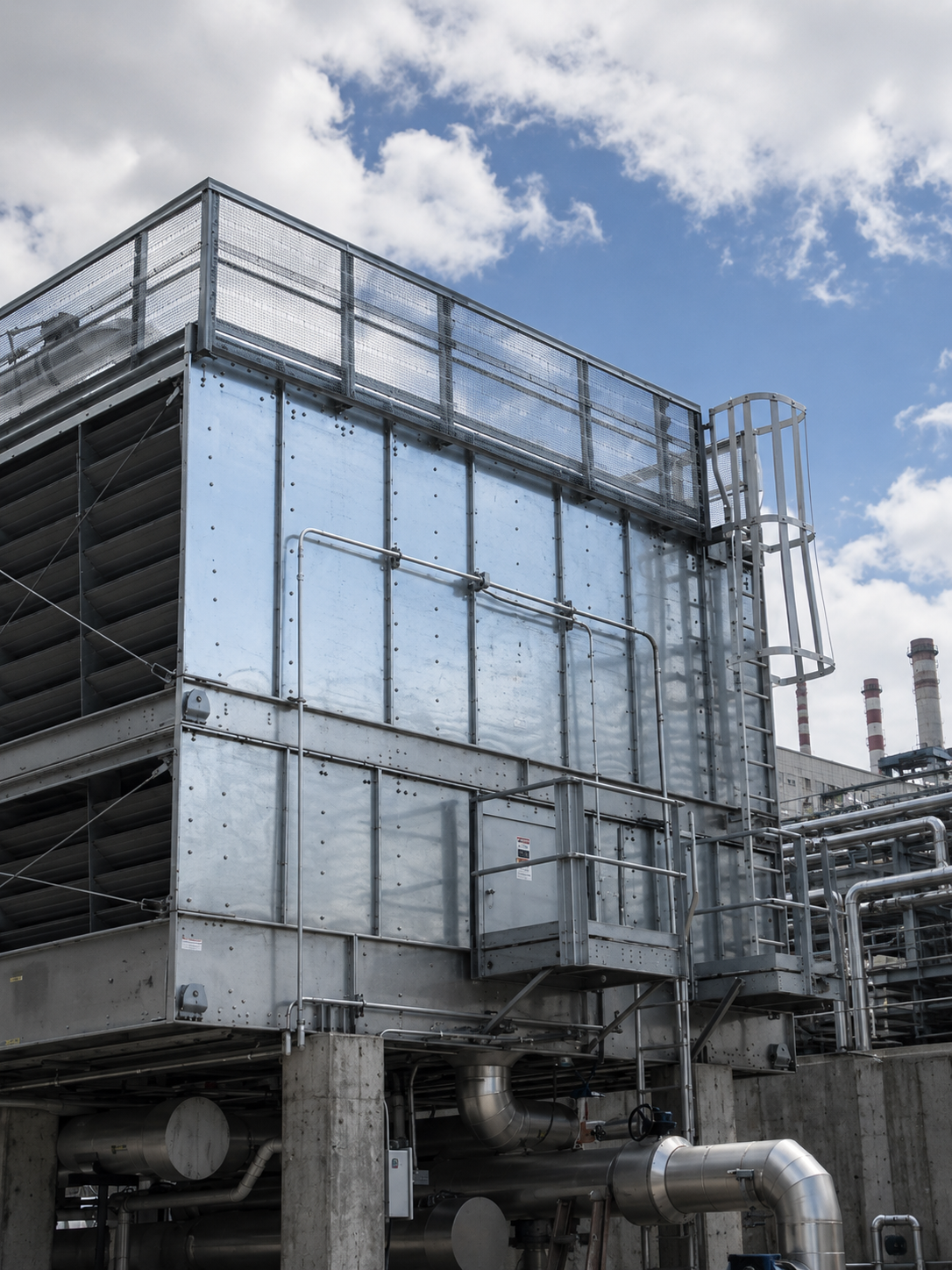
Bernd and Hilla Becher began photographing together in 1959, and they refined the deadpan method into something approaching a scientific discipline. Overcast sky only, so there are no shadows. Straight-on perspective, the camera placed at a height roughly matching the midpoint of the structure. Black and white film, processed with maximum detail. No people, no cars, no evidence of life. They arranged their finished prints in grids of nine or more, inviting comparison the way an entomologist arranges beetle specimens. Water tower. Winding tower. Gas holder. Blast furnace. The same subject repeated over and over, each iteration slightly different, together forming a typology of disappearing industrial forms. The architectural critic Reyner Banham noted that human presence had been relentlessly excluded from their images, but that the handiwork of men was everywhere visible (Metropolitan Museum of Art, Water Towers, 1988).
Viewing a Becher grid is a strange experience. Part of you wants to treat it as art. But another part, probably the better part to be honest, wants to treat it as data. You can ask yourself which water tower has the broader base, which one has the more elegant proportions. The photographs refuse to tell you which is better. They insist only that these things existed and here is the proof. This approach gave their images a dual life: they were simultaneously works of conceptual art and documents of industrial archaeology, preserving a world that was rapidly disappearing (NYFA, So What Exactly Is Deadpan Photography?, 2014).
The Bechers taught at the Kunstakademie Dusseldorf, where Bernd Becher became a professor in 1976. He insisted that photography was the equal of painting as a fine-art medium (The Art Story, Dusseldorf School Movement Overview). Their students took the deadpan method and pushed it in directions the teachers could never have anticipated. Andreas Gursky scaled it up to monstrous proportions, producing prints two metres by four metres filled with so much detail you can spend an hour reading a single corner. His photograph 99 Cent, from 1999, depicts a dollar store in Los Angeles with such overwhelming detail that the shelves of merchandise dissolve into abstract fields of colour. The Museum of Modern Art described his work as a sophisticated art of unembellished observation (MoMA, Andreas Gursky Retrospective, 2001). Thomas Ruff turned the same neutrality onto the human face, producing portraits so evenly lit and expressionless that he described the effect as dermatological realism. His subjects are stripped of biography, their faces revealing nothing about who they are. Charlotte Cotton argued that this dramatically curtails our expectation that we can know anything essential about a person through their photographic image (Charlotte Cotton, The Photograph as Contemporary Art, 2004, p. 107). Candida Hofer photographed the interiors of empty museums and libraries, spaces designed for human use rendered as sterile as operating theatres (is it what led to liminal photography?). Thomas Struth walked to the centre of deserted streets in New York and Tokyo and pointed his camera straight down the vanishing point, producing deadpan views of urban space that read like architectural typologies.
But there was an American thread to this story too, and it ran parallel to the German one for years before anyone connected them.
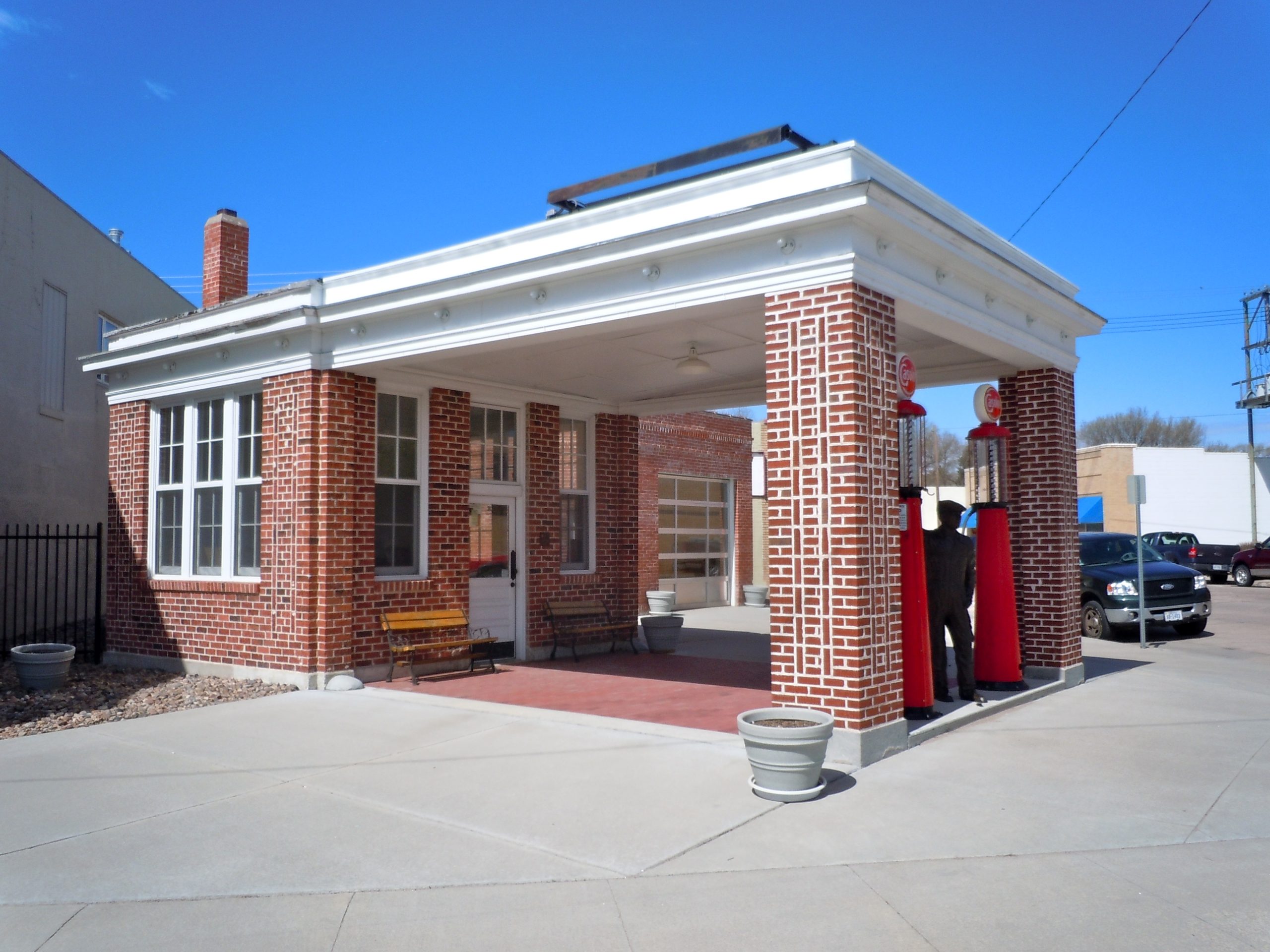
In 1963, Ed Ruscha published a book called Twenty-Six Gasoline Stations. The title tells you everything you need to know. It is exactly what it claims to be: photographs of gas stations on Route 66 between Los Angeles and Oklahoma City, printed cheaply and stapled together. The photographs are technically bad. The lighting is off, the framing is casual, the subjects are mundane. Ruscha gave copies away for free or sold them at a nominal price. The Whitney Museum later described the project’s deadpan presentation and serial structure as anticipating the strategies of conceptual art, placing it in the American tradition of laconic snapshot photography that includes Walker Evans and Robert Frank (Whitney Museum of American Art, collection note on Ed Ruscha). At the time it was something simpler: an artist refusing to perform. The deadpan was in the delivery, not just the picture.

This refusal defines deadpan photography more than any technical rule. The photographer has an opinion, obviously. You can’t choose a subject without revealing something about yourself. But the opinion is withheld from the image itself. The picture says: here is a gas station, or a water tower, or a young farmer on his way to a dance. Now what do you make of it?
In 1975, curator William Jenkins gathered ten photographers at the George Eastman House in Rochester for an exhibition called New Topographics: Photographs of a Man-Altered Landscape. The show included Robert Adams, Lewis Baltz, Bernd and Hilla Becher (the only bridge between the European and American traditions), Joe Deal, Frank Gohlke, Nicholas Nixon, John Schott, Stephen Shore, and Henry Wessel Jr. The ten contributors hung 168 images on the walls, and many visitors found them boring. Parking lots. Tract housing. Industrial parks. I hear that the exhibition catalogue itself is worth tracking down, but I haven’t. These photographers had rejected the grand tradition of Ansel Adams and the sublime American landscape. Yosemite and Monument Valley held no interest for them. What they wanted to photograph was the strip mall that was replacing the wheat field. They did it without editorial comment. As the Los Angeles County Museum of Art noted, romanticisation gave way to cooler appraisal, focused on the everyday built environment (LACMA, New Topographics exhibition notes).
Stephen Shore, the only colour photographer in the show, deserves special mention (and not just because he’s one of my favourite photographers at the moment). His series American Surfaces, shot on a 35mm point-and-shoot during a cross-country road trip in 1972, and the later Uncommon Places, shot on a large-format camera, brought deadpan to colour photography (I managed to get my hands on early editions a while back). Motel rooms, diner counters, small-town intersections, and roadside attractions were rendered with the same neutral gaze the Bechers applied to water towers, but in the full, mundane spectrum of late-twentieth-century American life. Shore’s work expanded the deadpan project by proving that colour could be as emotionally withheld as black and white. Not everybody would formally link Stephen Shore to deadpan, but I find the transition from one to the other obvious.
Lewis Baltz, in particular, made a career out of this refusal. His series The New Industrial Parks Near Irvine, California, published in 1974, a year before the New Topographics exhibition, is a catalogue of blank corporate facades, chain-link fences, and construction sites. It was described as a radical departure in landscape photography. What is radical about it is the absence of any visible attitude. Baltz himself said his approach was a conscious effort to eliminate any sign of style. That is a strange thing for an artist to claim, but it worked. Sotheby’s writes that his deadpan pictures of suburban sprawl represented a radical change in Western landscape photography (Sotheby’s, Lewis Baltz artist biography).
Charlotte Cotton devoted an entire chapter to deadpan in her book The Photograph as Contemporary Art, published in 2004. It remains the definitive treatment of the subject. In it she described the approach as a cool, detached, and keenly sharp type of photography, a way of seeing beyond the limits of individual perspective. She noted that deadpan had become the most popular style in gallery photography, which is a curious fate for a movement built on emotional withholding. The Bechers started out bewildering collectors. Their work now sells for sums that would have seemed absurd forty years ago.
One thing Cotton captured well is how deadpan enables photographers to address large subjects, social, political, and ecological, without being didactic about them. The Canadian photographer Edward Burtynsky is the most striking example. His monumental prints of mines, quarries, oil fields, and recycling yards apply the deadpan gaze to the planetary scale of human industry. The work is deeply critical of what it depicts, but the criticism is encoded in the choice of subject and the overwhelming scale of the print, not in any editorialising within the frame.
Deadpan photography has been so thoroughly absorbed into the visual language of contemporary life that we barely notice it anymore. Google Street View is deadpan. Architectural documentation is deadpan. Half the photographs in any art fair are deadpan by default, because the style has become the baseline against which expressive photography measures itself. A large portion of the photographs on Substack are clearly deadpan. Rineke Dijkstra photographed adolescents on beaches, pregnant women, bullfighters, soldiers. She used the simplest possible formula: one person, centred, straight-on, against a minimal background. Her subjects, caught in states of transition, reveal their vulnerability because the camera refuses to supply any narrative comfort. The Czech photographer Jitka Hanzlova, in her series Here, documented everyday German life with the detached gaze of a foreigner, offering no personal interpretation and leaving viewers with a sense of unease and unfamiliarity (NYFA, So What Exactly Is Deadpan Photography?, 2014). Dijkstra and Hanzlova both understand that the deadpan portrait is not really about the person in the frame. It is about the space between the subject and the camera, the slight awkwardness of being looked at, the small adjustments people make when they know they are being observed. And what about Richard Avedon and his series In the American West (1979–1984)? Portraits on white background facing the camera dead on, taken with large format cameras, with little more than a name and a profession attached. You can’t help but wonder about these people, even though they’re not particularly expressive (I know I have enough to actually try to find one of them).
It is the same trick Buster Keaton pulled in his films a hundred years ago. The straight face makes everything around it look absurd.
There is a contradiction within deadpan photography I keep thinking about ever since I started thinking about the term. The deadpan photograph claims neutrality, but neutrality is a position too. Photographing a gas station rather than a mountain is itself a statement about what matters. Choosing an empty industrial park over the workers who built it is a statement too. The deadpan gaze can be a kind of honesty, or it can be a kind of evasion. Pretending to be objective is not the same as being objective.
The pretence is the point. I think that’s what attracts me to the idea. It refuses to tell you how to feel, and that refusal forces you to reckon with your own response. It’s documentary without the commentary, but documentary with the photographer’s responsibility engaged nonetheless through the choice of subject matter. You stand in front of a Gursky print, two metres wide and filled with the chaos of a stock exchange floor, and you feel something. But the photograph will not name it for you. You have to name it yourself. That is rare in a culture that is always telling you what to feel about everything (think algorithm). Deadpan leaves you alone with the image. It is a cold gift. But it is a gift nonetheless.
#Photography #Opinion #IMayBeWrong #Deadpan
[…] Deadpan Photography: Enjoying the Pretence · Stop Being Exploited · Deadpan: An Investigation · In the Moment · Will Photography Die With GenZ? · Become a […]