
Street photography is something that bothers me, so I want to understand it. And to understand things, I need to classify them and understand how they relate. Call it professional bias.
With street photography, I quickly hit a wall: the term clearly covers many disparate activities and everybody has a point of view on what it really is about. So when I tried to classify it, I realised that I couldn’t create a neat and orderly way of breaking things down using the clear known categories.
My starting point was the categories I’ve always used: urban, architecture, street portraits, street activity, events. But these didn’t seem to always work with the photographs I was looking at. For example, an empty alley at dusk where the light is the subject isn’t architecture or urban, exactly. A candid portrait of a stranger and a carefully composed shot of someone who knows you’re there aren’t really the same category either.
It became clear that calling all these things street photography is like calling every book a novel: it will work sometimes, but it will fail most of the time. Or calling every song a ballad: you lose a lot of precision once you start looking at what exists.
Szarkowski got some of the way there with his His five categories (The Thing Itself, The Detail, The Frame, Time, Vantage Point) published in The Photographer’s Eye. But five isn’t enough once you start looking at details. His point of view was historical more than diagnostic, so I have a different purpose. I wanted something that could describe any street photo, including ones that don’t exist yet, so I built a taxonomy with fourteen axes (I did my PhD around taxonomies).
Here’s the list:
- Population: empty to crowded. How many people are in the frame.
- Human role: primary subject, secondary element, or absent. Are people what the photo is about, or just part of the scene.
- Architectural presence: absent to background to dominant grid. Is architecture the stage, or the performer.
- Photographer relationship: unaware candid, aware/acknowledging, or directed/staged. Does the subject know you’re there.
- Distance: intimate (under 1m), portrait (1-3m), or environmental (3m+). The physical space between you and what you’re shooting.
- Framing structure: geometric and ordered versus dense and organic. Is the frame built on lines and symmetry, or layered and chaotic.
- Temporal peak: a single decisive instant, or no peak moment at all.
- Colour: monochrome, muted, or saturated and driven.
- Atmospheric weight: documentary and transparent versus atmospheric and painterly.
- Light source: natural ambient, mixed, or artificial/introduced flash.
- Motion: frozen, blurred, or motion as the subject itself.
- Juxtaposition: absent or present. Is there an unexpected collision in the frame.
- Narrative density: single subject, layered scene, or abstract and non-representational.
- Intention: found and observed, hunted and anticipated, or constructed and set up.
Each axis has a spectrum of answers. A vector across all fourteen describes any street photo more precisely than the word “street photography” ever could.
After testing this classification on a number of photos, I realised that there are well defined clusters and these already have names. For example:
- Populated frame, people as primary subject, candid relationship, geometric framing, single peak instant: that’s the Decisive Moment, the HCB special.
- Architecture as dominant grid, a person walking through to complete it, observational distance: that’s the Geometric Stage.
- Atmosphere as subject, colour doing the talking, painterly weight, no temporal peak: that’s the Poetic or Painterly.
So I thought it would make things easier to name those clusters as archetypes: Decisive Moment, Geometric Stage, Poetic and Painterly, Social Documentary, Environmental Portrait, Crowd or Swarm, Abstract Experiment, Humorous Encounter, Nocturne, Empty Street, Surreal Juxtaposition, Street Portrait, Flash Noir, and Documentary Minimal.
Most interesting photos don’t fit within a single archetype: not only they span several axis, but they also break cluster boundaries. For example, Saul Leiter’s rain-on-window reflections (e.g. Snow) cross Poetic and Painterly and Abstract Experiment. A lot of Alex Webb’s Tehuantepec (Mexico, 1985) is simultaneously Social Documentary, Decisive Moment, and Geometric Stage (even borderline Crowd or Swarm).
At first, it can feel like the system is broken if photos cross sections. But reality isn’t a nicely ordered filling cabinet where everything fits in a single drawer. Reality is complex, it’s messy, it’s disorganised. So a system that will describe it will be complex and will have a lot of relationships.
When a photo spans three archetypes, the taxonomy is doing its job. Tehuantepec works because it’s a documentary of a specific place, a portrait of specific people in the street, and a frozen moment, all at once. The overlap tells you something about why the photo holds together.
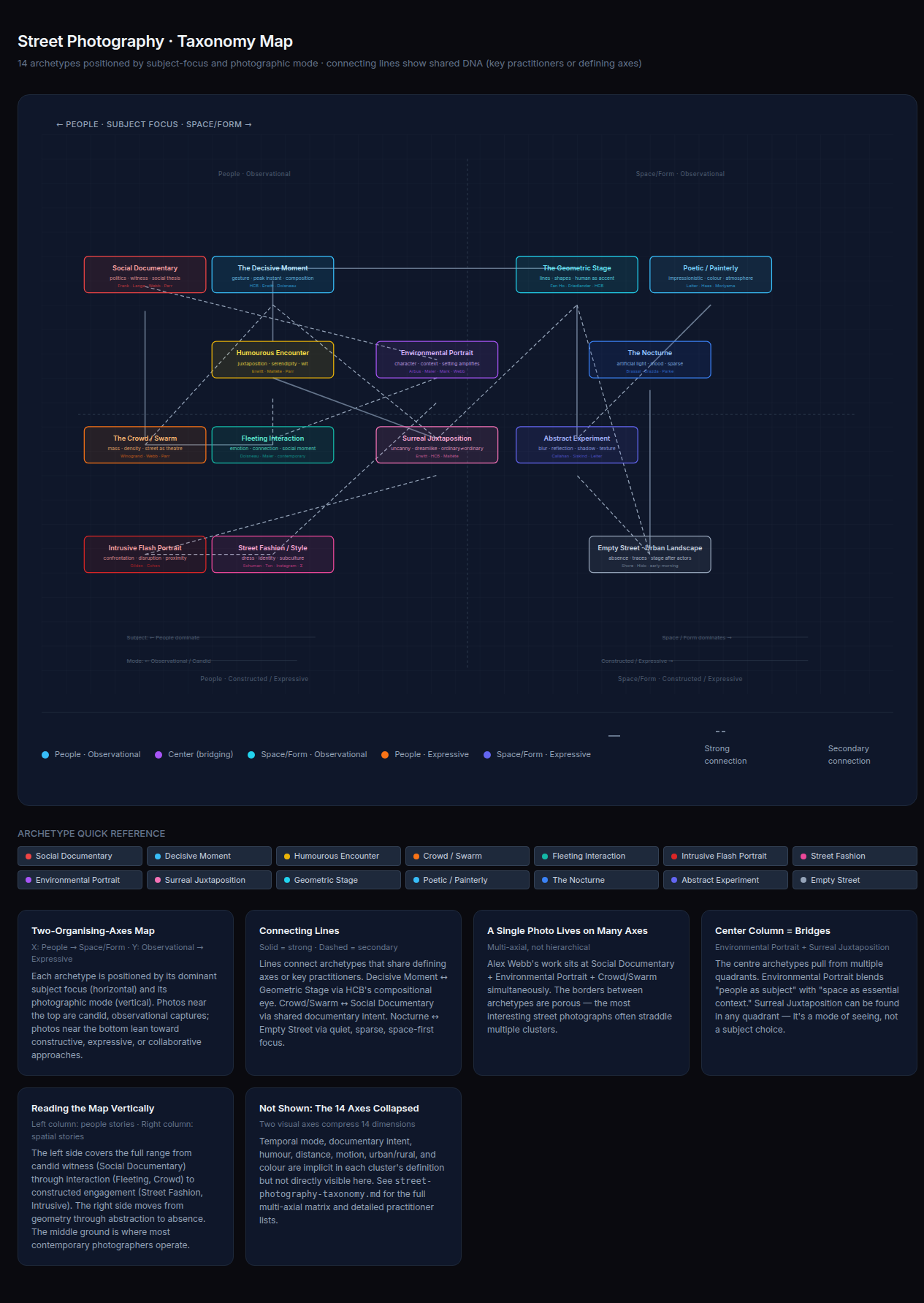
I built a 2D map to make this visible (well, technically an machine did, it was a bit too complex for me to draw by hand), placing all fourteen archetypes on a grid with the horizontal axis running from People to Space and Form, and the vertical axis from Observational to Constructed. The centre row (Environmental Portrait, Surreal Juxtaposition) acts as a bridge.
A quick note on that map: fourteen dimensions can’t really fit on two axes and two dimensions. The taxonomy was projected onto the two dimensions that seem to carry the most organising power. It’s a simplification. The full resolution lives in the fourteen axes themselves but that’s a mind-bending fourteen dimension graph; the map is just a way to see relationships at a glance.
The top-left quadrant is the classical canon, with Decisive Moment in the corner: people-first and observational, Social Documentary and Humorous Encounter clustering nearby. The right side is where space, light, and form lead: Geometric Stage, Abstract Experiment, Nocturne, Empty Street. The bottom half holds Street Portrait and Flash Noir, along with the staged work and flash intrusions generally. It’s a different kind of photography than the top-left quadrant.
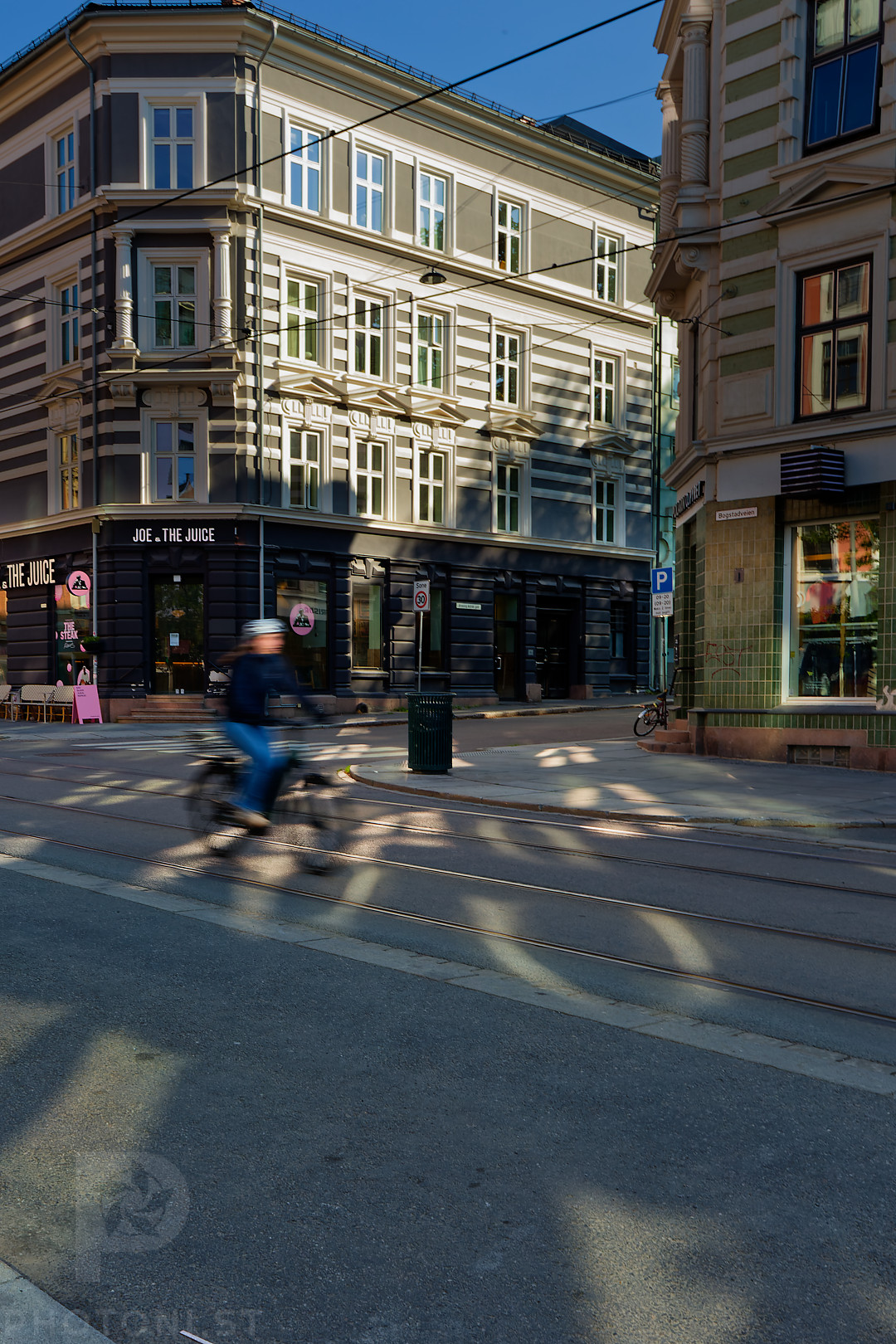
For example, I took one of my favourite photos from last year: Bogstadveien, Oslo, early morning. A cyclist crossing a sunlit intersection with tram tracks leading across the frame, a Neo-Classical building with a Joe and the Juice on the ground floor anchoring the left side. I’d always thought of it as a decisive moment shot: the timing catching the cyclist in that exact patch of light, motion blur suggesting movement stopped and preserved.
Running it through the axes turned up more. Architectural presence was dominant, not background (that building was organising the whole composition and I remember that I wanted to have those buildings in the frame at the time). Framing structure was heavily geometric: the stripes on the façade, the tram tracks as leading lines, the overhead tram wires. Atmospheric weight leaned painterly, because of the long shadows and the way the light hit the upper stories while leaving the street in partial shadow. And there was the reflection on the road: light bouncing off the building windows formed two circular patches on the asphalt, with a diagonal shadow line connecting them into a bicycle silhouette riding ahead of the actual cyclist.
The photo was four archetypes at once: Decisive Moment, Geometric Stage, Poetic and Painterly, and Surreal Juxtaposition. It’s not clean and easy, but it makes perfect sense and matches what I wanted at the time.
That empty alley at dusk where the light is the subject: low population, architecture as dominant grid, painterly atmosphere, no temporal peak. It falls between Geometric Stage and Poetic and Painterly. Neither architecture nor landscape. Just something that lives in the overlap. It makes perfect sense.
This system seems to work and to make sense. But it raises questions. The biggest one is about the fourteen archetypes themselves: are they real structures in how we make street photographs, or just patterns my brain imposed on the data? I probably mapped my own biases into the system somehow. But at least it works for me.
Photos Referenced in the Taxonomy (Practitioners)
| Photo / Series | Photographer | Link |
|---|---|---|
| The Americans (social documentary) | Robert Frank | LensCulture |
| Migrant Mother (documentary) | Dorothea Lange | MoMA |
| Le Baiser de l’Hôtel de Ville (staged street) | Robert Doisneau | BBC Culture |
| Paris de Nuit (nocturne) | Brassaï | Artsy |
| Facing New York (intrusive flash) | Bruce Gilden | about photography |
| World’s Fair, New York City, 1964 (crowd/swarm) | Garry Winogrand | Art Institute of Chicago |
| Mount Rushmore, 1969 (geometric) | Lee Friedlander | Fraenkel Gallery |
| New York City, 1974 (Dog Legs) (humour) | Elliott Erwitt | Holden Luntz Gallery |
| Uncommon Places (empty street) | Stephen Shore | The Independent Photographer |
| Dream/Life (nocturne/poetic) | Trent Parke | Magnum Photos |
| Dream/Life (review) | Trent Parke | Talking Pictures |
| Self-portrait shadow (environmental) | Vivian Maier | CNN Style |
| Hong Kong geometry (geometric stage) | Fan Ho | Digital Photography Courses |
| Surreal street humour | René Maltête | Bored Panda |
| Abstract wall textures | Aaron Siskind | ICP |
| Multiple exposure abstraction | Harry Callahan | Pace Gallery |
#Photography #IMayBeWrong #Opinion #StreetPhotography #Classification