I first came across Gerda Taro’s work years ago as I was investigating claims that Capa didn’t actually land on Omaha Beach with the first waves (come back next week for a whole post on that subject) as a side story to that old post, and I’ve been thinking about her lately as I was writing this series. She was one of the most important war photographers of the 1930s, and then she was forgotten. This is the story of how it happened, and how she was finally found again.
Robert Capa wouldn’t exist without Gerda Taro. She invented him: the name “Robert Capa” was her idea. A fictional American photographer, rich and successful, who could command higher prices than two hungry Jewish refugees in Paris. The early “Capa” work was partly hers. She was the manager, the strategist, the one who understood that talent needs packaging. Without Gerda Taro, there’s no Robert Capa.
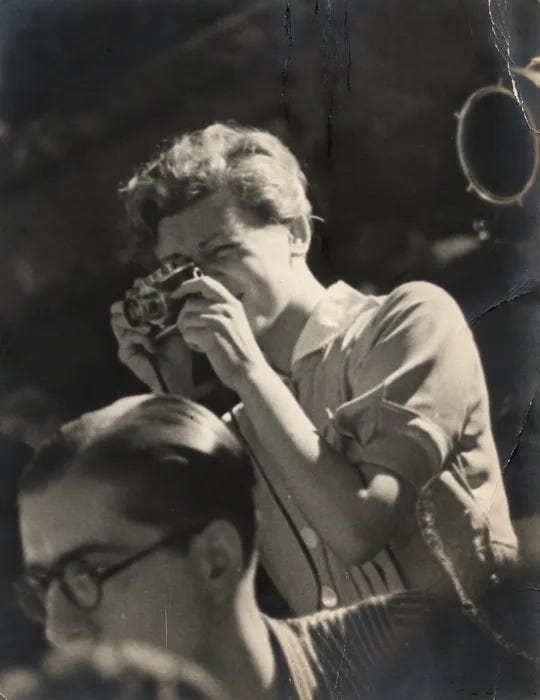
In the famous photo of Gerda Taro taken in July 1937, she’s holding a Leica. It’s probably a Model II or III, fitted with a 50mm Summar lens (I have the Zorki equivalents of both models). She looks young and small. She’s standing in a narrow Paris street, her back against the wall, the camera in front of her face. That’s probably one of the most famous photos of her (there aren’t many I’m aware of).
She was born Gerta Pohorylle in Stuttgart in 1910. She came from a middle-class Galician Jewish family rooted in what is now Poland, though they lived comfortably in Germany by then. She excelled at school and picked up languages apparently effortlessly: French, English, German. She joined the Wandervogel youth movement, which was all about free-spiritedness and the emancipation of the body, hiking through the countryside, swimming in lakes, rejecting the stuffy conventions of bourgeois life. At the tennis club, she fell in love with a boy called Pieter Bote.
Her parents sent her to boarding school in Geneva, Pension Florissant, probably hoping she’d calm down and become a proper young lady. It didn’t exactly work out that way.
In March 1933, she was arrested for distributing anti-Nazi leaflets and spent seventeen days in prison. When the SA arrested her, she apologised for her clothes. “You see, it’s because the SA arrested me just as I was about to go out dancing”. You couldn’t make it up. Inside, she taught her fellow prisoners French and English, sang American songs, and rang the forbidden alarm bell when she heard screams coming from the men’s quarters. During interrogation, she could cry on cue, a useful skill in a Gestapo prison. Her Polish passport got her freed, since the Nazis couldn’t hold her as a German national.
She fled to Paris that year, like so many left-wing Jewish refugees of that era. The early thirties Paris was full of them. Artists, writers, photographers, intellectuals, all mobbing the cafes of Montparnasse, all broke, all talking revolution.
Gerda met André Friedmann in September 1934. He needed a blonde model for a Swiss insurance brochure. His friend Ruth Cerf took the job and brought Gerda along for company. They clicked, him a Hungarian Jew and her a German Jew, and together they were two refugees from different corners of the same collapsing world. He was funny, talented, chaotic. She was organised, ambitious, sharp. Opposites attract.
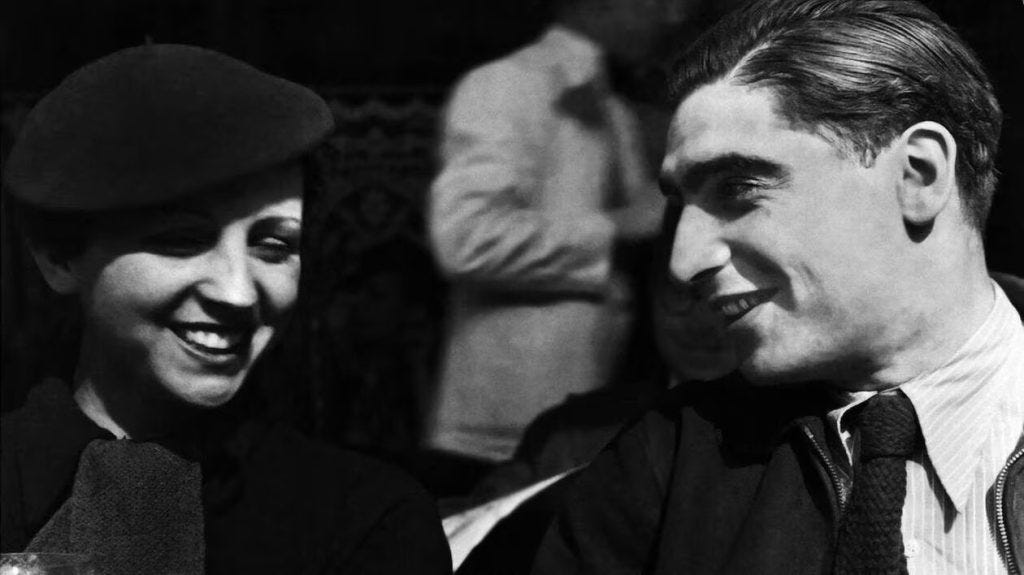
Gerda saw his talent immediately, along with his complete inability to present himself. He dressed badly, talked too much, and undersold his work, so she decided to manage him, getting him to dress better and teaching him how to present himself while taking control of his career. The Fred Stein photographs of them together are the only ones that survive, and you can see their complicity.
Gerda’s ruse was to invent a wealthy American photographer, call him Robert Capa, and charge American prices for his work. The name was deliberately generic, intentionally international, a name you wouldn’t question. Who could tell where a Robert Capa was from? It worked, for a while.
Around then, she changed her own name to Gerda Taro. Nobody knows for sure where “Taro” came from. The usual story is that she blended the name of Taro Okamoto, a young Japanese artist living in Paris, with “Garbo” from Greta Garbo, the Swedish actress. It’s guesswork, but the effect was the same: a name that sounded international and hard to place, like Robert Capa. Maria Eisner, the agent at Alliance Photo, later admitted she’d known the whole thing from the start.
The ruse blew up at the League of Nations in Geneva. Lucien Vogel, the editor of Vu magazine, called the bluff. There was no American photographer, just two Hungarian and Polish refugees with a good story. But by then, the work was too good to ignore, and André Friedmann chose to become Robert Capa for real. The name stuck.
They flew to Barcelona in August 1936 with Gerda, Capa, and Chim (David Seymour, the Polish photographer who’d later co-found Magnum). The plane went down hard on the runway, but everyone survived. Barcelona was in revolutionary fever with churches burning, workers carrying rifles, and the anarchists having taken over the city.
Gerda used a Rolleiflex at first with its square format and waist-level finder, while Capa used the Leica and a Contax for rectangular frames that were eye-level and faster. You can tell their work apart by the aspect ratio. But in the early weeks, there wasn’t much to photograph. War, it turns out, involves a lot of waiting, frustration, and boredom during long afternoons in the Spanish heat with nothing happening.
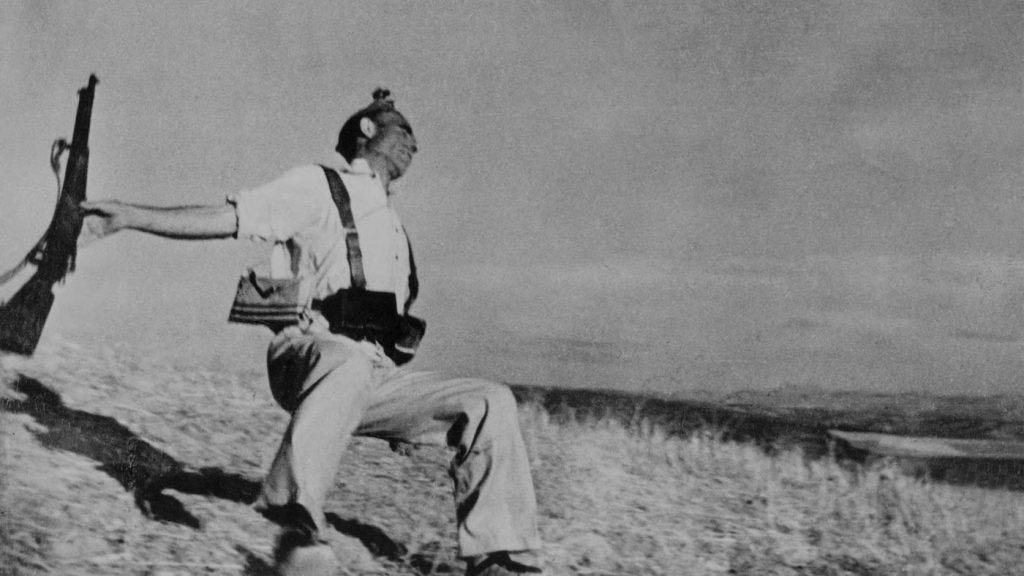
Then Cerro Muriano happened. The first real horrors of villagers fleeing and soldiers dying. Capa made his most famous photograph there, “The Falling Soldier”, the one that’d define his career. There aren’t any known photographs by Taro from that day, and the accounts are unclear, but something changed in her after that.
Taro became known as “la pequeña rubia”, the little blonde. The Republican soldiers loved her. Fearless, cheerful, utterly committed to the cause.
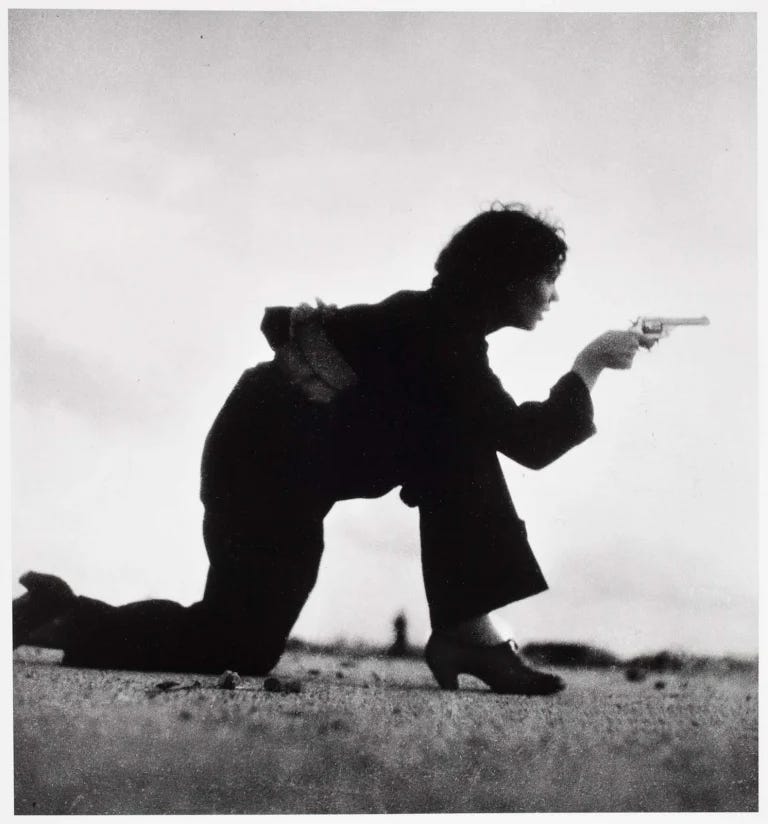
Over time, she found her style, and it certainly was different from Capa’s. Her work smelled of Soviet modernist influence with its heroic figures.
Look at the photograph she took of a woman militia training on the beach in Barcelona. She shot from a low point of view, lying in the sand, making her subject tower above her and against the sky. The horizon is near the bottom of the frame while the centred subject fills the square frame. The composition is deliberate and purposeful. And instead of grabbing this frame in the middle of the action, she positioned herself, most likely made the subject pose, waited for the right moment, and pressed the shutter.
The woman isn’t glamorous. She’s sunburned and looks dirty, holding a gun she probably barely knows how to use (she’d probably break her wrist if she fired it in this position). But the angle transforms her into something monumental, heroic. Taro photographed her with respect, as a protagonist or war, not a victim of it. She shot from below to emphasise strength and purpose. This was her signature. In that way she’s related to Catherine Leroy. But notice that the woman still wears feminine shoes, not military boots. Like Lee Miller, Anja Niedringhaus or Jackie Spinner, she manages to remind us of the humanity of her subjects within the horror of war.
Compare this to Capa’s photos from the same period, where he moved through chaos. His images are blurred, instinctive, snatched. “The Falling Soldier” is the perfect example: a man caught at the exact moment of death, parts of the subject out of focus, the composition far from perfect (his feet are cropped). It was the result of a millisecond reflex. Taro’s work is the opposite.
Capa proposed marriage, but she refused, understanding that marriage would subsume her. She wanted to be her own photographer, not Robert Capa’s wife. She started working independently for Ce Soir, the French communist daily. Her byline read “Photo Taro”. A small rebellion against the machine that was already absorbing her work into his legend.
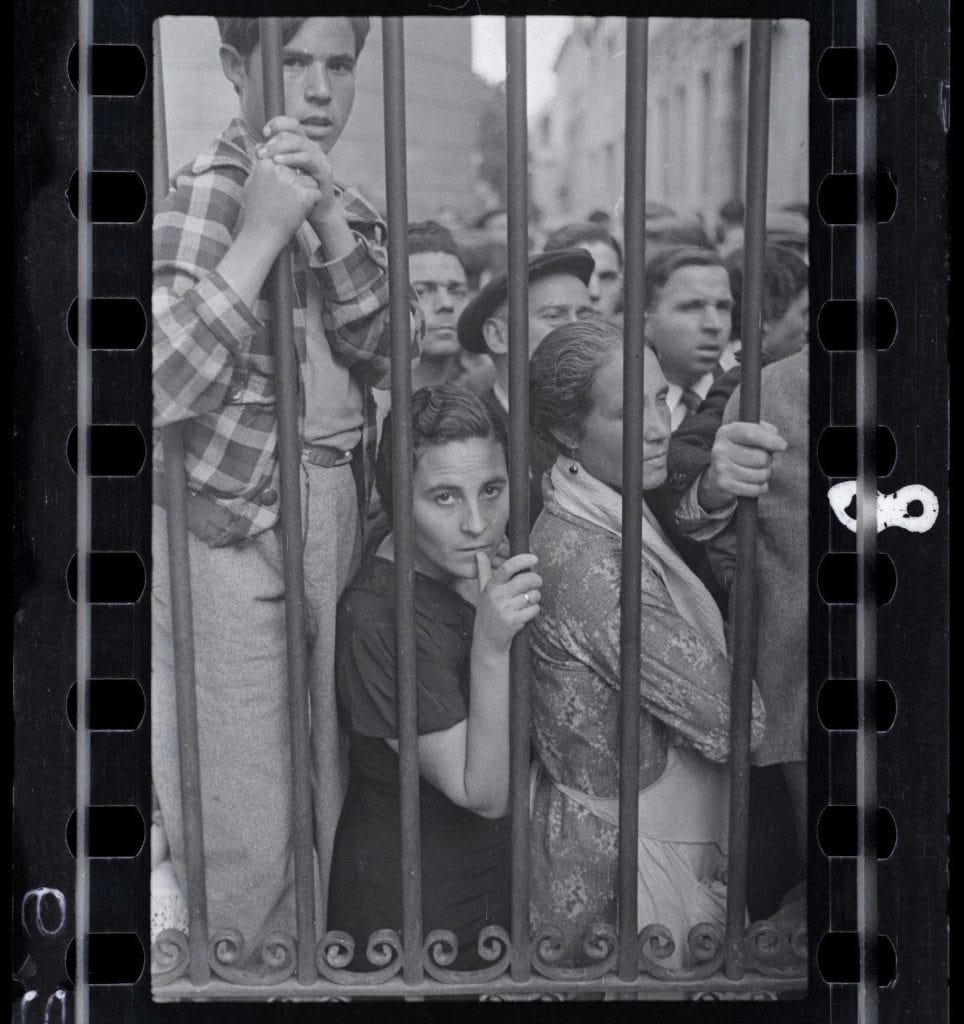
One of her most famous series of that time was taken outside the Valencia morgue. In one of the photographs, a woman stands behind a gate, looking straight at the camera. The gate bars frame her face, and the light is flat and merciless. These people are waiting to hear about their deads. Published in Regards magazine under her own name, it could be her masterpiece. One frame, one woman in the crowd, the whole Spanish Civil War in a single human face.
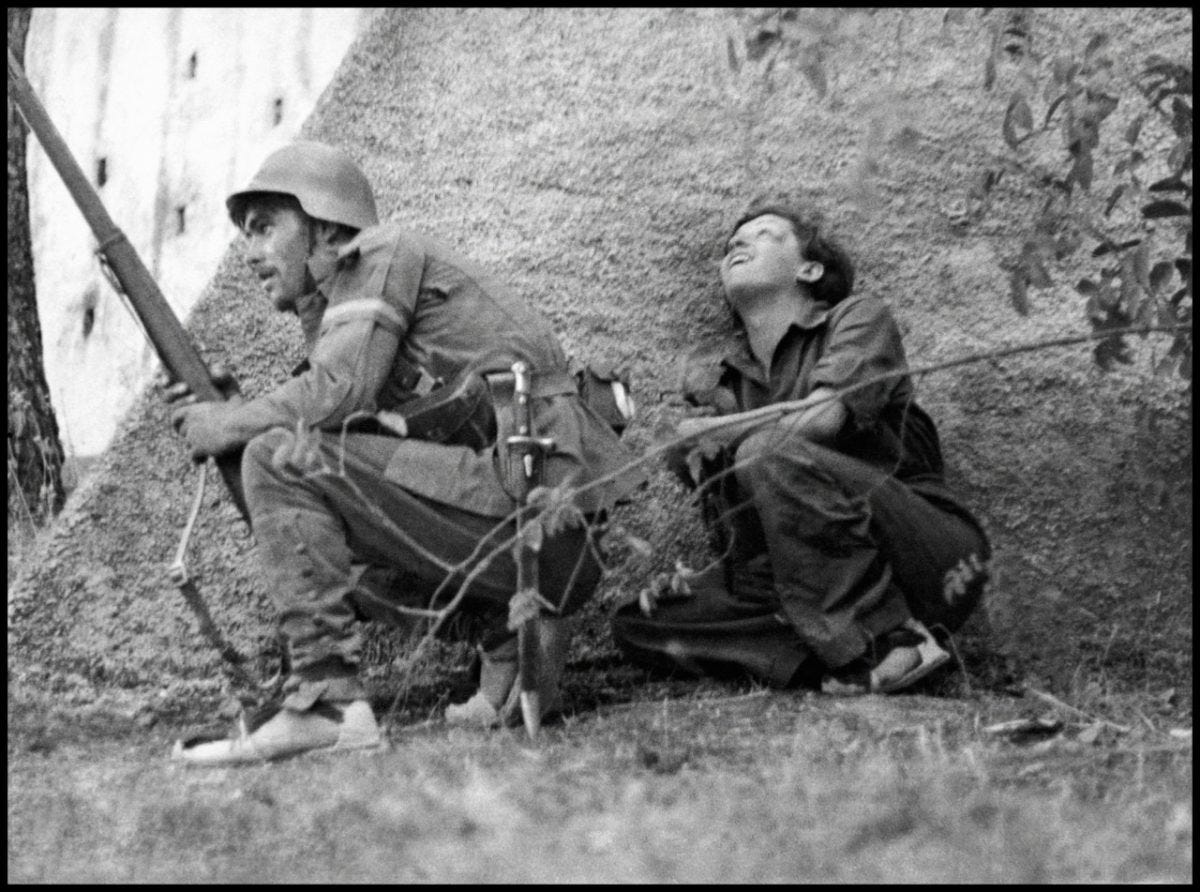
On July 25, 1937, the Nationalists launched a counter-offensive at Brunete, and the Republican army was retreating in disorder. Gerda was there with a young Canadian journalist called Ted Allan, who admired her enormously. He wrote about her afterwards, and her bravery at Brunete became part of her legend as she rallied fleeing soldiers back to a trench and held them there under bombardment for an hour. Ted Allan was with her, terrified, taking cover, watching this small blonde woman shout at grown men to stop running.
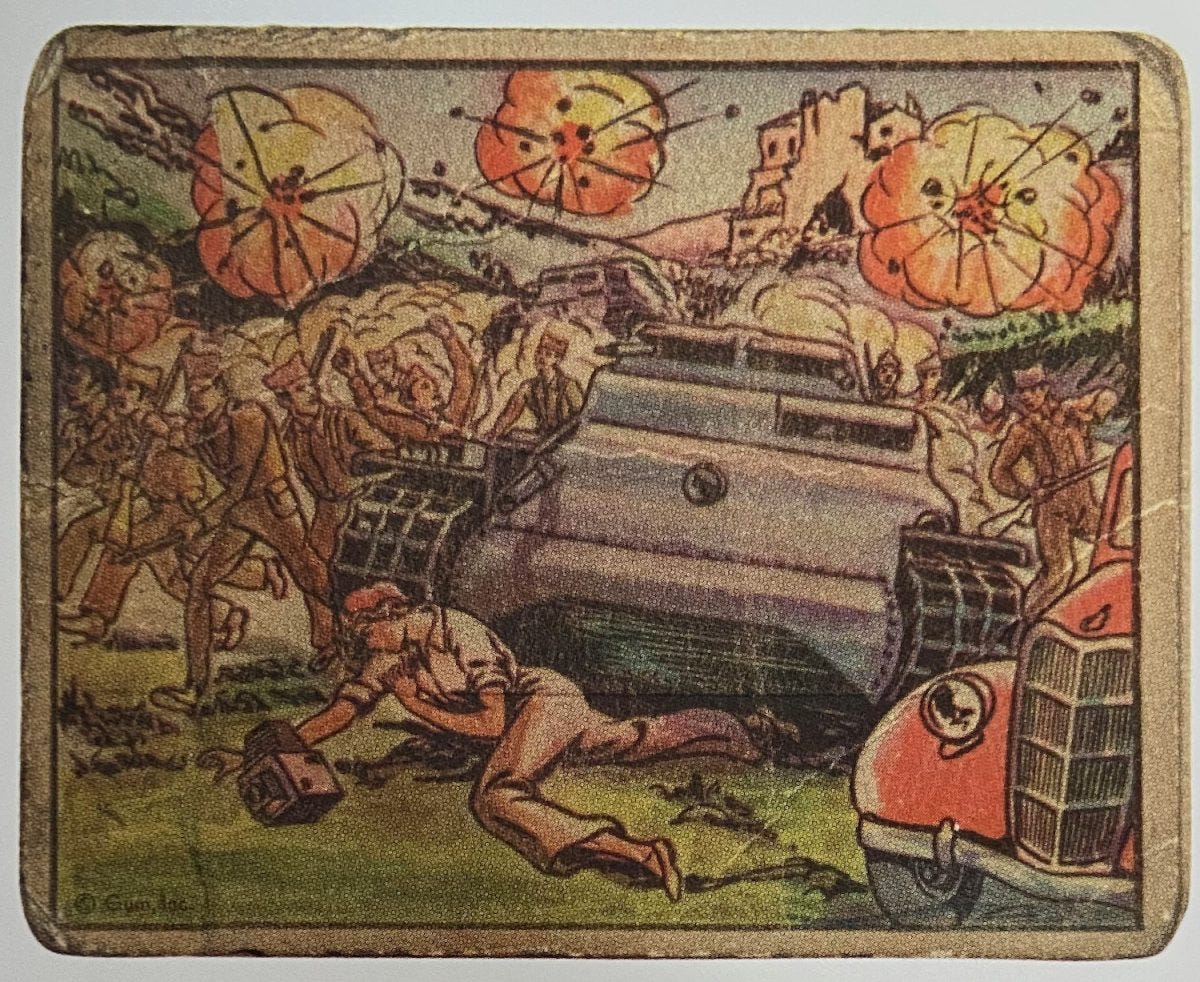
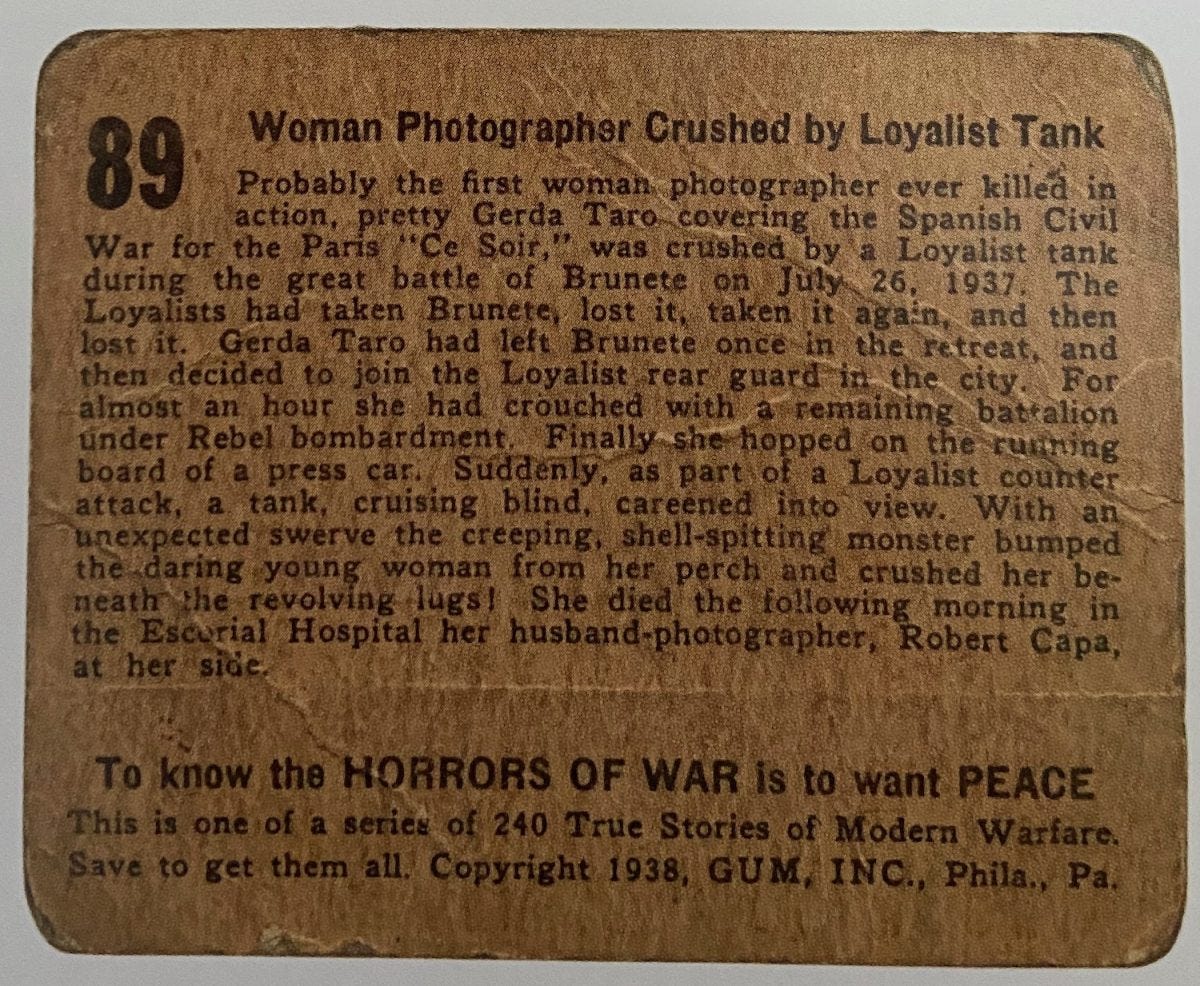
When the bombardment stopped, she’d run out of film and decided to leave. She and Allan came upon General Walter’s big black car, which was being used to carry wounded soldiers to hospital. Gerda passed her cameras through the window, jumped on the running board, and the car took off. It hadn’t gone far when an out-of-control Republican tank veered into the car, crushing her.
Taken to El Goloso, a hospital at El Escorial, with wounds to her stomach, she was still conscious. An American nurse later remembered that Gerda asked repeatedly if her cameras were safe. Ted Allan asked to see her, but she didn’t, apparently, ask about him. She died during the operation, on July 26, 1937, at twenty-six years old.
Her funerals in Paris was a communist affair, and it was enormous, with tens of thousands of people lining the streets as Chopin’s Funeral March played. Louis Aragon and Jean-Richard Bloch, her editors at Ce Soir, gave the funeral orations, and the poet José Bergamin spoke after them. She was buried at Père Lachaise in a tomb designed by Alberto Giacometti, a Horus falcon carved in stone, the falcon of the Egyptian sky god, watching over her.
Capa was inconsolable. His friends feared he might kill himself. He published “Death in the Making”, a book of Spanish Civil War photographs, dedicated “to Gerda Taro who spent one year at the Spanish front, and who stayed on”.
But then the erasure began. She’d worked for Ce Soir, the French communist daily, and her politics were unambiguous. When the Cold War started, this was unforgivable. In America, McCarthyism was in full swing, and a dead communist photographer wasn’t someone the mainstream press wanted to celebrate at the best of times, but by then it would have been political suicide. The press wasn’t more brave then than now. Magnum, the agency Capa co-founded, stamped “Robert Capa” over many of her prints. The negatives and prints from Spain all went into the same boxes, unlabelled and unattributed. Capa’s fame was growing fast, his name sold magazines, and hers didn’t. Without her byline, the images became his. The work was powerful, impactful. It must be Capa. And if some of it looked different, more composed, less frantic, well, an artist develops. That was the assumption for decades. The Spanish Civil War was also eclipsed by the Second World War, which was bigger, bloodier, and closer to home. Gerda Taro was forgotten.
Capa never forgot her, but he couldn’t save her work from the tide of history.
In 1939, before he fled Paris, Capa packed three boxes of negatives and left them with his friend Csiki Weisz. When the Nazis were getting near in June 1940, Weisz loaded the rolls into a rucksack and cycled to Bordeaux, hoping to get them on a ship to Mexico. He couldn’t, so he gave them to a Chilean he met on the street, who handed them on to General Francisco Aguilar Gonzales, the Mexican ambassador to Vichy. Gonzales took them to Mexico. They waited there to be discovered for more than sixty years.
In 2007, the boxes were rediscovered. Three cardboard boxes that would be known as the “Mexican Suitcase”, containing 4,500 negatives. About 1,000 of them were by Gerda Taro. A retrospective at a New York museum finally showed some of them properly attributed. It was properly, finally, hers.
“Something of her will not die”, wrote Ce Soir in its obituary, “with the memory of her bravery will be her photographs, witness to this bravery and to a truly great talent”.
“Millions and millions of women . . . will remember brave little Gerda”, wrote Mikhail Koltsov, Pravda’s correspondent in Spain, who would later be executed in Stalin’s purges.
A bubble-gum card from the 1930s, of all things, shows a drawing of “pretty Gerda Taro” being crushed by a tank. The caption reads: “To know the HORRORS OF WAR is to want PEACE”.
That Leica she’s holding in the photograph from July 1937 looks familiar to me as I have Russian knockoffs (Zorkis II, III, IV). She used it for barely a year as a photographer, while still learning, still finding her voice, still figuring out what kind of photographer she wanted to be, never getting to see her best work published.
Her camera was lost that day, most probably crushed under the tank. But the photographs made it out. Boxes of film waited first in Capa’s Paris darkroom, then in Mexico, then in New York, misattributed, scattered, lost, then finally found. The camera didn’t outlive her. Her pictures did. And now, seventy years later, they’ve finally made it home.
Gerda Taro survived through her own work. The photographs were always there, waiting, needing someone to recognise that “Photo Taro” wasn’t an apprentice or an assistant, but a master.
Sources:
- Wikipedia (bio and fact-checking)
- Magnum Photos “Gerda Taro: The First Woman War Photographer to Die in the Field” (institutional perspective)
- International Center of Photography, Taro constituent archive page (530 archived items)
- Télérama “Sur France 5 : Gerda Taro, la photographe de guerre éclipsée par Robert Capa” by Juliette Warlop (2021) (analysis of three specific photographs by documentary director Camille Ménager)
- Clio, “Gerda Taro, mort d’une pionnière du photojournalisme de guerre” by Gilles Legroux (2021) (includes the full Ce Soir front page article from July 28, 1937)
- Jane Rogoyska, Gerda Taro: Inventing Robert Capa (Jonathan Cape, London, 256 pages)
- François Maspero, Out of the Shadows: A Life of Gerda Taro (Souvenir Press, 2008, translated by Geoffrey Strachan, 152 pages)
#Photography #Opinion #PhotographerFocus #GerdaToro
[…] Capa's D-Day Landing · Photography Isn't Art. Until It Is · Photographer Focus #6: Gerda Taro · The Shape of Gone Things · Threshold Photography Gear · […]