
Before you push the shutter button, before even you leave the house, everything has been decided. You might not have a list of photographs you expect to take on the day, but your visual values have already decided what will come out of your day.
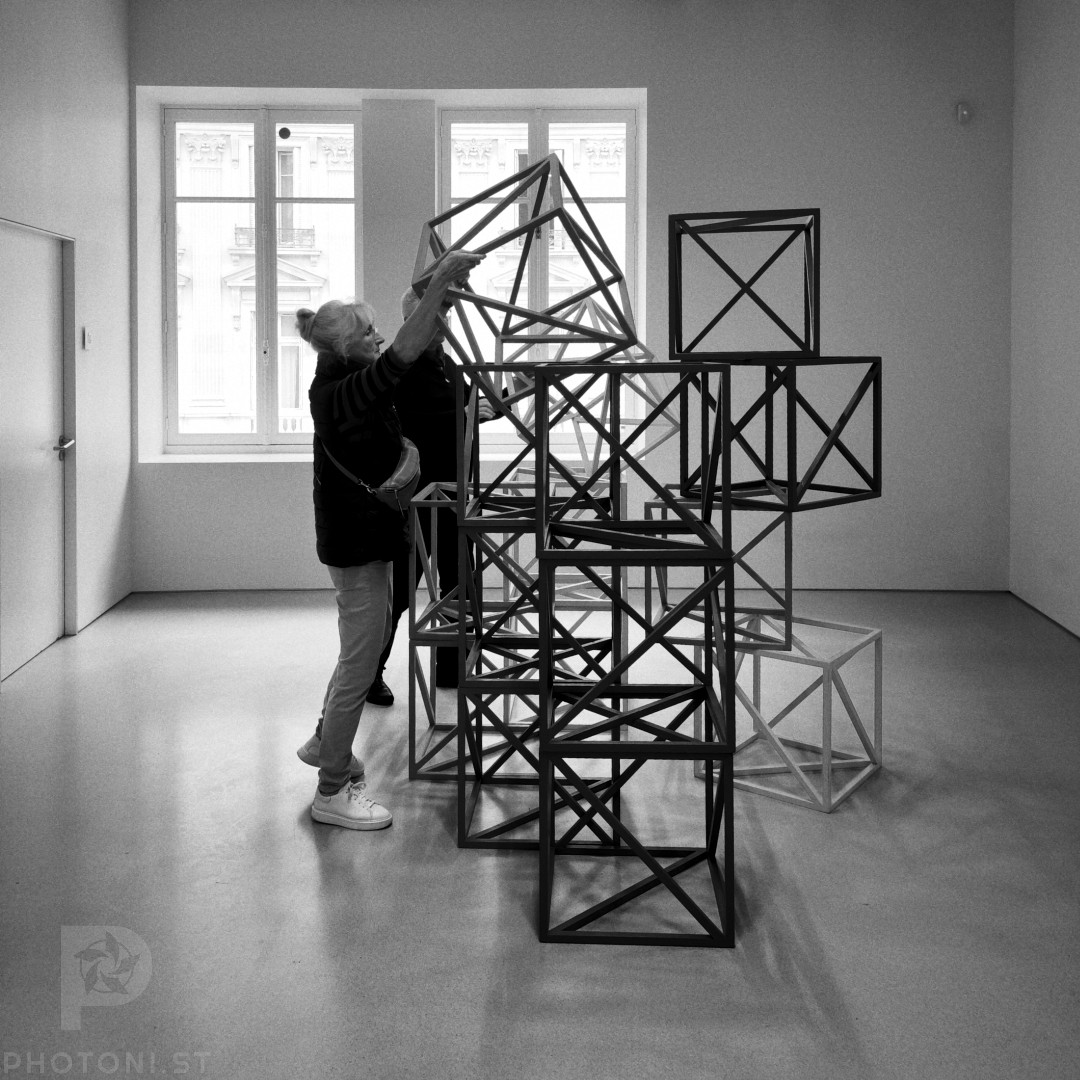
Vision exists before the encounter. When I walk out of the house to take a landscape, I have already something in mind: a location, a relationship between forms, an atmosphere, elements in the frame. Sometimes I know exactly what I’m looking for in every detail; I just know what image I want to produce before I call it a day. Sometimes it’s a bit more fuzzy and some of the elements aren’t well defined even though the overall result is clear.
Street photographers work from the same principle, even if it looks different from the outside. Most don’t wait passively for something to happen. Moving through the streets with a sense of human behaviour (think Cartier-Bresson), they’re looking for what they’ve already half-imagined. When it happens before them, they notice because it passed through a filter that was already there.
To understand what that filter is, it’s useful to compare to the mechanisms of language because visual values work on vision the way language works on thought. Both visual values and language condition what’s conceivable in the mind. Ancient Greeks had no word for blue. Homer described the sea as wine-dark, the sky as bronze, even though his eyes were functionally the same as ours. But his language hadn’t isolated that particular wavelength as a useful thing to name. A photographer whose visual vocabulary is built around stillness and compression can’t see the value of a chaotic, maximalist image. Vision sets the goal. Values determine which goals are available.
The encounter with reality, then, is a translation or interpretation rather than a transfer. Translations and interpretations are never neutral. The photographer carries an intention into contact with something that has its own properties and its own resistance: the landscape isn’t quite what you had in mind, the configuration of rocks doesn’t work as you expected, or the street gives something different from what was imagined. Sometimes the photograph gets made anyway, as a knowing compromise because it’s hard to go out and come back with nothing. Occasionally it doesn’t get made at all, and that decision to put the camera down is as much a creative act as pushing the button. The vision functions as a standard against which reality can be found.
What survives a successful translation is new. A single photograph creates something discrete, a visual fact with its own existence independent of the moment that produced it and independent of any other photograph or moment. The most powerful images aren’t faithful records of what happened so much as replacements for it. We don’t remember the event; we remember the photograph, and at that point the image has become a reality in its own right instead of a window onto one.
Built on that, a body of work becomes something other than just the sum of the photographs it contains. Instead of creating a single new reality (per photo), it builds a world, something with its own atmosphere, its own internal logic, its own consistent rules. The individual images that compose the body of work matter less than what they produce together. Inside Daido Moriyama’s Tokyo, the grain, the contrast, the cropping, the movement create a space immediately recognisable as his, not because of the events depicted, but because you’re inside a coherent set of values made visible. You’re inside Daido’s world before you’ve consciously realise it
Sharing that world is where things get complicated and a bit messy. A world that exists only inside the photographer’s head remains a private obsession. But as photographers, we want to share that world with everybody. sometimes it feels like it needs to be seen to really exist. But what viewers see isn’t identical to what was built. They arrive with their own visual grammar, their own accumulated history, their own version of Barthes’s punctum. The photographer builds, the viewer inhabits a version partly of their own making. Two people can stand in front of the same print and be moved by entirely different things, and neither of them would be wrong about what they saw.
In a way, two worlds collide: the one created by the photographer with their own understanding, visual values, and sensibility, and the one the viewer brings, with their history, their own sensibility, and understanding.
But it’s not a failure. It’s the condition of the whole process. The task is to build something coherent enough that strangers can enter it and find something for them to take away. What that is will never be exactly what was intended, and it’s ok.
#Photography #Opinion #IMayBeWrong #PhotographyTheory