

Photography typically tries to stop time. We capture moments, freeze them, extract them from the flow of duration. But there’s another approach that interests me more: using photography to make time visible through its effects. Not the moment itself, but what happens across years of moments. Not the pristine object, but the object after it’s lived.
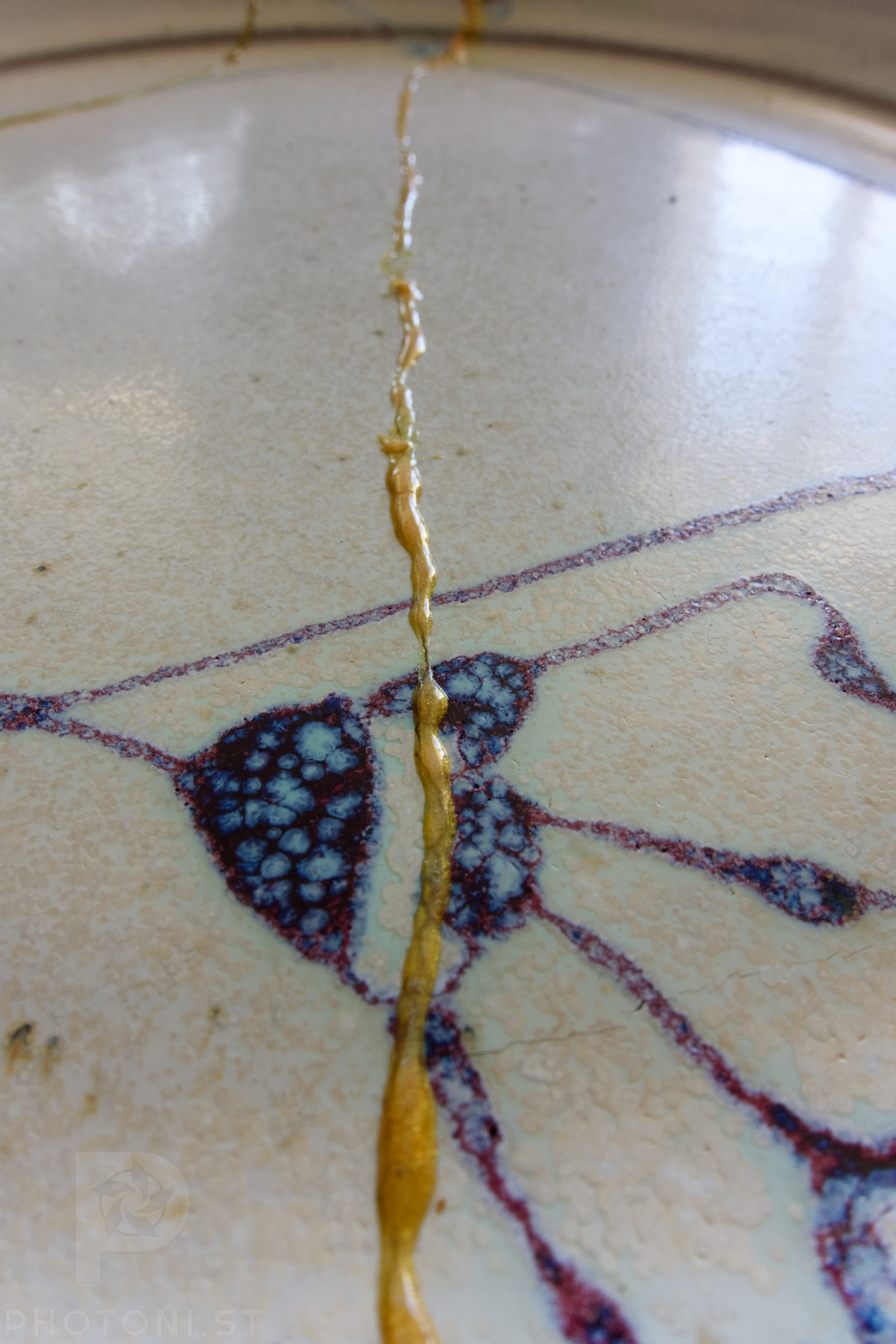
I’ve started photographing things that show their age. Objects that are scratched, discoloured, worn at the edges, sometimes broken and repaired. Most people discard things when they reach this state because consumer culture treats wear as diminishment and repair as economically irrational. But these damaged objects carry something valuable that pristine ones lack: visible history.
A camera body covered in bumps and scratches tells you it’s been handled seriously, carried everywhere, used hard. Discoloured plastic shows exposure to sun and weather. Worn edges reveal where hands have gripped for years. These marks aren’t flaws. They’re evidence. The object becomes a record of its own life, and photographing that record means documenting time itself.
This idea sits at the intersection of three concepts that seem distinct but actually converge: kintsugi, wabi-sabi, and memento mori.
Kintsugi is the Japanese art of repairing broken ceramics with lacquer mixed with gold or silver. The repair isn’t hidden. It’s emphasised. The break becomes part of the object’s story, marked visibly rather than disguised. A plate repaired with kintsugi is more interesting than an intact one because it carries history you can see. The damage and repair become intrinsic to what the object is.
This philosophy treats breakage not as failure but as event. Something happened to this object. It survived. The repair acknowledges that history rather than erasing it. Western consumer culture does the opposite. We hide repairs or, more often, simply replace broken things. An object loses value as it ages or damages. Kintsugi suggests the opposite: the object gains meaning through what it endures.
Wabi-sabi extends this further. It finds beauty in impermanence, imperfection, incompleteness. Things are more interesting as they age and decay because that aging reveals their true nature as temporary. Nothing lasts. Everything deteriorates. Wabi-sabi doesn’t mourn this. It accepts it as fundamental and finds aesthetic value in the process. Rust, cracks, fading, wear become qualities worth attention rather than problems to solve.
But wabi-sabi can sometimes feel purely aesthetic, focused on the beauty of decay without examining what that decay actually means. That’s where memento mori becomes relevant. Remember that you will die. Memento mori insists we confront mortality rather than ignore it. In art, this often means including symbols of death or decay alongside life and vitality. The message is clear: everything ends.
Photographing worn and damaged objects brings these three concepts together. Like kintsugi, I’m interested in objects that show repair or at least show their breaks. Like wabi-sabi, I’m drawn to the aesthetic of imperfection and impermanence. Like memento mori, I’m using these images to make mortality visible. Not through skulls or explicit death imagery, but through the evidence of time passing and things wearing down.
Objects age faster than we notice ourselves aging, which makes them useful proxies for understanding duration. A camera used hard for twenty years shows those years in scratches and perishing. A building weathered by decades shows that time in cracked paint and eroded stone. We can’t see time directly, but we can see what it does. Photographing damaged objects is photographing time’s effects, which is as close as we get to photographing time itself.
The subjects can be personal or communal, and both matter for different reasons. A personal object carries individual history. The scratches on someone’s daily-carry knife show how they held it, where they used it, what they cut. The wear pattern on a camera shows which controls got used most, which hand gripped it, how carefully or roughly it was treated. These marks are biographical. They document one person’s relationship with one object across time.
Communal objects carry collective history. A building used by a community for decades shows that use in worn steps, faded paint, replaced panels, improvised repairs. Public benches get smoothed where people sit. Doorways get marked where hands push. Walls accumulate layers of paint, posters, graffiti, cleaning, repainting. The object becomes a palimpsest of everyone who interacted with it. Photographing this documents not an individual but a community’s passage through time.
Both scales interest me because both reveal the same fundamental thing: we live, we use things, we leave marks, we decay, we die. The personal object shows this at human scale. The communal object shows it at social scale. Neither is more important. They’re different lenses on the same truth.
There’s also a kind of reciprocity in using worn equipment to photograph worn subjects. My cameras show their age. They’re scratched, dented, slightly battered from years of use. When I use them to photograph other damaged objects, there’s a symmetry. The tool and the subject share the same quality of having lived. The camera that’s been used seriously is perhaps more qualified to document other things that have been used seriously. There’s honesty in that relationship. I’m not using pristine equipment to aestheticise decay from a safe distance. I’m using equipment that participates in the same process of aging and wear.
This approach is also a refusal of how consumer capitalism wants us to relate to objects. The economic logic says: use things until they’re worn, then discard and replace them. Repair is inefficient. Worn things have lost value. Keep buying new. Photographing damaged objects asserts the opposite. These things have value because of their wear, not despite it. Their history matters. Their scars are interesting. Their continued existence after damage is worth documenting.
I’m not interested in pristine objects anymore. Perfection is boring because it’s static. It exists outside time. A perfect object could have been made yesterday or fifty years ago. You can’t tell. A damaged object tells you immediately that it has history. Something happened to it. It survived or didn’t quite survive. It got repaired or left broken but still functional. That narrative is what makes it photographable. I don’t remember the last time I bought something new other than food.
What I’m really documenting isn’t the objects themselves. It’s time made visible. It’s mortality rendered in scratches and rust and cracks. It’s the evidence that things exist, get used, deteriorate, and eventually stop functioning. Which means it’s evidence that we exist, live, age, and die. The objects are proxies. The subject is impermanence.
Photography can do this in ways other media struggle with. A painting of a worn object is still an interpretation. A photograph has indexical relationship to what it shows. The scratches in the photograph correspond to actual scratches on an actual object. The evidence is direct. I’m not inventing decay. I’m recording it.
This doesn’t mean the photography is objective. I’m still choosing what to photograph, how to frame it, how to light it, how to process the image. Those choices shape meaning. But the underlying fact remains: these marks existed. This wear happened. Time passed and left evidence. My role is to notice that evidence and make it visible to others.
We live in a culture that hides aging and decay, that replaces rather than repairs, that values the new over the endured. Photographing worn objects is a small resistance to that. It insists that history matters, that marks of use are valuable, that imperfection carries meaning. It records what consumer culture wants us to ignore: everything we make and use will eventually deteriorate, just as we will.
Kintsugi repairs with gold. Wabi-sabi finds beauty in decay. Memento mori reminds us of death. My photography tries to hold all three at once: acknowledging damage, finding value in imperfection, and using both to make mortality visible. The camera that’s lived photographs the world that’s living. Both are wearing down. Both are worth documenting while they’re still here.
#Photography #IMayBeWrong #Opinion