
I’ve spent a lot of words arguing that the ordinary is enough. To me, documenting your own life is the most interesting thing you can do for your own future self. And as I mentioned before, I see Japanese photography as the centre of that approach.
So when a Substack note appeared on my feed the other day about a teenager in Tokyo who’d won a million yen with a photocopied zine of her own life, I knew who they were talking about, of course. Who is interested in photography and hasn’t heard of that zine?
The note came from The Last Rangefinder Society, and it made a big claim: that this zine, which won in 1995, is the origin point of the visual grammar of every phone camera. It turned out to be both too big and not big enough, and its subject is in London right now, hanging in a museum.
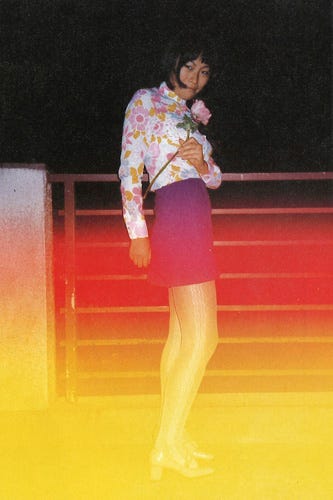
The zine was called Seventeen Girl Days, and the girl behind it was Hiromix: Hiromi Toshikawa, born in Suginami, Tokyo, in 1976. In March 1995, at eighteen, she won the grand prize of the New Cosmos of Photography, the competition run by Canon. The judge who picked her was Nobuyoshi Araki, who had a certain reputation as a photographer of women, which made the choice something of a surprise: the prize carried a million yen, paid for photocopies of breakfast taken by am eighteen year old girl. It must have made a lot of serious photographers cross.
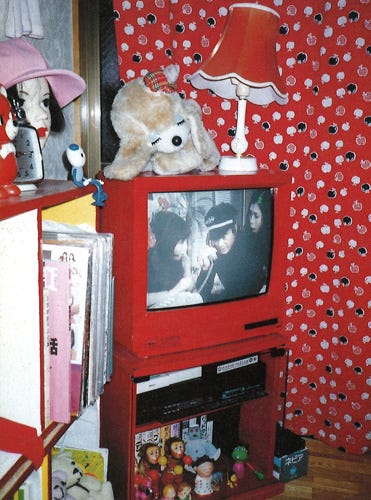
What she’d submitted was a thirty-six-page booklet of colour photocopies of ordinary prints, shot on a cheap compact and developed at the local kiosk. Something anybody could have done at the time. Self-portraits in underwear. Her room, with the television and the stuffed animals. Half-eaten breakfasts and friends, often blurred. She made the pictures at seventeen and won at eighteen, which is good going and precocious in a world where the gatekeepers tend to be middle-aged men.
Her own statement for the competition is significant because it shows that she knew exactly what she was doing: “The daily life of a 17-year-old high school student is full of danger. Radical days. Passing days. A sadly pitiful world. Why is love painful. ROCK IS MY LIFE. I’m scared that I’m getting closer to becoming an adult. I live, reflecting upon myself”.
That’s her life in eight sentences: the fear of adulthood, the worship of rock and roll, the conviction that her ordinary days are worth stating out loud. “A sadly pitiful world. Why is love painful”. It’s surprising of confusion and clarity at the same time. Asked later about the girls she photographed, she said: “They don’t expect anything at all from the future”. She said it in 1997, about a generation that came of age after the bubble burst. That’s a sentiment I see in Japanese posters’ posts on Substack today.
Araki’s comment feels like a man talking himself into a decision: “Girls tend to hold nothing back, and don’t think too much. Without thinking too much, they let their feelings rule their actions. Her feelings that she wants to create and try anything, as well as her flexibility are apparent. Guys think too much. I think teens are going to be interesting”.
There was a great irony in the pairing. Araki had spent his career photographing naked women often in submissive situations (look him up, I can’t reproduce any of his photos here), and here he was handing the prize to a girl who photographed herself exactly as she found herself. His praise is a compliment, but it’s also a prison: it explains her as a natural force, a girl who doesn’t think too much, rather than as someone making deliberate decisions. She was both, but the establishment will try hard to erase that second part.
The camera was a Konica Big Mini, a cheap autofocus compact, plus disposables for variety. Film went to the local kiosk with everyone else’s holiday snaps. The Christian Science Monitor opened its 1997 profile with this sentence: “Hiromi Toshikawa shoots what is in front of her face”. It described her photographing her friends, her cat, her room, her food, herself: a young woman who’d set down her art school paintbrush and picked up an inexpensive autofocus camera called a Big Mini. “I take photos of what I like”, she told them. In the introduction to her first book she put it this way: photography is “the place where I can express all what I feel and think in my everyday life”.
To understand what happened next, you need the Japan she was born into. The economic bubble had burst, and consumer culture, desperate for growth, had turned its attention from salarymen to teenage girls. Those tools arrived at the right time: cheap point-and-shoot cameras from 1990, and Purikura photo booths from 1995, the year she won. Teenagers had access to cameras with no one telling them what to point them at. Before that, the images of Japanese girls that filled the media had been made by men like Araki: idealised, sexualised, arranged. The girl was the subject of photography, never its author. From 1995 the girl in the frame was the one taking the picture, and the decisions were hers alone. That was a cataclysm for the industry.
A year after her win, the critic Kotaro Iizawa gave this new wave its name: “onna no ko shashin”, girly photography, grouping Hiromix with Yurie Nagashima and Mika Ninagawa as if they were a single person. That label described the photographers rather than the photographs: young, female, cute, and therefore safe to smile at. A line in the Substack note explains it: “Being canonised under a diminutive is the critical equivalent of being given a knighthood and a nickname on the same afternoon”. I’m not sure Iizawa set out to contain anyone. He coined the term with a measure of admiration, and it pointed at something concrete: young women, candid cameras, a shared fluency in the cute culture they’d grown up in. But a diminutive diminishes whoever it’s applied to, planned or not. Nagashima, whose work was folded into the same term, argued it implied women couldn’t handle serious equipment. Hiromix never identified with the label. In interviews she gave in 1997, a reporter asked about influences and he received a shrug and two sentences. “I don’t have any particular theme”. “Nobody else is any good” (hum!). Cameron Barr, who conducted the interview, read the act as “at once haughty and naïve”, and he had a point: it may have been a cultivated persona, or it may have been genuine, certainly provocative.
Iizawa saw the contradictions. To the Monitor he described the photographers as engaged in a tug of war with society, and warned that their weapon was perishable: “They’re using cuteness as a tool, but cuteness is short-lived”. Japanese photography, he also said, was “a men’s-men’s-men’s world”, which is why the label caught on so easily.
The fame came fast, and it took a distinctly Japanese form. In March 1996 Studio Voice put her on the cover and gave her fifty pages (!). A later issue, titled “We Love Hiromix”, was devoted to her entirely, with texts from her family, her friends and Araki himself. Her first book, Girls Blue, appeared that September: 122 pages chosen from more than 30,000 photographs. The books kept coming: Japanese Beauty and Hikari in 1997, a Steidl edition in 1998 edited by the French critic Patrick Remy, which carried her work to the West, then a book of her Paris years in 2001 and, in 2002, Hiromix 01, which mixed poems and drawings in with the pictures. Their success over time was fading, though.
Between the books she was in a band called the Clovers, released a solo album and two EPs, worked as a DJ, appeared in a Yves Saint Laurent fragrance advertisement and turned up briefly in a Lost in Translation (Sofia Coppola). Wolfgang Tillmans photographed her in 1997. Takashi Murakami included her in Superflat at the Parco Gallery. Then, in 2000, came the Kimura Ihei Award, one of the most significant prizes in Japanese photography, shared with Nagashima and Ninagawa (still lumped together). Nagashima reportedly considered refusing it, objecting that the “girly” framing had swallowed the intent of their work. The award went ahead, shared three ways. But you can understand Nagashima’s position: the “girly” label had followed her for years by that point and was restricting how she was perceived. Hiromix went on to judge the prize she’d once won, from 2011 to 2015, and by 2022 her name was in Japan’s high school art textbooks, listed among the country’s eminent female photographers. She had legitimised the photo diary style, the form everyone now practises because of social media.
There is a darker side to this story. The Japan Times put it bluntly in 2001: the girly photographers had quickly understood that the less clothing they wore in their self-portraits, the more support they received from the male-dominated establishment. Candid snapshots became bra-and-panties pictures, then nudes. And when their own bodies stopped reading as schoolgirl-fresh, some of them turned to younger models, becoming exactly the type of photographer they’d seemed to be rebelling against. A French essay on Hiromix’s work answers the accusation by reading her pictures as the materialisation of the ordinary: adolescence, femininity, change, dreams. What she was after, the essay argues, was imperfection and proximity rather than the beauty and provocation the accusation assumed. That reading covers her whole career, the nudes included: the later work keeps chasing that imperfection and proximity, still refusing to arrange anything for a viewer.
The zine itself answers these accusations when you try to understand it. Whatever the movement became, whatever the industry did with the label, the booklet itself does none of the strategic things the critics describe. There’s no strategy in it at all, as Araki was saying at the time. The underwear self-portraits are there, sure, but so are the half-eaten breakfasts, the stuffed animals and the blurred friends, and nothing is arranged for a viewer. It barely seems to know a viewer exists. As I’ve argued many times long after Hiromix (hey I never said I was a pioneer!), build your work for yourself first, record your reality without posturing for an audience.
Fumio Nanjo, the co-judge, described the winning booklet as “This kitschy presentation, editing, this is it. This shows the precocious mysteriousness of late teens, kind of like the pain, the anger, the fragileness. The cover is also enveloped in a mysterious glamour”. To me the zine exudes confidence. The confidence of someone who never learned that a photograph has to justify its existence. Hiromix had had no training as a photographer and no mentors in photography, so she decided for herself what mattered: breakfast, friends, her own face, blurred and tilted and full of feeling. The zine was pure, unadulterated witnessing of every day life.
Now look at the zine again, three decades on, to see where the original Substack note claim came from. It put the argument this way: “Look at that thirty-six-page zine now… and you are looking at the entire grammar of the phone in your pocket: the front-facing self-portrait, the photographed lunch, the deliberately unflattering frame offered as proof of sincerity”. Front-facing self-portrait, photographed lunch, deliberately unflattering frame offered as proof of sincerity. It is the modern phone camera roll, not a booklet from 1995. The self-portrait wasn’t new (the first ones I’ve seen were made in the 19th century). Neither was the photographed lunch. Family albums are full of both. What was new was who was taking them, what they were made of, and the fact that an institution had rewarded the result. The zine didn’t invent the grammar of the phone camera. It invented the grammar’s legitimacy: the unarranged life was a claim you could now make in public, and the label that followed was the establishment’s answer to a claim it couldn’t control.
Iizawa saw the mechanism back then: “She can really record their lifestyle. She’s a participant and an observer”. The photographer inside the life, not outside it. The phone is just a more modern packaging. Think Tracy Emen’s bed in 1998.
However, a diminutive diminishes by itself. The term wasn’t describing a style of photography so much as a demographic, and a cute name was the cheapest way to keep a demographic in its place. It was the cutest name for something the establishment saw as a threat, so it wanted to remind the girls of who they were. A containment strategy. I’m surprised that Hiromix, Nahashima, Ninagawa, and others didn’t try to reappropriate the term for themselves to fight back. But maybe that’s because I’m not seeing the story from a Japanese cultural perspective.
Now the containment has come full circle, in the best way. She’s in “Japanese Women Photographers: From 1950s to Now” at The Photographers’ Gallery in London, running from 24 June to 27 September 2026. The premise is in the title: Japanese women have been making photographs for decades before Hiromix arrived, and the survey puts her among them. A generation on from the photocopied zine’s victory, the girl in the underwear self-portraits hangs in galleries. That is how a grammar gets legitimised: once the museum hangs the work, the camera-roll habits stop being a guilty pleasure and start being a way of seeing. Purikura supplied the habit; she supplied the legitimacy.
I don’t photograph my life the way she photographed hers. The slowness and the deliberation are mine, I don’t have the energy of youth (my parents would argue I never had it), and the underwear self-portraits were never going to happen on my side of the camera (you can thank me for that). But the principle she set down in 1995 is the argument I’ve been making for a long time: the ordinary is enough. You don’t need to travel, or wait for the golden hour, or own a lens that costs more than a used car: you just need to decide that your actual life, unarranged and unposed, is worth recording.
Nobody ever told me my camera was too heavy for my hands, or filed my work under a nickname (you could argue that nobody ever cared enough about my work, but that would be harsh). I get to make that argument cheaply, without fighting an establishment. The ordinary was never a risky subject for me. For her, in 1995, claiming it meant pointing the camera at herself, unarranged, blur and all. The establishment’s answer, when it came, was a diminutive. She won anyway in the end.
She never called herself a girly photographer, and she never accepted the label anyone else used. Three decades later, a billion phone cameras pointed at breakfast tables and unmade beds keep proving her right, and the girl who was called cute is in the canon she was supposed to be locked out of.
Every selfie you’ve ever taken owes its legitimacy to a seventeen-year-old and a photocopier.in the Christian Science Monitor, Monty Dipietro’s 2001 piece in The Japan Times, Sabukaru, Yokogao Magazine, Tylaar Haran’s Substack note in The Last Rangefinder Society, the video essay “How a Teenager Changed Photography”, the Bleu Minuit Club essay, and the Photographers’ Gallery and Aperture listings for “Japanese Women Photographers: From 1950s to Now”.
Sources:
- Canon New Cosmos of Photography archive, 1995 Grand Prize:
https://global.canon/en/newcosmos/gallery/grandprix/1995-hiromix/index.html - Christian Science Monitor, Cameron W. Barr, “Hiromix Frames a for-the-Moment Japan”, 7 May 1997:
https://www.csmonitor.com/1997/0507/050797.feat.arts.2.html - Wikipedia:
https://en.wikipedia.org/wiki/Hiromix - Sabukaru, “Hiromix: Shaping the Identity of 90’s Japanese Female Youth” (Dec 2021):
https://sabukaru.online/articles/hiromix-shaping-the-identity-of-90s-japanese-female-youth - Yokogao Magazine, Gill Princen, “The Girl Behind the Camera, Hiromix and the Rewriting of Youth”:
https://www.yokogaomag.com/editorial/the-girl-behind-the-camera-hiromix-and-the-rewriting-of-youth - The Japan Times, Monty Dipietro, “’Girly photographer’ charts her own course” (2 May 2001):
https://web.archive.org/web/20240304140319/https://www.japantimes.co.jp/culture/2001/05/02/arts/girly-photographer-charts-her-own-course-2/ - Bleu Minuit Club, “Idole, adolescence & ode à l’ordinaire: L’œuvre d’Hiromix” (French):
https://bleuminuitclub.com/blogs/journal/succes-sexe-selfie-loeuvre-dhiromix - Tylaar Haran, The Last Rangefinder Society, Substack note, 1 Aug 2026: substack.com/@tylaar/note/c-305845932
- “How a Teenager Changed Photography” (out here., YouTube): youtu.be/-znj8xlVpnM
- Photographers’ Gallery / Aperture listings for Japanese Women Photographers: From 1950s to Now (24 Jun – 27 Sep 2026)
#Photography #IMayBeWrong #Opinion #LendOfTime #Hiromix #PhotographerFocus