
Tracy Friedlander’s post on the three Substack creator type appeared on my Substack timeline one Sunday morning. I found it interesting and it got me thinking about what these types were. But thinking about them made me realise that they were simplistic and I wondered how I could reduce them to something more flexible.
The post is called “The 3 Substack Creator Types On Substack…”, and it proposes three types: Authority, Pathfinder, Magnetizer. Authority builds from what you know, Pathfinder from what you’ve been through, Magnetizer from how you see the world. Her post opens by admitting that nobody likes to talk about where they started, because it’s not sexy. It’s very true: in our age of social media where you have to appear successful at all times to appeal to the masses (unless you can turn it into clickbait) confessing that you started somewhere and at some point you didn’t know what you were doing isn’t a selling point for your side hustle.
There’s a quiz at the bottom of her post, and taking it gets you your type by email along with a mini-guide. Below the quiz is the Creator Type Blueprint, an email-delivered course, and below that workshops on paid tier design. It’s a well-designed funnel: quiz first, then the course, then the workshops, each one pointing at the next.
I waited a few weeks before publishing this post because I didn’t want to risk hurting her business model (ok, I don’t really think I have that power or reach, but I didn’t want to be accused of trying to damage her income). Not that I think I’m being unfairly critical of her post, I’m being very honest in my analysis and my opinion of the subject, and my point isn’t to say she’s doing something wrong, it’s to show my exploration of the idea and the different conclusions I arrived at. To be clear: my opinion isn’t her failure.
I have a bias in my approach here: I did my PhD working on overlapping biology taxonomies and how they can be captured and manipulated in computer systems, so I tend to think about these problems in connected and overlapping classifications. When you think about little other than one problem for 4 years, it changes the way you think for life. I even wrote a (unpublished) paper one night about how the world is a graph database that I really liked but I couldn’t find a good place to submit it.
That led me to build a street photography taxonomy (that should be published at the same time as this one). The old street photography labels just didn’t work for me: someone would post a photo and I couldn’t decide whether it was street or urban or documentary or social commentary. And not knowing what the photos were meant to be made it hard to understand them (you don’t look for the same thing in urban landscape and street portraits, for example). Eventually I decided that the argument was pointless, because these photographs could be several of these labels simultaneously. So I built a different kind of system based on fourteen axes: human presence, human role, architecture, relationship, documentary intent, abstraction, environmental weight, temporal mode, colour, humour, distance, motion, setting, framing. Every photo takes a position on every axis at once (a 14-value vector). The famous kinds of street photography, e.g. the Decisive Moment, the Empty Street, the crowd scene, are not separate things. They’re heat clusters: combinations of axis values that recur so often it makes it easier to name them.
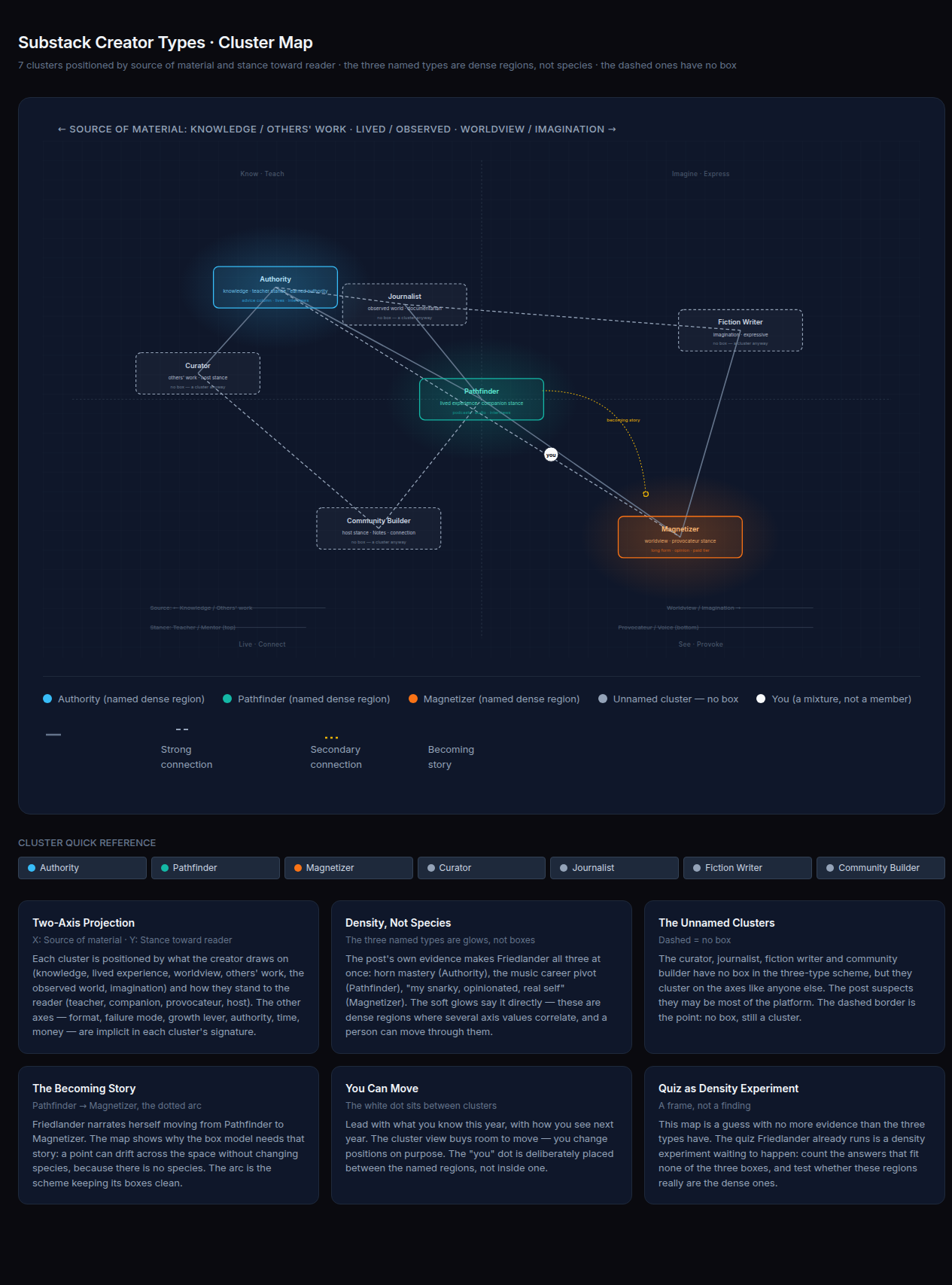
Similarly, I decided to create a taxonomy of creators starting from Friedlander’s types. To me, Friedlander’s three types are in fact dense regions where several values happen to correlate. They’re in fact really three answers to the same question: what you lead with. The axis is: what you know, what you’ve been through, how you see. A person can lead with what they know in one post and with how they see in the next.
Underneath that shared axis the information space is much wider:
- Source of material. What you draw on: knowledge, lived experience, worldview, other people’s work, the observed world, craft, imagination.
- Stance toward the reader. Teacher, companion, provocateur, host, curator. The same person can be a teacher on Tuesday and a host on Thursday without contradicting anything.
- Default format. Writing, audio, video, interviews, Notes, community, and they each have their habits and their audience.
- Failure mode. The one no quiz would ever ask about: hubris, self-centring, impatience.
- Growth lever. Might be visibility, packaging, connection, consistency.
- Relationship to authority. You can claim it, earn it, reject it, or borrow it, independently of whether you deserve it.
- Temporal orientation. It goes past, present, future, and it marks the point in time you’re writing from.
- Monetisation posture. It runs paid tier, courses, community, free, and it decides how a newsletter makes money.
This newsletter, for example, is clearly knowledge/lived experience source material, teacher/companion for stance toward the reader (with a slightly different position toward curator for the Lens of Time sub-newsletter), writing for default format, hubris for failure mode, consistency for growth lever, earn for relationship for authority, mostly present for temporal orientation, and free for monetary posture.
Evaluate Friedlander’s three types against those axes and you’ll see what they really are. High knowledge, a teacher voice, earned authority, advice formats: that combination is what she means by Authority. Lived experience, a companion voice, audio and interviews: that’s the Pathfinder. Worldview, a provocateur attitude, long form: the Magnetizer. Each one is a dense region where several values happen to correlate. The labels are just shortcuts that describe where the density is.
To be clear, that’s a framework that helps understanding. I have no data to back it, and I’m pattern-matching the same way she is. The difference is she’s got the quiz, and every answer she’s collected is a data point she could analyse and plot them on all dimensions to confirm (or not) the taxonomy.
The beauty of the axes it that they make you discover that there are in fact many more clusters. The Curator draws on other people’s work and stands to the reader as a host, curation on the format axis. The Journalist clusters around the observed world, the Fiction Writer around imagination, the Community Builder around Notes and connection. And so on. I suspect most of Substack isn’t covered by three boxes.
I think the post itself comes close to proving my taxonomy. Twenty years to master the horn before she felt she’d actually done it: that’s Authority material, straight down the knowledge axis. Then the career pivot, the podcast where she interviewed hundreds of musicians who had done what she wanted to do: Pathfinder material, built from lived experience. And then this comment: “my snarky, opinionated, real self came out”. Magnetizer material, worldview doing the talking. She’s all three at once, which is awkward for a scheme of three separate boxes.
Unfortunately, the boundaries leak, and the post admits it in passing: “as any of the types can be an authority in their space”. If any type can be an Authority, then Authority isn’t a type. It’s a quality, like being tall. The post’s own description of the Authority backs this up: “a feeling you want, an admiration”. A want isn’t a category.
To fix that, the post tells a story of becoming: she started as a Pathfinder, she became a Magnetizer. Nobody can be two at once, so she must have switched somewhere along the way. The becoming story is how the box model keeps its boxes clean and saves itself, and the labels just describe whichever one she was leading with at the time.
The cluster approach doesn’t have that problem and it gives you something the box view can’t: room to move. You can lead with what you know this year and with how you see next year, and you haven’t betrayed anything, because there was never a type to stop you. Those axes are descriptive instead of prescriptive, and you can change your position on purpose, at any time.
I see the axes model as aspects: you can carry many aspects and show any of them to the world at any time. They’re all you, but all partial.
Three types clearly aren’t enough. More variation and specificity are needed.
#Photography #Opinion #IMayBeWrong #Taxonomy