
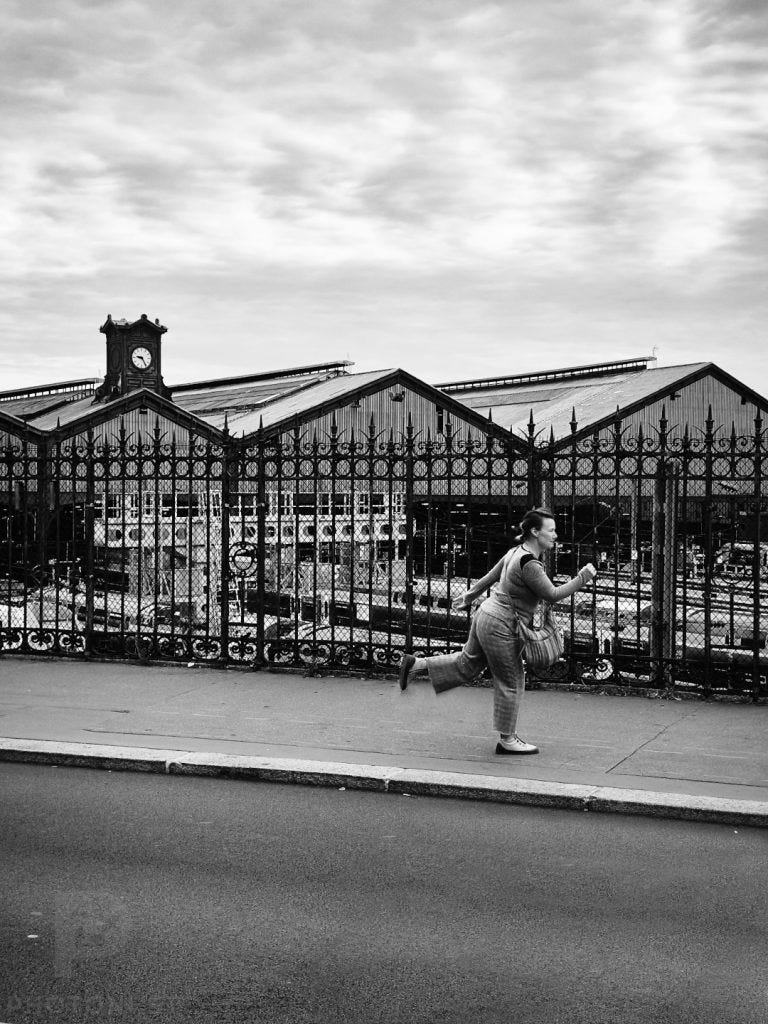
The most famous photograph in street photography is the Gare Saint-Lazare jump by Cartier-Bresson. Out of that photo a whole philosophy was born about decisive moments, no-cropping, and seeing. But it’s all a lie.
Thanks for reading I may be wrong! Subscribe for free to receive new posts and support my work.
One day of 1932, Henri Cartier-Bresson found a construction fence next to Gare Saint-Lazare in Paris. There were gaps between the planks, barely wide enough for him to squeeze the lens of his camera through. Even the viewfinder of his Leica couldn’t fit, so he had to shoot blind. When he processed the film, a fence plank appeared on the left edge of the frame, which he cropped out. According to him, it was one of only two frames he ever cropped in his career (he printed his negatives with black borders to prove to editors that nothing had been touched).
The irony is obvious: the guy who, for his whole life promoted the idea that a frame should not be modified, was most famous for a photograph he cropped. But in the grand scheme of things it’s really of minor importance. What is more important is that a whole philosophy was derived from his practice and his convictions: the “decisive moment”.
The phrase wasn’t even HCB’s creation. His 1952 book was titled “Images à la Sauvette” in French: images on the sly. It’s an American publisher that extracted a tiny fragment from the foreword and made it the English title. HCB is supposed to have been unhappy with it, which doubles the irony: that HCB is famous for wasn’t from him and he didn’t like the term.
What the decisive moment describes is a feeling: the photographer sees a convergence in front of him/her, presses the shutter at the exact right instant, and that is the photograph. Vision precedes capture.
But a feeling isn’t a method. And it’s problematic that the decisive moment has been raised to the level of a method that fulfils a philosophy.
Photographers often work from contact sheets (physical or virtual). They shoot what they see or what they had planned to shoot, then select afterward. Most of the time, the moment isn’t decisive at the time of capture. It’s identified as decisive later, under inspection, in the edit. Look at the Magnum Contact sheets book, how the greats work the scene, take rolls of film in one location, and only later select the one they think is the right one. The moment becomes decisive in retrospect, which means the critical act is not pressing the shutter. It’s knowing, afterwards, which frame is the right one and being able to say why. This is actually really hard.
I may be wrong about the extent of this in HCB’s specific case. He had documented anticipatory reflexes and a well-developed ability to read a scene and anticipate. But that doesn’t make it an applicable doctrine. Especially if that was the ability of a singular mind. Students are told to wait for the moment, to feel it arriving. . The philosophy went from “this is how I understand my own practice” to “this is a standard by which photographs are judged”.
What the decisive moment mythology hides, by making everything about the single moment of pressing the shutter, is that selection is a skill. And I know I’m not good at it. It’s way more teachable than waiting for a feeling that might or might not come depending on obscure mechanisms. Most of the time, you suspect something, shoot, and find out later whether you were right. Even if you shoot digital because there is a very big distinction between quickly checking the appearance of a photo on the back of the camera, and comparing it to a bunch of other images to decide its success.
Teaching people to fetishise the instant, at the expense of developing judgement in the edit, might have produced generations of photographers that wait for that feeling that, even in HCB’s case, might only be judged later.
Ignore the decisive moment hype. Shoot and edit instead.
#Photography #Opinion #IMayBeWrong #Cartier-Bresson #DecisiveMoment