
Christine Spengler’s first camera wasn’t hers. It was her brother Éric’s. A Nikon with a 28mm wide-angle, the kit of a fashion photographer, and in 1970 she borrowed it in Chad and took her first photograph. She had never looked through a lens before.
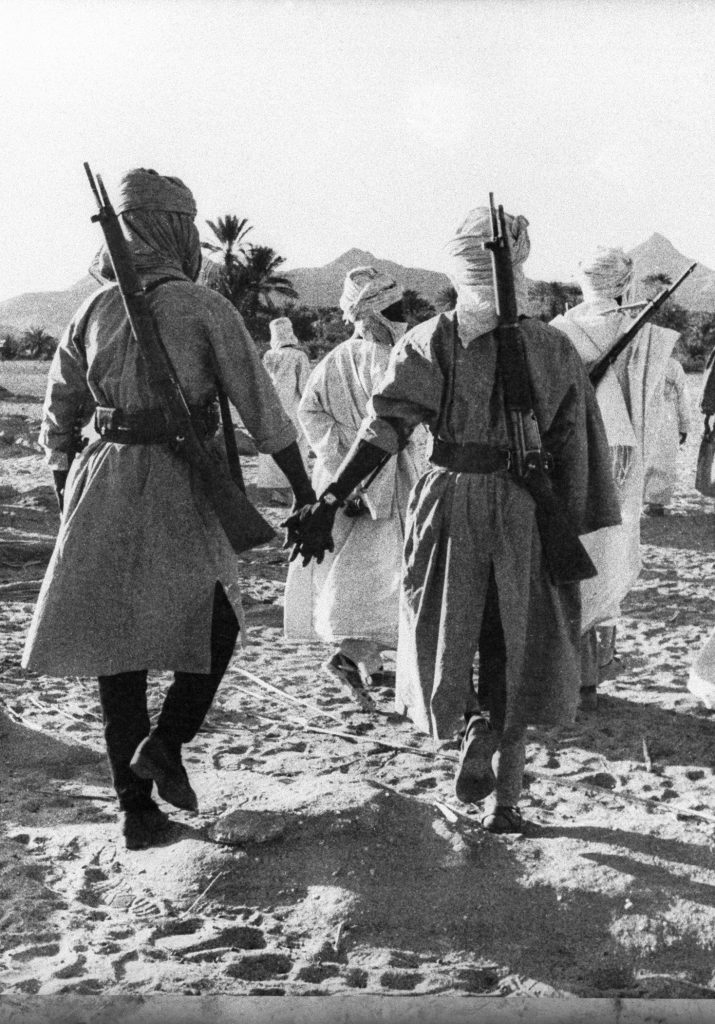
The picture is simple: Toubou fighters armed with Kalashnikovs going to the front hand in hand. It was taken in Bardaï, in the Tibesti, during the Toubou revolt. She was a young Frenchwoman of Alsatian origin, as far from being a photographer as you can get while holding a camera.
The two of them, brother and sister, were arrested as suspected spies and spent weeks in prison. When they came out, Éric told her: “You are the strongest of us two… You will be the witness and the war correspondent.”
Her answer became her career. “I will learn my profession in the field and I will become a war correspondent to bear witness to just causes.”
She was born in 1945 to an Alsatian family. Her parents divorced when she was seven, and she was sent to Madrid to live with her diplomat aunt and uncle, Marcelita and Luis. Twice a week her aunt took her to the Prado. Velázquez’s Las Meninas (one of my favourite paintings) was part of that education. But it was Goya who shocked and moved her most, and here’s a detail I love: she lived on the corner of two streets named after painters, Velázquez and Goya. Her uncle took her to bullfights. The weeping virgins in the churches reminded her of her mother, the Surrealist artist Huguette Spengler.
She studied French and Spanish literature at the lycée in Madrid and wanted to be a writer. Her education was Goya and the bullring, not photography magazines. She was trained by Goya before she ever held a camera.
After their father Édouard died, Christine and Éric set out on a long journey that reached Chad in 1970. When she describes holding the camera, you believe her: “When I have the camera in my hands, I am neither cold, nor hot, nor afraid; I didn’t know it but I was born to do this job.”
Then Ireland, 1972. She covered the Troubles with no press card, faking one from her Madrid alpine club card and claiming she was from Life. The ruse fell apart when the real Life journalist arrived. He invited her for a drink and scolded her, which seems a Life way to handle it.
Don McCullin befriended her and gave her guidance. Released by Sipa-Press, her first famous photo was “Carnival at Belfast”: Irish kids in carnival hats being frisked by British soldiers. Her account of the instinct is the best description of what she does: “When I spotted those boys in the street, I thought to myself, maybe they’ll be searched and the contrast with their little hats will be perfect.”
There’s also “Children of Derry”, of the Bogside kids. When they blocked her way, they shouted “Fuck you, we’re the Kings of the road.” She’s been telling that story for more than fifty years.
“On the battlefield I never wore helmets or bullet-proof jackets, just jeans and sandals.” Jeans and sandals in Northern Ireland in 1972. That’s either bravery or madness.
In 1972-73, for Sipa Press, she documented the return of Sheikh Mujibur Rahman after nine years in captivity. Asked how she’d manage with only her 28mm lens, she told how she’d befriended the leader’s wife with Guerlain perfume and was invited as the only photographer allowed at the homecoming. She signed her first contract with Life on the spot. I like that she negotiated the war with perfume before she negotiated it with the camera.
She went to Vietnam next, arriving alone in Saigon in 1973, working for Associated Press at $15 per photo. By her own framing she’s one of the few women war photographers of her generation; as she tells it, she was the only female photographer there. That claim comes with a caveat: Blind Magazine notes that others would follow from 1969 onwards, mostly French women: Christine Spengler, Françoise Demulder and Marie-Laure de Decker. The truth of who was where in 1973 is less tidy than the legend.
Horst Faas, the AP picture editor, told her: “remember baby, a beautiful photograph doesn’t need a legend.”
“Saigon enters the Year of the Buffalo” shows a child wearing a soldier’s helmet, smiling at the camera while bathing near a buffalo. It ran in the New York Times. “The Departure of the Americans” shows a young Vietnamese woman polishing American soldiers’ boots, in the words of her official biography, “for the last time in her life, an hour before peace”.
And it’s in Vietnam that the story turns. While she was in Vietnam, in March 1973, the telegram arrived: her brother had killed himself in Paris. “I lost all sense of colour the moment the blue telegram arrived. I dressed completely in black for many years and started searching for death.”
Then the sentence that explains the rest of her working life: “My personal mourning has become universal mourning, I tried to find it in the subjects of my photographs.”
For ten years she ran forward, in black and white, photographing what she calls the mourning of the world: Cambodia, Lebanon, Western Sahara, Nicaragua, El Salvador, Iran, Afghanistan. “I have the determination of a man but then, letting my heart as a woman speak, I always go towards the survivors.”
Her Nikon and Éric’s 28mm lens became like a talisman. That talisman travelled with her.
The Leroy connection is usually told wrong. Catherine Leroy had been there first, the only female combat photographer in Vietnam until she left at the end of 1968. Spengler arrived in 1973. They never overlapped in Saigon, but they shared the profession and the city of Paris. Spengler on the four French women: “Horst Faas once said, ‘I have no idea why, Christine, but nearly all the female war photographers are French.’ He was right: Catherine Leroy in Vietnam, Françoise Demulder in Cambodia and Beirut, Alexandra Boulat in Gaza and finally me.”
On assignment the friendship went out the window, and what replaced it was real rivalry. “With Catherine Leroy and Françoise Demulder, we were very close friends in Paris. But as soon as we were on assignment, we were rivals. We barely even greeted each other.”
The teasing, when it came from Leroy, was relentless and always aimed at the feminine gaze. “Often, she made fun of me. When I came back from the front in the evening, she would call out: ‘So, what did you photograph today, with your “feminine gaze”?’ I would answer: ‘I made a moving image, devoid of meaning, but just like Robert Capa used to.’ Capa is my favourite war photographer.”
After that, Cambodia. The famous picture, “The Bombardment of Phnom Penh”, dates from February 1974. By her account, she was the only one there that Sunday, while everyone else stayed by the hotel pool. They called her “Moonface” and laughed from the pool: “where are you off to in battledress? It’s Sunday, don’t be ridiculous. C’est repos de la guerre.” She went anyway.
The caption that travelled with the image is the only description of it I trust: “Survivors sift through rubble after the Khmer Rouge bomb Phnom Penh… Under the Pol Pot Regime, the Khmer Rouge are laying siege to the city, attacking the two million refugees who have gathered there.”
XIBT Contemporary Art Magazine calls it “a pictorial photograph, as dramatic as Goya’s May 3, 1808 and Picasso’s Guernica“. The Goya comparison makes sense when you remember where she learned to look at pictures.
A second Cambodia story matters more to her, the pairing titled “Hope in the middle of the ruins”. From a taxi she saw children in the middle of the war, playing and learning to swim on empty shell casings in the Mekong. She stopped the taxi to photograph them “because I always love to show hope too”. A few hours later she found the same child at his father’s bedside. The boy wouldn’t even have time to bury his father; he’d have to flee under the bombs.
Of the second picture, her own account is the clearest statement of her method. The male photographers rushed to photograph the father dying in his blood; she took none of those pictures. She waited, and when the child came running, desperate, and knelt beside the stretcher where his dead father lay wrapped in a plastic poncho, with the shadow of the mortar behind, she took two photos, discreetly. What mattered more to her was showing the grief of the surviving child, who hours earlier had been swimming with his friends in the Mekong.
Both stories come from a 2009 interview, published under the title “A few hours before the fall of Phnom Penh”.
Western Sahara, 1976. Back in Paris, she worked for the Sygma agency and made the first photographs of the fighters of the Polisario Front, for Time magazine. The archive captions are devastating in their plainness: “Nursery of the Polisario Front, The Western Sahara, 1976”. “Nouenna, fighter of the Polisario Front, 1976”. “Camp at Tindouf, 1976”. “Women in training, 1976”. One signed print at Espace Philippe Artidor is captioned “Woman carrying her child and a rifle during the training of Polisario Front soldiers, Western Sahara, 1976”. A nursery, a camp, a woman with a child and a rifle. The whole war in three captions.
Iran, 1979. In Tehran during the Islamic revolution, being a woman in a headscarf and black gave her access to places male photographers couldn’t enter. “I had access to a whole world of women, to which no man could have access.” She photographed the “Cemetery of the Martyrs of Qom, 1979” and the “Guardians of the Revolution, 1979”. Her aim: “I wanted to show the world that those widows are pretty, despite the chadors they wear.”
She was clear about the advantage, which was real and which she used without apology. “When you are a woman, you have the right to go everywhere. Men can only enter where men are. That is one of the advantages of being a woman in this profession.” In Afghanistan, later, the same logic held: “the Taliban, even being the worst fighters, cannot touch a woman.”
Beirut, 1982. She was arrested by Mourabitoun fighters who accused her of being a Zionist spy. In her memoir “Une femme dans la guerre” she describes the revolutionary tribunal with her eyes bandaged, refusing water and answering in Arabic: “you are mistaken, I am not afraid, I am only thirsty.” She kicked the bottle away. “I was to be executed that same evening. But I stayed very dignified. I am a believer; I think that is why I have never been afraid of dying.” She was released in extremis by the Druze leader Walid Jumblatt. Her comment on it all: “It is the only time in my entire life that being a woman turned against me.”
And Beirut is where the colour came back. The decision she made is recorded in her official biography: “for every photo of mourning I have taken in my life, I will make its counterpoint in beauty.” Her nights, the biography says, “were then peopled with magnificent dreams. Paradoxically, the fact of having come so close to death made her finally discover the beauty of the world.”
In 1983, ten years after Éric’s death, she made the forbidden pilgrimage to his tomb in Alsace on All Saints’ Day. She began making small funeral altars in colour, surrounding portraits of the dead with fabrics, pearls and broken glass, “like Iranian women, those of Mexico City or Bolivia”. In 1985, at the Arles Festival, she presented “Le deuil d’Éric” in the Théâtre Antique, alternating black-and-white war photographs with dreamlike colour visions. Le Monde praised it.
From 1984 to 1988 she made colour series with a 50mm lens: “Polisario Dream”, “Sahara interdit” and “Vierges et Toreros”, dedicated to the bullfighters of her Madrid childhood, later published with calligraphies by Christian Lacroix. The photomontages are baroque dreamlike still lifes built from a black-and-white photograph surrounded with jewels, fabrics, flowers, feathers, leaves, chillies and corals. Her subjects: her family, Marlene Dietrich, Jeanne Moreau, Rossy de Palma, Pedro Almodóvar, bullfighters, flamenco dancers, and eventually the “Série Indochinoise”, her tribute to Marguerite Duras. Red became the dominant colour. XIBT describes it as “blood that she has seen flowing and to which she will never leave room in war photographs, but also a reminder of love, passion and life”. And there was Ibiza: “Every time I came back from a war zone, I would go to Es Vedrà to forget the smell of gunpowder.”
In 1997 she spent a month in Afghanistan photographing women oppressed by the Taliban. She made the portraits she later dubbed “the Afghan madonnas”: burqa-clad mothers cradling sick children at Kabul Hospital. Her camera went under her veil. The women knew and asked for it “so that the photographs could be a testimony of their pain to the world”. She says she never stole a photograph. The work ran in Paris-Match, the New York Times and El Mundo, and travelled as an exhibition in thirty countries organised by Médecins du Monde.
Recognition came late, but it came. She calls herself “a war correspondent, visual artist and writer”. The SCAM prize in 1998 for her work on women in war; “Woman of the Year” in Brussels. Two Marval books in 2003, “Années de guerre” and “Vierges et Toreros”, plus an Iraq report for Paris-Match. The memoir was reissued in 2006. Chevalier des Arts et des Lettres, then the Légion d’honneur in 2009, awarded in Madrid. In 2012 she wrote “L’Homme Bleu”, about her eight-year love affair with a Tuareg of the Algerian desert.
The Maison européenne de la photographie gave her the major retrospective “L’Opéra du monde” in 2016. Her homage to Duras, “Série indochinoise, hommage à Marguerite Duras”, followed in 2017, with texts by Duras and a preface by Fanny Ardant. The documentary “Moonface, une femme dans la guerre” won two prizes at the Malaga festival in 2018, and she photographed the backstage of Dior’s AW18 show for Maria Grazia Chiuri, with models marching “like an army”. She donated her archive to the French state in 2021. In 2022 she was shown in “Femmes photographes de guerre” at the Musée de la Libération de Paris, among eight women war photographers: Lee Miller, Gerda Taro, Catherine Leroy, Christine Spengler, Françoise Demulder, Susan Meiselas, Carolyn Cole and Anja Niedringhaus. And in 2024, a retrospective at the Sosoro Museum in Phnom Penh, roughly fifty years after her Cambodia coverage.
Her photographs are easy to recognise across a room: black and white, wide-angle, people in the middle of things. Jim Casper of LensCulture put it this way: “Her photos rarely show bloody wounds, violent skirmishes or dead bodies. Instead we discover people attempting to have some sort of ordinary life in the vast, empty smoking ravages of bombed-out landscapes.” The AWARE archive says she works “avoiding sensationalism or the macabre”, capturing “the strength and dignity of survivors with rare sensibility”.
Her captions tell the same story as the pictures: fighters going to the front hand in hand; kids in carnival hats being frisked; a child in a soldier’s helmet smiling at the camera while bathing near a buffalo; a woman polishing boots an hour before peace; a woman carrying her child and a rifle; widows in chadors she wanted to show as pretty. “I wanted to show women fighters, children, civilians. Showing the different sides of the war is important.”
The theatricality is there too, the Goya inheritance. XIBT’s comparison of the Phnom Penh photograph to “May 3, 1808” and “Guernica” is art criticism, but it’s the right register: her best pictures are staged by the world, not by her. Her portraits are frontal and direct. The wide angle puts her inside the scene.
And then the colour work, which is the other half of the sentence. Ten years of black and white, of mourning, then the altars and the montages: red as blood she never put in the war photographs, red as love and passion and life. Black and white for the mourning of the world, colour for the counterpoint in beauty. She’s been clear about the why: “I’ve always been a committed woman, a concerned photographer. It’s more than a mere fascination. I wanted to report on just causes.”
Come back to the camera, now, with everything it carried. She borrowed the Nikon in 1970. It was her brother’s, the camera of a fashion photographer who never grew old. The XIBT profile puts it plainly: “Her Nikon and Eric’s 28mm lens become like a talisman.”
Think about what that means. Her personal mourning became the world’s mourning, and she went looking for it, from Cambodia to Lebanon to the Western Sahara to Iran and Afghanistan, in black and white, for ten years. The camera she never planned to use became the instrument through which she turned private grief into public testimony. And the lens was Éric’s. In a real sense, she photographed every war with him.
Sources:
- Official biography: christinespengler.com/biographie
- LensCulture, Jim Casper (2006): War Photographer: Between Shadow and Light
- XIBT Contemporary Art Magazine, Dolores Pulella (2022): Je suis née le jour de ma première photo
- Polka Magazine, Lucy Warnock (8 Mar 2022): Les femmes n’ont pas un regard différent des hommes sur la guerre
- Ibiza History Culture, Martin Davies (14 Jan 2012): Christine Spengler: Among War and Dreams
- Wikipedia: EN / FR
- Fondation GoodPlanet: Christine Spengler raconte une image
- Deutsche Börse Photography Foundation: artist page
- AWARE Archives of Women Artists: Christine Spengler
- Espace Philippe Artidor: Femme combattante du Front Polisario, 1976 (print)
- squal-photographie: Christine Spengler
- Frieze: In Pictures: Women War Photographers
- The New York Times (9 Mar 2022): We Wanted to Be in Combat Zones. We Were as Courageous as the Men.
- Blind Magazine: Blonde Braids and Fatigues: Catherine Leroy in Vietnam
- CambodiaMag (Margaux Duquesne, 2009): Quelques heures avant la chute de Phnom Penh
- Dazed, Hollie Williamson (8 Mar 2018): The decorated female war photographer who shot Dior’s AW18 show
#Photography #LensOfTime #ChristineSpengler