Juliette wrote last week about Deadpan photography. I was intrigued because it’s a term I had seen start appearing all over the place lately and I wasn’t sure what it was. So I did a deep dive to understand for myself (unpublished on Substack as it’s not an opinion piece). But in turn it got me thinking about what Deadpan was doing and how.
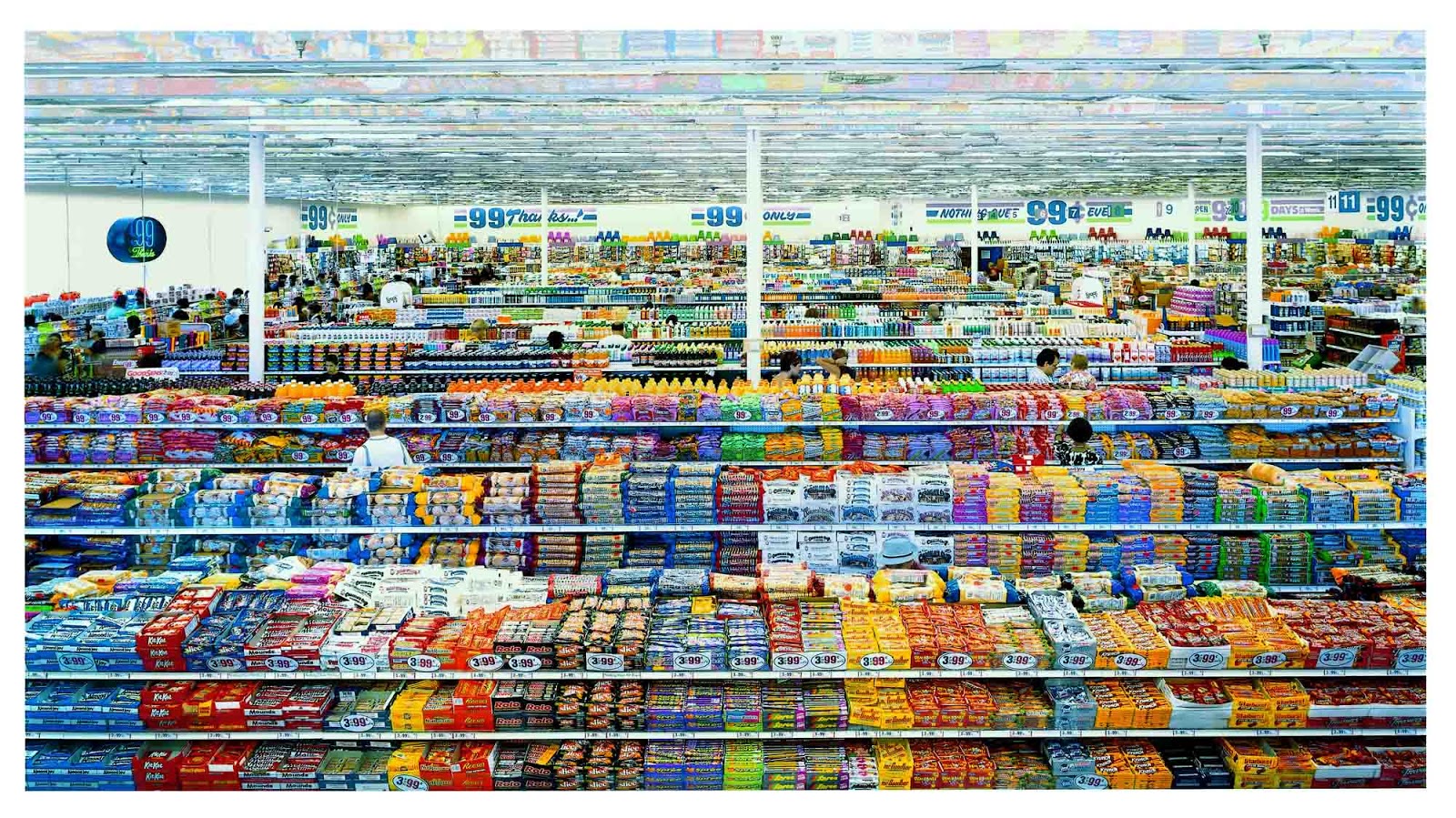
Look at Andreas Gursky’s 99 Cent. Let your eye travel along those shelves. Notice the grid, the symmetry, the way the ceiling mirrors the shelves and the whole frame vibrates with the same repetitive energy. Now notice that you are being watched. The image is watching you look at it. It knows what it is doing.
Certain photographs give you a feeling of truth. Some pictures feel true because they caught something that was happening. Famous photojournalism photographs fall in that category (Phan Thi Kim Phuc’s photo for example). Others feel true because they noticed something ordinary and pointed at it, saying it mattered. For example Walker Evans, Roadside Stand near Birmingham, Alabama, 1936. Simple, but shows the reality of life at a point in history and plays as social commentary. Others feel true in a third sense: true the way a document feels true, as though someone held up a camera and let the world print itself.
That feeling is the deadpan trick. And it is interesting to understand how the trick works, because it shows you how photographs get under your guard.
The deadpan style borrows the visual language of the survey, the scientific record, the architectural typology. Frame square to the subject. Light even and flat. Everything equally in focus, equally important. The message is: there was no editor. The photographer stepped aside. You are seeing what was there.
But of course Gursky, one of the most important recent members of the movement, composed 99 Cent. He chose the angle, the lens, the moment, the crop, the colour grade. The image is even mot likely a composite (we’d call it a stitched panorama today). The whole thing is built to make you forget anyone built it. What’s different in that photograph isn’t that he made choices, because everyone makes choices when they hold a camera. It’s that the style is built to hide the fact that choices were made. A form of artifice that presents as the absence of artifice.
The usual critique is obvious here: deadpan isn’t neutral. It can’t be. Every photograph selects. Calling a style objective when it is anything but is naive, or dishonest, or both.
That critique is true, of course, but it’s not what’s interesting about deadpan: neutrality is a performance, so what? The interesting thing is that you can see the performance happening. Look at 99 Cent and you know, somewhere under the surface, that this is not how a store really looks. It is too clean, too ordered, closer to a diagram of a store than a photograph of one. The pleasure of looking at that photograph lives in that space. You know the trick and you let it work anyway.
This is the form’s real operation. Deadpan does not convince you it is neutral. It performs neutrality in a way that lets you enjoy both the performance and your awareness of it. You are in on the joke. The image says it didn’t choose, and you know it chose, and both of you agree to pretend otherwise because the pretence produces something valuable: attention. By stripping away the obvious markers of authorship, the deadpan photograph hands the interpretive work to you. I will not tell you what this means, it says. You decide. A gift, or a challenge, or a cop-out, depending on what is in the frame.
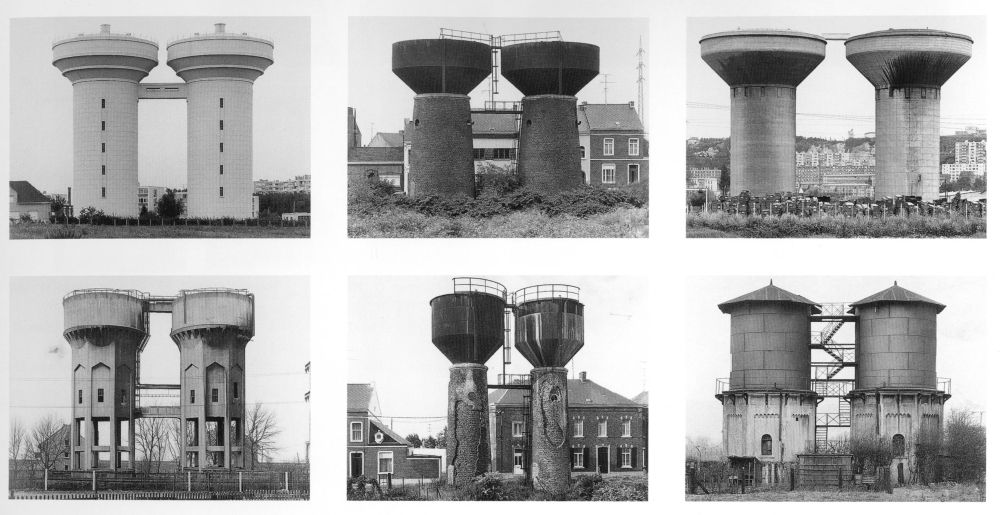
The Bechers understood this better than anyone. Their grids of water towers and blast furnaces look like the most objective photographs ever made. Straight on. Grey sky. No people. Same framing, same distance, same conditions. Arranged as a grid they present as data. As though the photographers were botanists collecting specimens of an industrial species on the verge of extinction.
Watch what the grid does to your attention. You stop seeing one water tower and start seeing the differences between them. Your eye jumps from one frame to the other in a loop playing the differences game. The curve of this one’s legs against the straight lines of that one’s struts. The tapered neck here, the blunt top there. The Bechers taught you a way of looking. The method was: look closely. Compare. Notice what changes when nothing else does. That is editorial, but the kind of editorial that expands what you can see rather than narrowing it.
Deadpan works best on subjects that can hold that weight. Industrial architecture. Corporate interiors. Strip malls. The grid of consumer goods on a shelf. Things that are already saying something about how we organise our world. The deadpan frame amplifies that structure. It says: this is a system. Look at it as a system. Decide what you think.
The thing that bothered me when I was looking at these photos is what happens when the subject can’t hold that weight. What does deadpan do when it meets something that demands a response?
Think about photographs of prisons, border infrastructure, industrial farms. Subjects where I will not tell you what this means starts to sound less like a gift and more like an abdication. A deadpan image of a detention centre is, formally, no different from a deadpan image of a power plant. The framing would be straight, the light even, the refusal to editorialise the same. But that refusal means something different when the subject is a place where people are held and suffer. It starts to look like complicity. The photographer chose the wrong thing to have no opinion about.
This is where the pretence turns into something harder to enjoy. The style’s claim that it leaves judgment to the viewer is easy to accept when the subject is a 99-cent store. Harder to accept when it is a border wall and you want the image to take a side. The formal operation is identical. The stakes change what it means.
I don’t think this completely breaks the deadpan approach. It shows the limits of the game. When the subject is low-stakes, you enjoy the performance of neutrality. You admire the craft. When the subject is high-stakes, the performance stops being playful. The image’s refusal to choose becomes a choice, and you feel the weight of that choice; it starts to feel inappropriate.
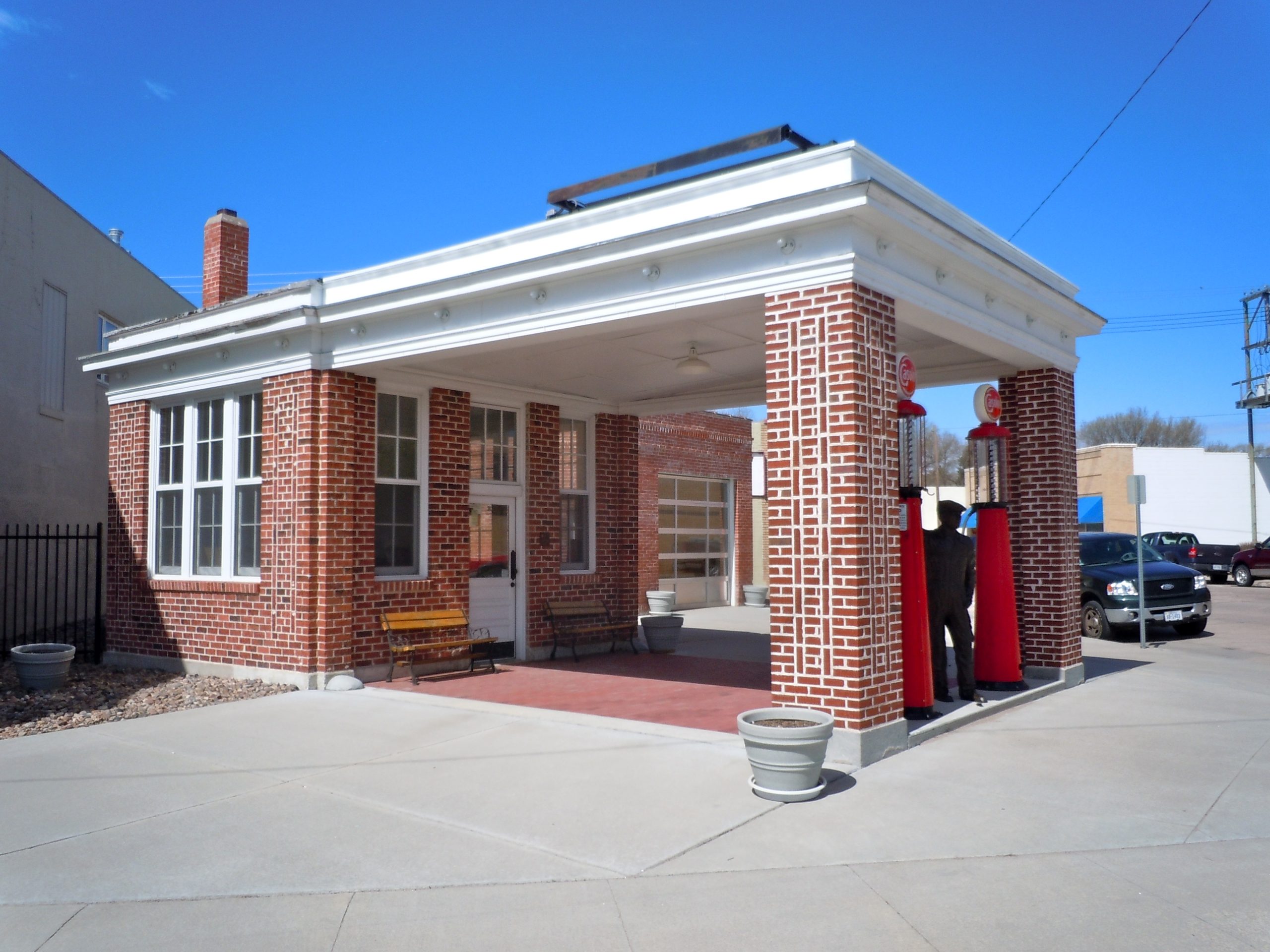
After all this, I came to this decision regarding what deadpan really is: the photographs don’t actually pretend to be neutral. They put on a performance of pretending. The whole machinery is on display so you can see it and decide what to do with it. The best deadpan images are the ones where you catch the photographer in the act of pretending not to act. Gursky arranging his shelves. The Bechers curating their grids. The empty street that someone waited an hour to capture. The theatre is visible. That visibility is the source of the form’s honesty, and also its limitation.
Deadpan tells the truth about the fact that a photograph can’t tell the truth. It lets you watch the mechanics of looking. You have to be willing to watch the mechanics instead of asking the picture to tell you what to see. For some subjects that is a reasonable request. For others it may be too much.
So the deadpan image doesn’t resolve its own contradiction. It lives inside it. That is what makes the form interesting. It is not a style that solved neutrality. It made the problem of neutrality visible and handed it to you. What you do with it depends on what is in the frame, and whether you are ready to do the looking yourself.
#Photography #IayBeWrong #Opinion #Deadpan #DeadpanPhotography