
My quest through deadpan photography and New Topographics has led me to discovering a photographer that kind of lives at the intersection: Lars Tunbjörk.
I’ve spent a worrying fraction of my life inside offices. When you work as a university researcher or as a software developer, that’s pretty much all you know. Fluorescent tubes, carpet tiles, the smell of someone else’s lunch reheated in a shared microwave (ewww! I remember particularly nasty fishy leftovers).
You rarely photograph your own office: you complain about it, pin things to the partition, count the meetings that could have been emails (hint: that’s most of them). The room becomes the background and nobody cares about the background. It’s just where you happen to be, which is probably why so few serious photographers ever bothered with it.
Either I’m an exception, or I’m not a serious photographer (the jury is out on that one). I have taken photos of all my offices over time, sometimes because something was happening (e.g. office move), sometimes for no reason, just because for me it was pretty much home. I used to work until very late and I knew all the night staff and the cleaners by name.
Lars Tunbjörk did as well. Hence the affinity I felt with him when I discovered him. For five years, between 1994 and 1999, he went through offices in Stockholm, New York and Tokyo, with the occasional stop in a smaller Swedish city such as Gothenburg. The book that came out of it, titled Office, was first published in 2001 by Journal/Max Ström as a limited edition. It sold out quickly and stayed out of print for more than twenty years, an unfortunate fate for one of the best records we have of how work actually looked at the end of the twentieth century.
The project nearly didn’t happen. In 1997 Tunbjörk was on assignment for the New York Times Magazine, sent to photograph offices; the magazine’s photo director, Kathy Ryan, was a close friend. Greger Ulf Nilson, the Swedish designer who worked with him for decades, remembers what actually tipped him in. “He was on assignment for The New York Times… and he just saw this building with these empty offices”. Tunbjörk had spent his working life until then learning to look at unremarkable places, which is what made the empty building something to look into.
He picked up a camera as a teenager working for a daily paper in Borås and later travelled the world as a press photographer with Agence VU’, shooting for the New York Times Magazine, Time, GEO and Liberation. In the palette you can feel William Eggleston, who made American colour respectable, and in the deadpan composure something of Christer Strömholm, the great Swedish black-and-white photographer; both were early influences on him. Along the way he collected the Swedish Press Photographers Club’s Photographer of the Year award and First Prize at World Press Photo.
His breakthrough came in 1993 with Landet utom sig, known in English as Country Beside Itself, a portrait of Sweden as supermarkets, theme parks and tourist sites that recorded, in the words of his biography at Moderna Museet, “the last death-throes of the Swedish welfare state”. Sweden didn’t enjoy having that mirror shown to it. “People were shocked by Country Beside Itself”, Nilson remembers, “they thought it was very cynical, ‘this is not the country that Sweden is’”. Except it was, it wasn’t cruelty.
In offices he found the perfect subject for that cold observation. He shot with harsh on-camera flash, which throws a hard little light into every corner and flattens depth, and saturated colour pushed until it’s almost garish. Tim Adams, writing in the Guardian, said: “Tunbjörk, who died in 2015, did not stage his pictures. He became a modern master of the padded cubicle and the strip light and the ergonomic swivel chair”. The results live somewhere between deadpan documentary and low horror (think backrooms creepypasta). Low angles push the ceilings down until they become a threat. Corridors stretch away without end. The palette is a muted wash of greys and off-whites. It doesn’t show places where anyone would want to be.
He photographed the office “like an alien” in the soulless, banal uniformity of these workplaces. His camera appears to ask what is going on, what are the rules, what are these places. The images don’t seem to make sense, but you know as the viewer that this is reality.
Tim Adams picked one picture, a lawyer’s office in New York shot in 1997, as the anchor of his big-picture essay on the republication, and once you’ve seen it you understand why. The published description says it all: small men wandering the office with cigars between their teeth, women in pearls surrounded by legal proofs under the office tables. It clearly wasn’t a paper-free office (TPS reports anyone?). It would be impossible today.
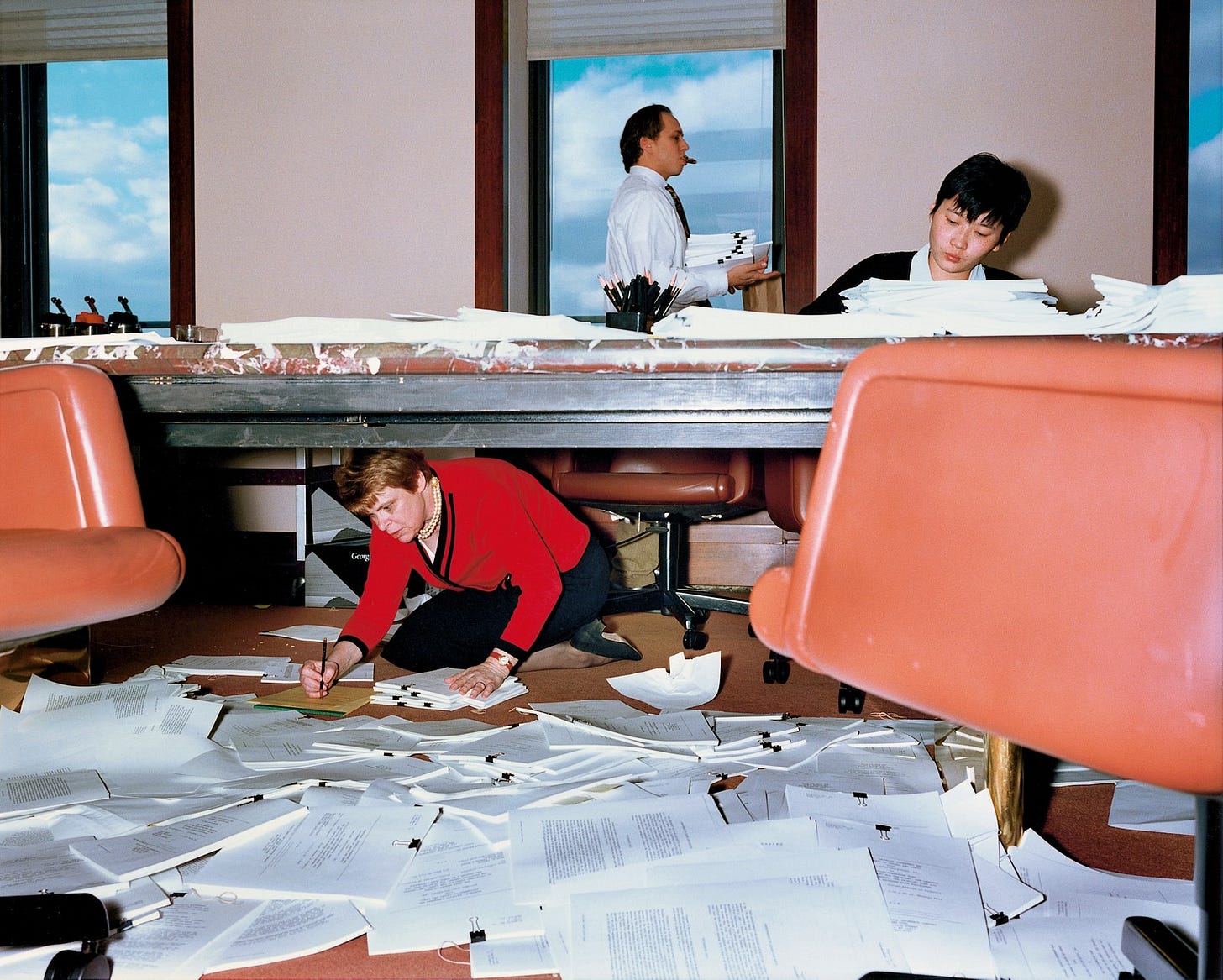
The picture freezes the office at the moment of transition, before its contents were replaced by screens and electronic devices. You don’t need to know what the job was. It’s a feeling you recognise if you worked through the 90s, one that Tim Adams put in a phrase: “enclosed, climate-controlled worlds in mortal jeopardy.”
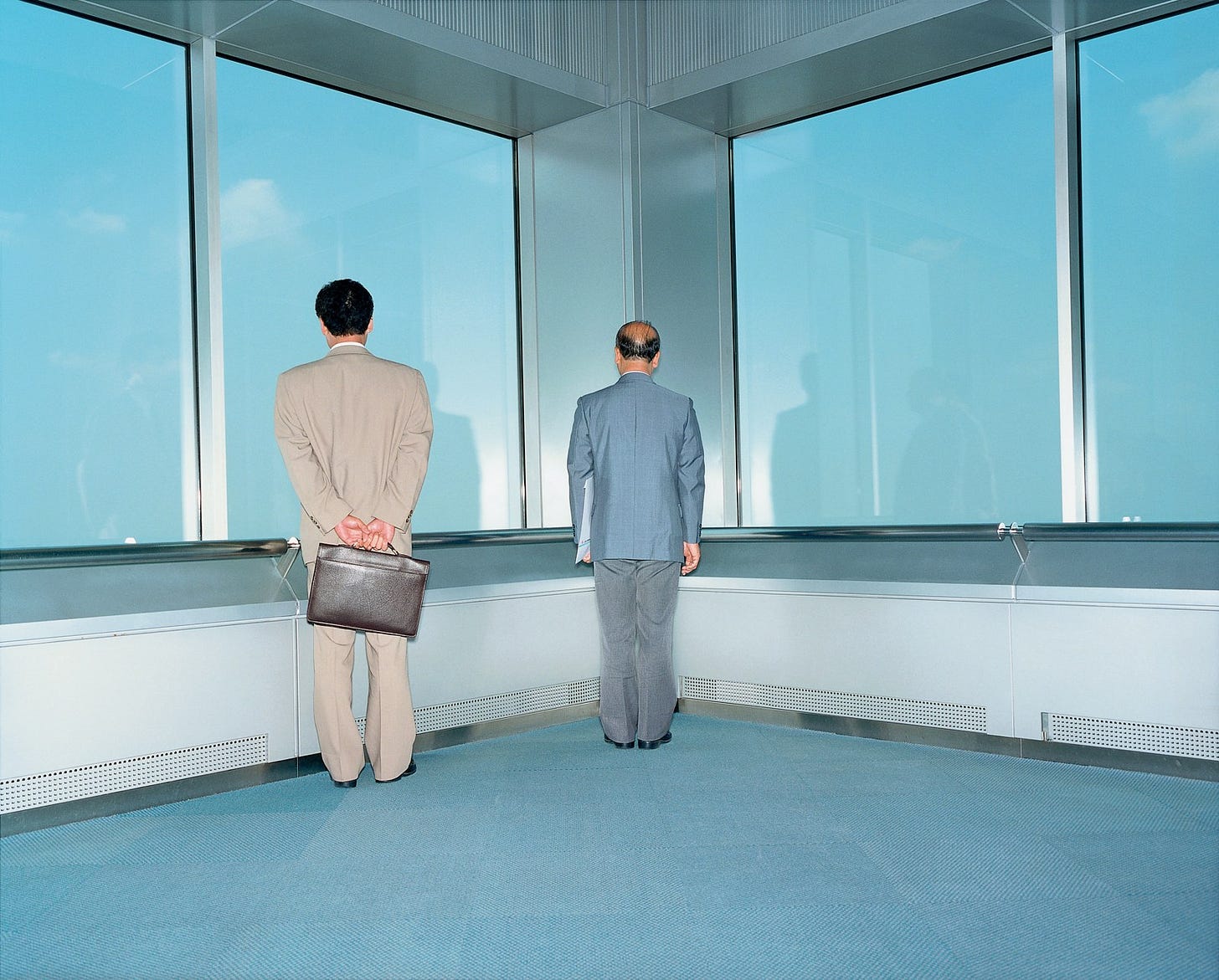
The stockbroker office in Tokyo, photographed in 1999, exists along the same lines. It’s part of the batch of Tokyo pictures that now looks like illustrations for an argument that arrived years after the film was exposed.
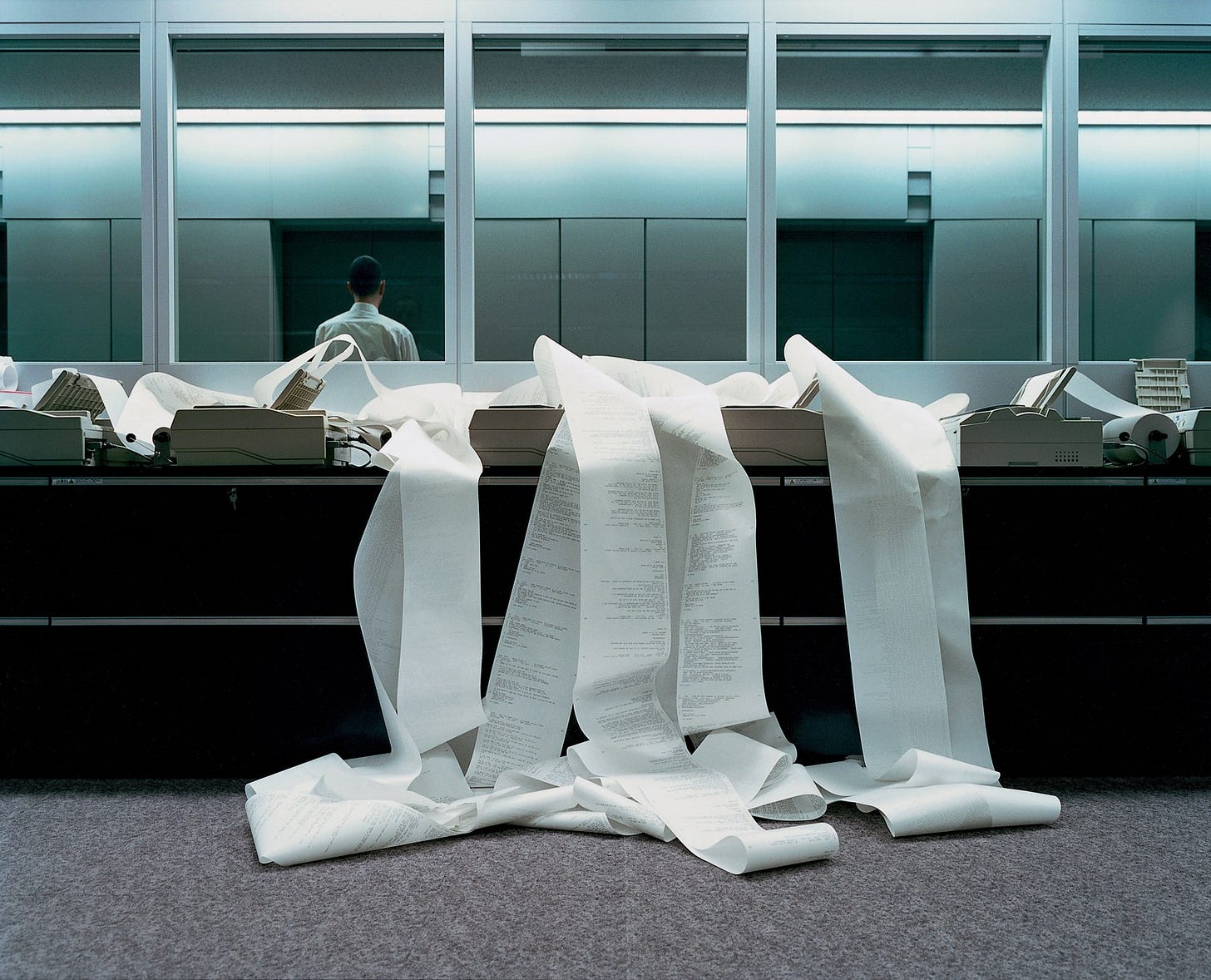
That argument came from an anthropologist. In his essay Bullshit Jobs, David Graeber claimed that “[h]uge swathes of people, in Europe and North America in particular, spend their entire working lives performing tasks they secretly believe do not really need to be performed”. “The moral and spiritual damage that comes from this situation”, he wrote, “is profound”. When Loose Joints reissued Office in 2024, they printed Graeber’s essay inside the book, introduced by lines from Bob Dylan’s “Ballad of a Thin Man”.
1999 gave the world Office Space and The Matrix, both fantasies about how working life this hateful could only end with a printer smashed in a field or a red pill swallowed. 2001 gave British television The Office, a sitcom constructed from the small (and arse clenching) bruising incidents of a paper merchant’s branch. Cal Newport, writing in the New Yorker about the reissue, said the photographs share many elements of the Office Space style and should “remind us that it didn’t have to be this way”.
Office wasn’t the first if its kind, and Nilson is careful to name its rare precursors when he talks about how unusual the project was. “It’s not very common that photographers go for that boring environment… There is a few, of course – Anna Fox did a book called Work Stations, then there is Lee Friedlander’s At Work. But just boring offices, not that many have documented that.” Anna Fox’s Work Stations came out of photographing offices around London in the Thatcher years; Lee Friedlander’s At Work documented American labour of every kind. Tunbjörk narrowed the subject to a single white-collar species and stayed there for five years. Hardly anyone else thought the banal room itself, with no event in it, deserved that kind of attention.
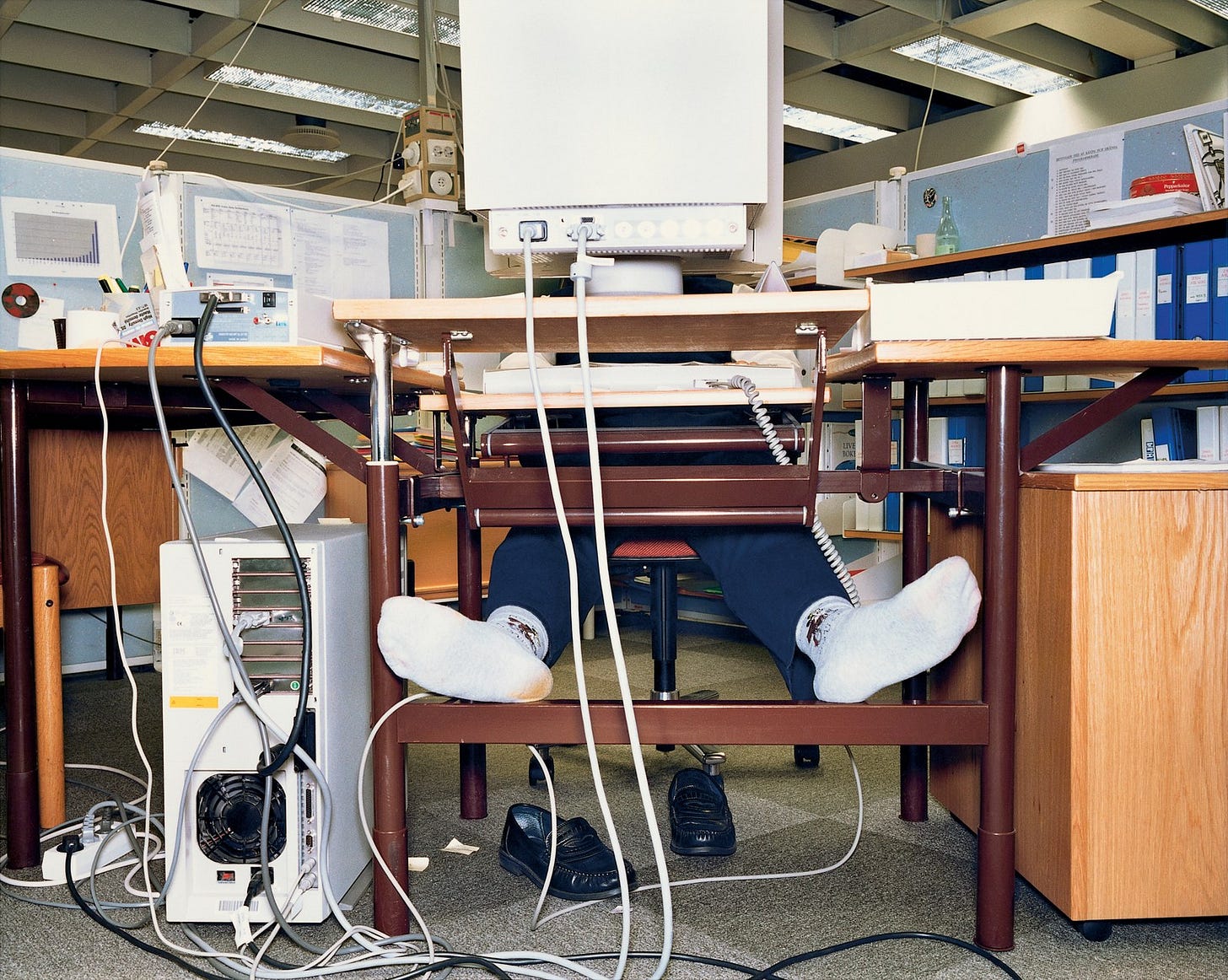
Take the car manufacturer’s office in Gothenburg, 1997. Nothing happens in it, which is the point. Tunbjörk called the office “the most common – but closed and secretive – place in the western world”. That photograph is completely everyday, white socks and all, but you will never be allowed inside.
The Tokyo municipal offices push the claustrophobia further. Low angles make the ceiling feel oppressively low, corridors seem to go on past reason, and the people in the middle of it all look less like masters of their environment than part of the furniture.
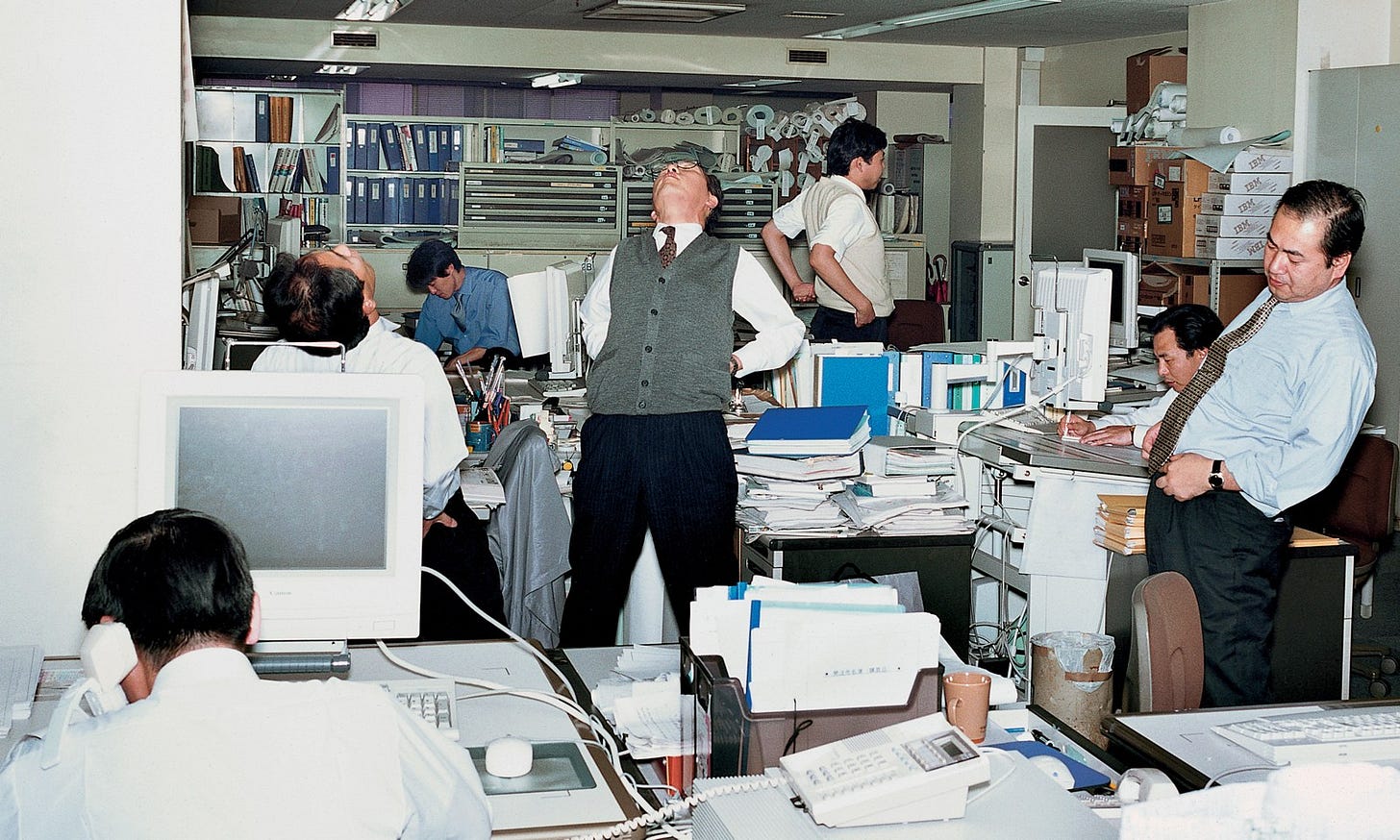
Creative Review described the book as “equal parts chaos, claustrophobia, and comedy”. Some of the photos indeed border on comedy. Probably unintentional. For example in the construction company in Tokyo, 1999, workers seem to be doing stretching exercises in a cramped office where files pile up floor to ceiling, and where desks swallow all the available floor space.
The book vanished from the shop shelves for two decades while the culture it documented became the norm, a nightmare, then a memory. The 2024 reissue from Loose Joints, produced with the Lars Tunbjörk Foundation, arrived as a two-volume set in a slipcase that Nilson designed to resemble office file storage, reworking his original 2001 design. Its second volume is where the story takes a strange turn.
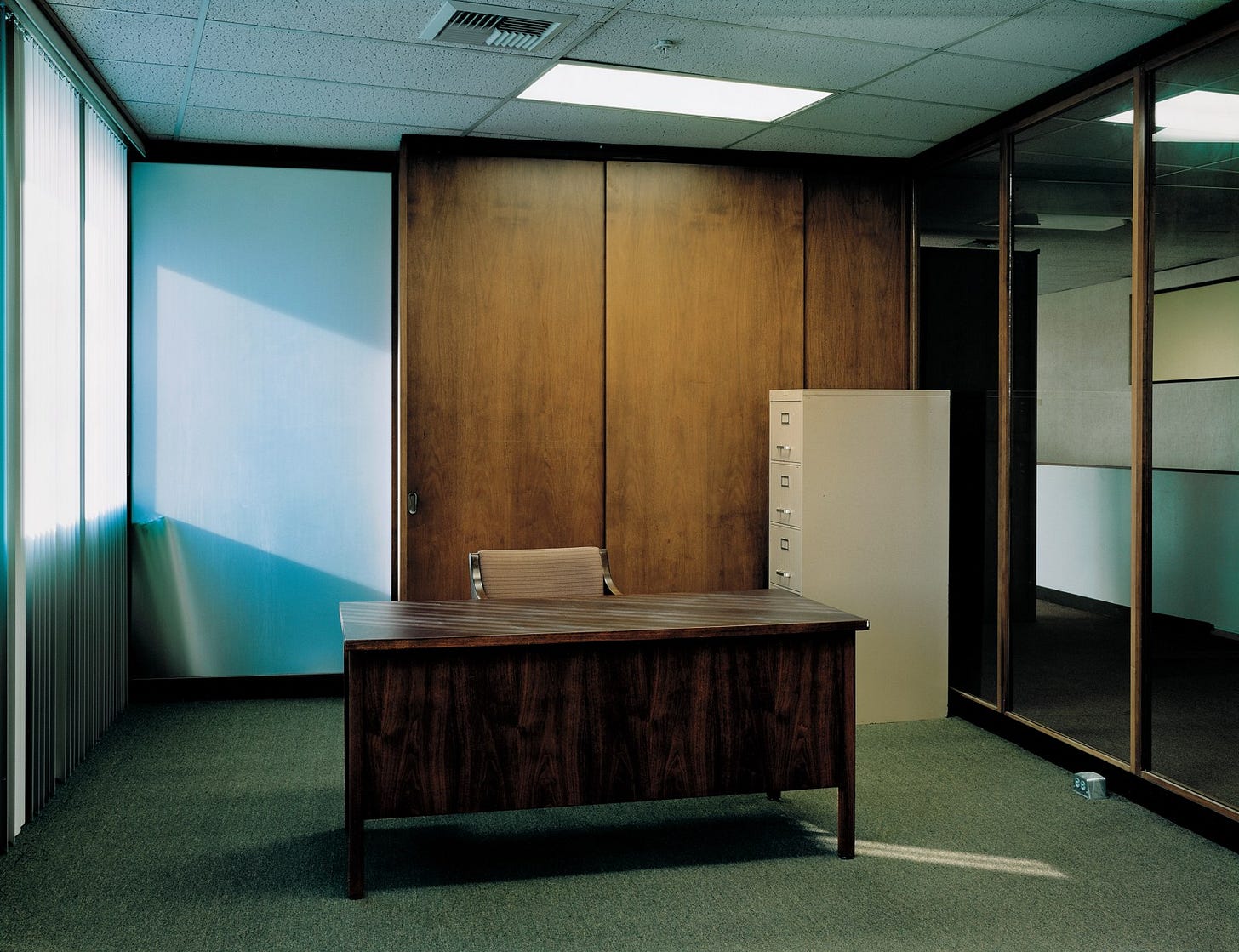
It’s called LA Office. Shot in 2004, it consists of just thirteen images of vacant offices in Los Angeles. No workers. Only rooms with chairs and desks, still arranged ready for occupancy, as if the tenants of the previous decade had mysteriously vanished. Office’s grey and brown colour schemes and labyrinths of partitioned walls have since given way, Creative Review noted, to “brighter, more open plan spaces”.
Tunbjörk died suddenly of a heart attack in 2015, at fifty-nine, so he never saw either volume published. He had created more than half a million negatives by then. The retrospective happened without him: in 2018 Fotografiska in Stockholm mounted a survey of his work under the title Tunbjörklandet – blicken från sidan, and his pictures are in the collections of Moderna Museet in Stockholm, the Maison Européenne de la Photographie in Paris, MoMA in New York, the Hasselblad Center and the Borås Konstmuseum.
Kathy Ryan, the editor who sent him to those first offices, wrote after his death: “The great thing about being an artist, a writer, a musician, is that you leave something behind. And Lars left something extraordinary behind”. She meant his whole body of work, but Office is the part that remains the most relevant, which is probably why Wallpaper, Creative Review, the Guardian and the New Yorker all covered the reissue in late 2024. At the Swedish embassy’s 2023 Washington exhibition, the cultural counsellor Helene Larsson Pousette described the photos as revealing “a deep fascination for people’s loneliness and longing for meaning”, and said many Swedes recognise themselves in them.
You can read Office as an indictment, and plenty of people do. Or you can read it as a weird love letter to environments most people hate. Nilson, who knew him better than almost anyone, is unambiguous: “He was absurd, but never cynical. He was very much in love with the people that he took photographs of. Of course, critical as well, but not cynical, which is a big difference”.
I might be over-reading it, but that distinction, critical but not cynical, is really what the whole project is about. Tunbjörk was interested in the people and how they fit in their environment. No matter what their office looks like, they’re still people, sometimes crushed by their environment as in the Tokyo construction company photograph. Cynicism would have flattened the people into furniture. Tunbjörk didn’t.
The empty rooms of LA Office make the same point from another point of view. A room full of desks and chairs, all in their places, with nobody expected to arrive. Photographed in 2004, it looks now more as a preview of something Tunbjörk couldn’t have seen coming: the office kept warm and staffed by no one, the worker relocated to another place we don’t see. Some argue about how much these pictures predicted the empty offices of the 2020s. The difference between a room waiting for people and a room that people have left is small in photographs and gigantic in life, and we all lived that life in the last few years. As in deadpan photography, interpretation is left to the viewer.
I left offices a good while back. I’ve been working from home for the last 16 years, and I don’t plan to return to one full time (there isn’t one near my anyway). When I look at Tunbjörk’s pictures now I feel no nostalgia and no smugness. It’s more something like to recognition: someone bothered to look properly at the room I spent years in, and refused to dehumanise the people living in them. The office was going to disappear in its current form, and he caught it right at the edge, at full brightness, with the flash on. Kathy Ryan was right that he left something behind. His gift were pictures of the most common room in the world, taken by someone who loved the people inside it.
Sources
- Lars Tunbjörk, biography: https://en.wikipedia.org/wiki/Lars_Tunbj%C3%B6rk
- Moderna Museet, Stockholm, biography of Lars Tunbjörk: https://www.modernamuseet.se/stockholm/en/exhibitions/lars-tunbjork/lars-tunbjork-biography/
- Loose Joints, Office and LA Office (2024 reissue): https://loosejoints.biz/products/office
- Wallpaper, “Circling back: Lars Tunbjörk’s uncanny office photography is revisited in a new book” (6 November 2024): https://www.wallpaper.com/art/photography/circling-back-lars-tunbjorks-uncanny-office-photography-is-revisited-in-a-new-book
- Creative Review, “Lars Tunbjörk’s Office” (29 October 2024): https://www.creativereview.co.uk/lars-tunbjork-office-photography-book/
- Tim Adams, “The big picture: Lars Tunbjörk” (The Guardian, 1 December 2024): https://www.theguardian.com/artanddesign/2024/dec/01/the-big-picture-lars-tunbjork-office-photography
- “Lars Tunbjörk: Office life in pictures” (The Guardian, 11 December 2024): https://www.theguardian.com/artanddesign/gallery/2024/dec/11/lars-tunbjork-office-life-in-pictures
- Cal Newport, “The frightening familiarity of late-nineties office photos” (The New Yorker, 23 October 2024): https://www.newyorker.com/culture/photo-booth/the-frightening-familiarity-of-late-nineties-office-photos
- Blind Magazine, “Lars Tunbjörk: a view from the side”: https://www.blind-magazine.com/news/lars-tunbjork-a-view-from-the-side/
- photoanthology.org, “Lars Tunbjörk: Office”: https://photoanthology.org/projects/office
#Photography #IMayBeWrong #LensOfTime #Tunbjörk #PhotographerFocus