
One common advice to novice street photographers is to photograph the same area, near home, over and over again. That would allow them to know the place intimately and develop their skills in a familiar environment without relying on the extraordinary for interest. Of course, this leads to boredom with the place.
That boredom is what happens when a place stops being scenery and becomes what it actually is: buildings, streets, cars, everyday stuff. Following my Deadpan photography deep dive, I recognise the motivation behind a show that opened in Rochester, New York, in the autumn of 1975, even though almost nobody at the time knew what to do with it.
The show was called New Topographics: Photographs of a Man-Altered Landscape), and it ran from October 1975 to February 1976 at the International Museum of Photography at the George Eastman House. William Jenkins, the assistant curator of 20th-century photography, organised it in consultation with Joe Deal, then the museum’s exhibitions manager. Ten participants: Robert Adams, Lewis Baltz, Bernd and Hilla Becher, Joe Deal, Frank Gohlke, Nicholas Nixon, John Schott, Stephen Shore and Henry Wessel Jr. Eight young American photographers plus the German couple, the only non-Americans in the room. 168 photographs of parking lots, suburban tract homes, industrial parks, motels, downtown buildings, grain elevators and coal mines, rarely with any people in them.
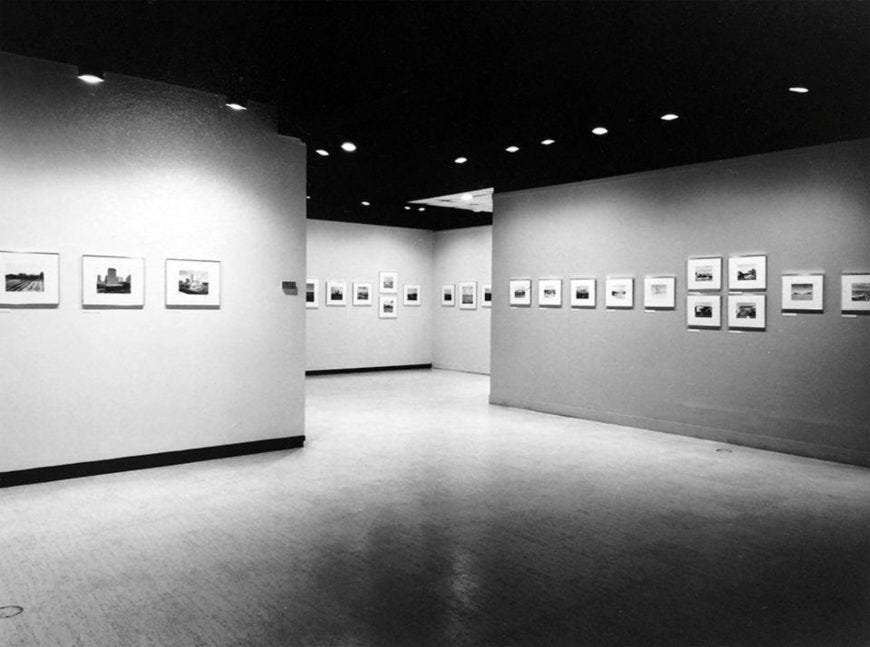
Adams was out in suburban Colorado where the tract houses were spreading, Baltz in the new industrial parks of Southern California, Schott on Route 66 with its motels, Nixon in downtown Boston, Gohlke with the grain elevators, Deal with the suburbs going up around Albuquerque, Wessel with the everyday West, and Shore with ordinary American streets.
About half the photographers used 8×10 view cameras and printed at roughly the same size. Deal and Gohlke worked in square medium format. Baltz and Wessel shot 35 mm. The Bechers printed at the European standard of 30×40 cm. And in 1975 colour was still considered commercial rather than serious art, so Stephen Shore worked in colour alone.
Jenkins’s catalogue introduction set the scene. The pictures were “neutral”, he wrote, “reduced to an essentially topographic state, conveying substantial amounts of visual information but eschewing entirely the aspects of beauty, emotion, and opinion”. But the common thread was “a problem of style”, a “stylistic anonymity” that amounted to an apparent absence of style. He framed the show as documentary rather than polemical, “more anthropological than critical, scientific rather than artistic”. Photography’s real gift, he argued, was “its ability to describe something accurately and in detail”, and that meant the photographers had to get out of their own way: “they must not allow personal inflection or opinion to stand in its way”. Jenkins was asking, in effect, whether it was possible to make pictures without style. All ten of them had a go.
The idea had a clear lineage, and Jenkins was open about it. He took the title and its disengaged attitude from Ed Ruscha’s self-published photobooks: Twentysix Gasoline Stations (1963), Various Small Fires (1964), Thirtyfour Parking Lots (1967), deadpan, styleless treatments of mundane subjects. Ruscha wasn’t in the show, but his books were its patron saints. Behind Ruscha stood Eugène Atget and Walker Evans, both of whom had recorded the built vernacular landscape, and behind the Bechers stood the German New Objectivity of August Sander and Albert Renger-Patzsch. From the late 1950s the Bechers had photographed disused industrial structures across Europe and America, presenting series they called “typologies”, often in grids under the heading “Anonymous Sculptures”. And the word “topography” itself was chosen deliberately, to reach back to the 19th-century survey photographers Timothy O’Sullivan and William Henry Jackson, who documented the federal expeditions opening the West. Topography means mapping. It doesn’t mean romance. That one word explains the whole approach.
It’s easy to misremember them as drab. They’re not.
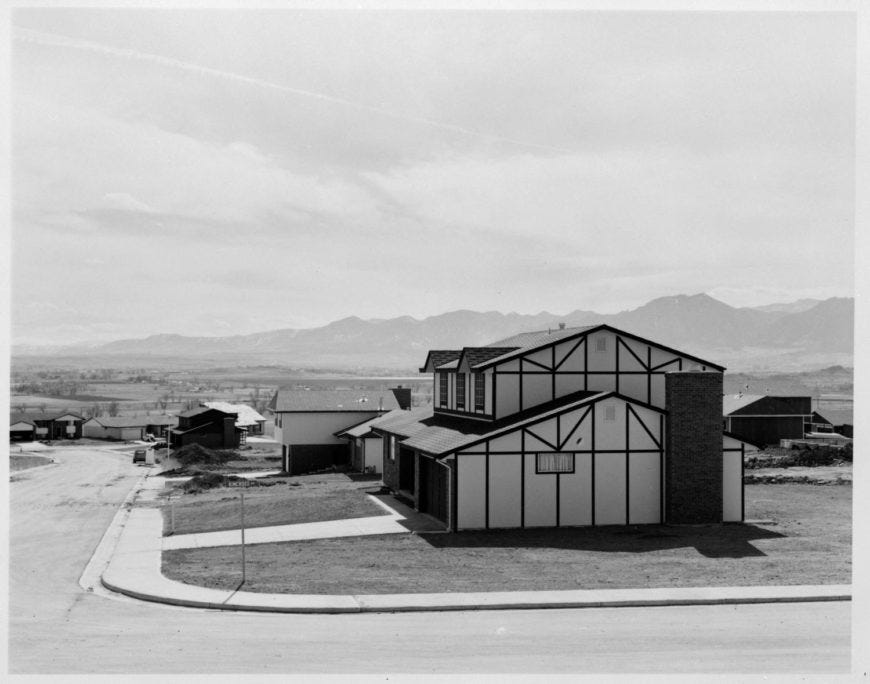
Look at Robert Adams’s Tract House, Boulder County, Colorado, 1973. A new house in a raw yard, fake half-timbering, a hard noon shadow thrown straight down. Ordinary daylight, the kind you normally avoid. The picture gives you everything and nothing, and the longer you look, the more you see: the builder’s haste, the optimism, the emptiness.
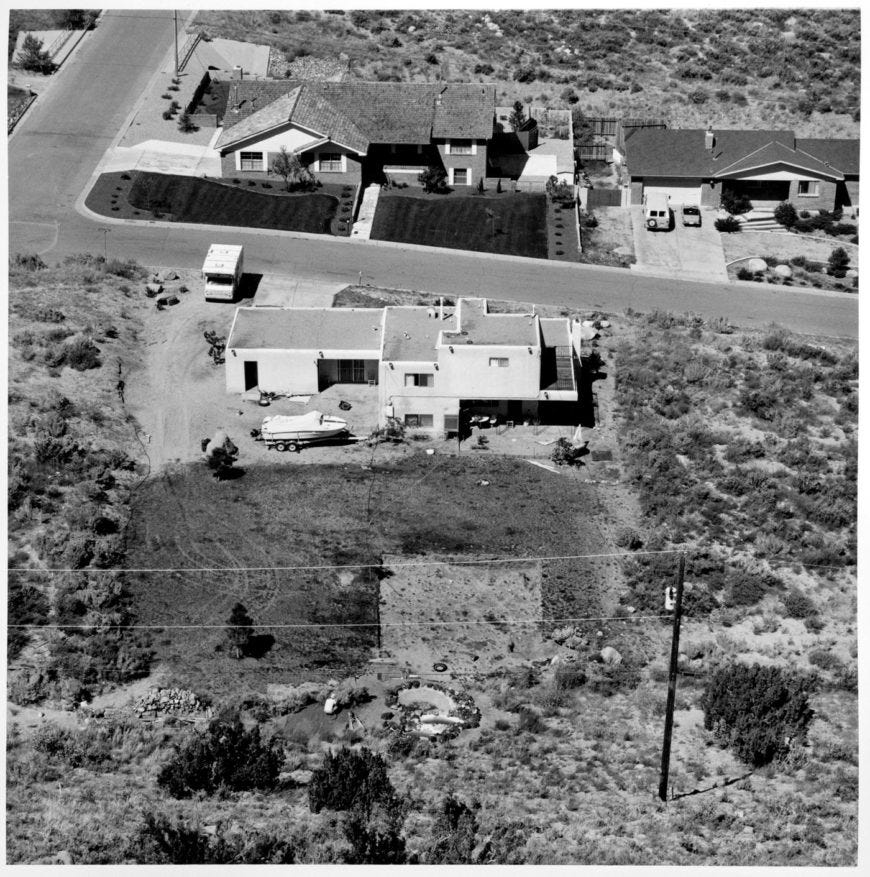
Joe Deal’s Untitled View (Albuquerque), 1974 is square, and the horizon is gone. Deal shot downwards, tilting the ground up until the houses and streets lie flat on the frame like features on a topographical map. Nearly like builder’s models.
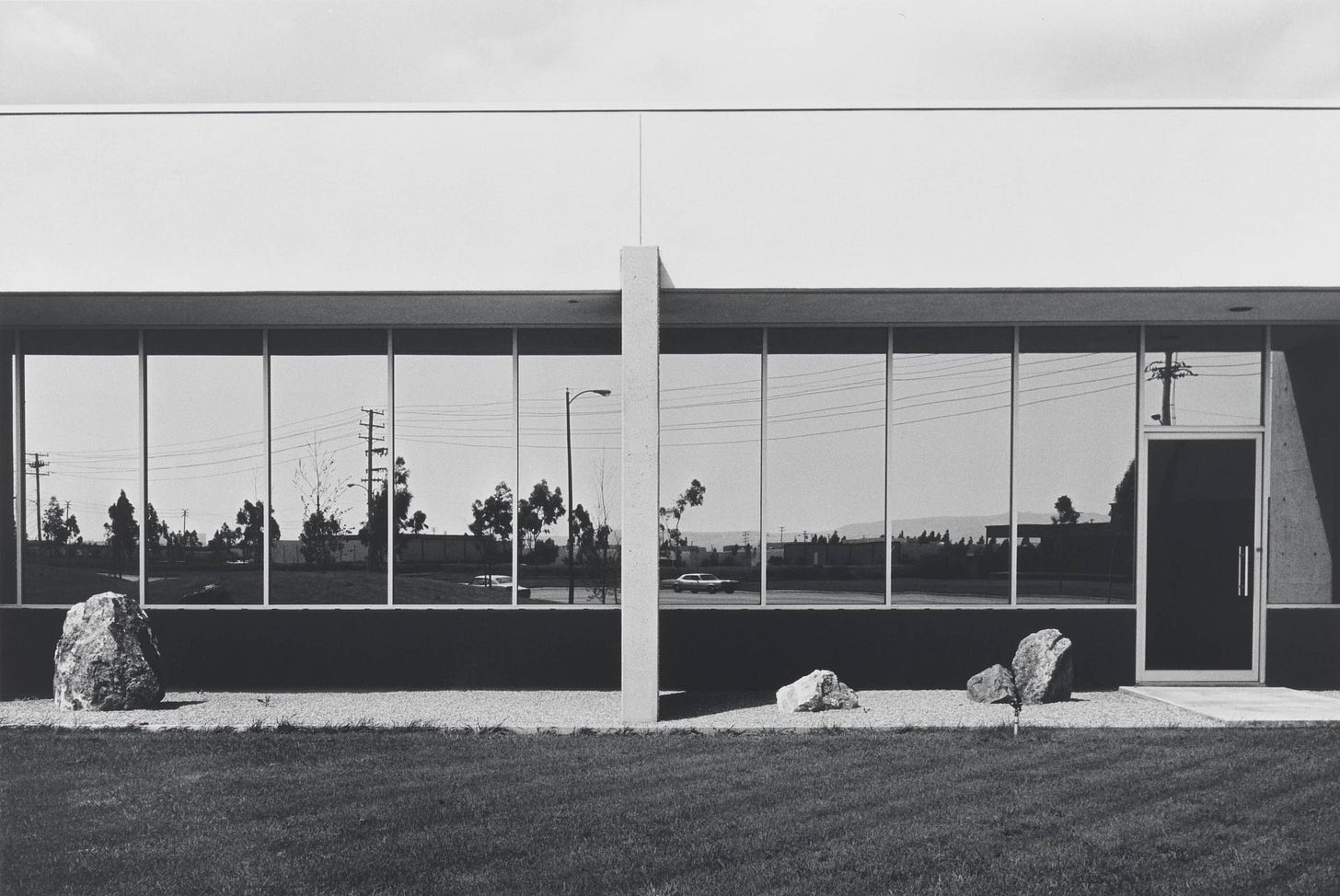
Lewis Baltz’s South Wall, Mazda Motors, 2121 East Main Street, Irvine is a blank corporate wall with a name on it, shot on 35 mm Kodak Technical Pan, a slow, fine-grained film that he enlarged to 8×10 paper. No people, no story. The title is the only thing that tells us anything.
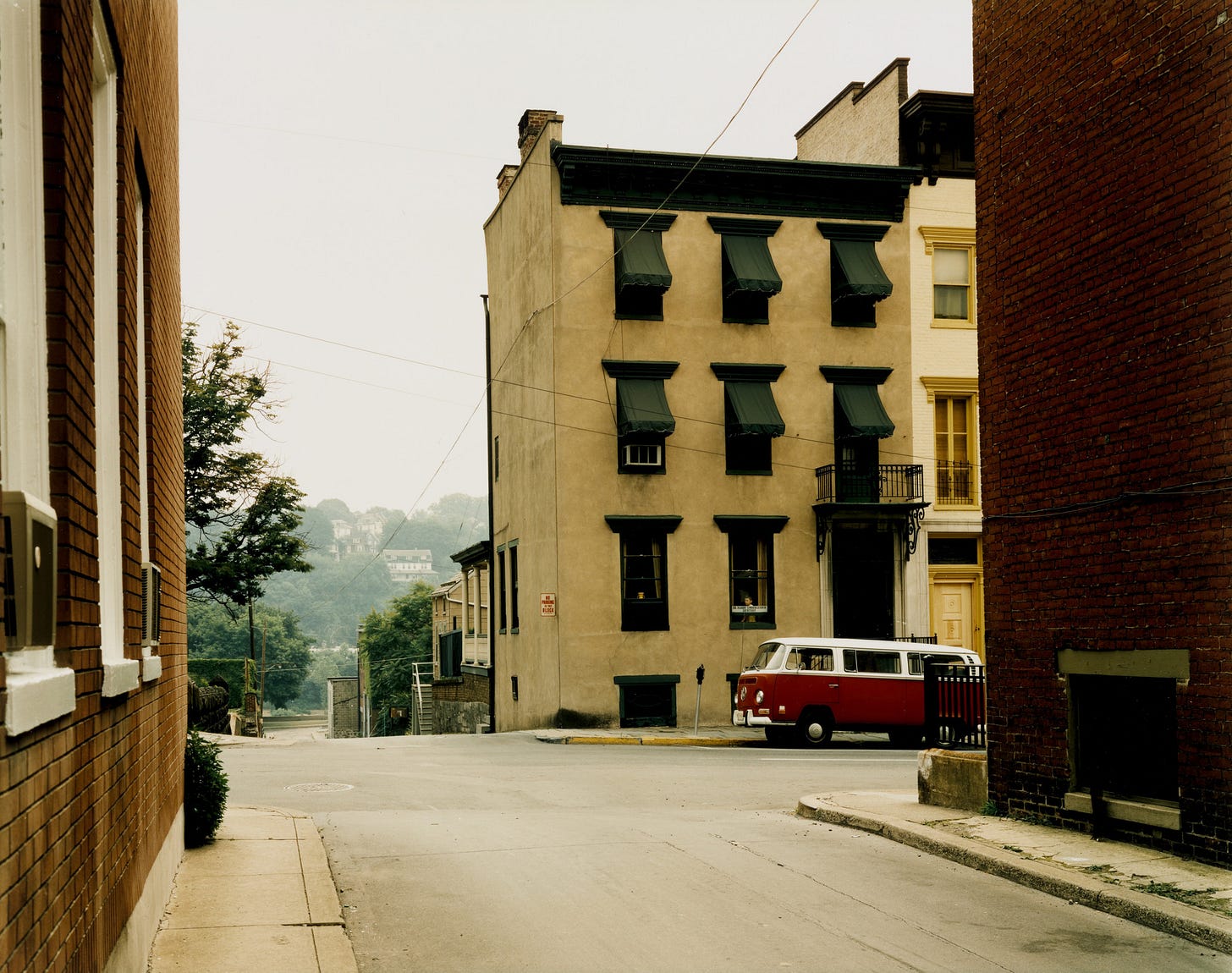
Stephen Shore’s Church and 2nd Streets, Easton, Pennsylvania, June 20, 1974 is the colour one, flat and even, the date in the title like an entry in a surveyor’s log.
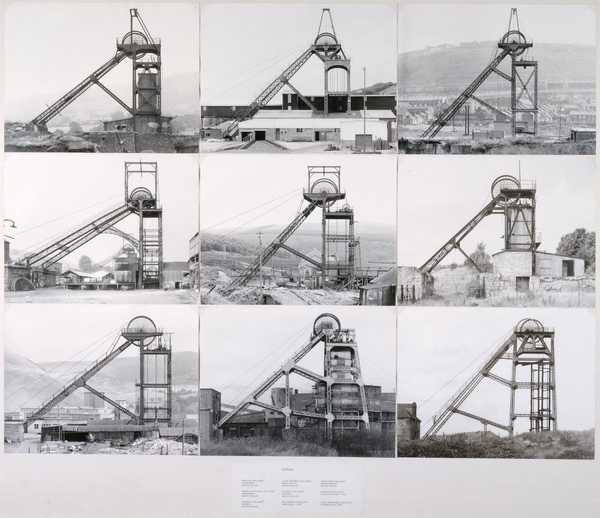
And the Bechers’ Pitheads, 1974 is a grid of anonymous mine heads, each one a specimen, closer to a herbarium than a gallery wall.
The reception was lukewarm and divided. Frank Gohlke recalled to the LA Times: “What I remember most clearly was that nobody liked it… I think it wouldn’t be too strong to say that it was a vigorously hated show”. Bess Abel, a photography student of Joe Deal’s, recorded visitors on 13 and 14 December 1975, and the tapes, which survive in the Joe Deal Archive at the Center for Creative Photography, read like a focus group for a product that puzzled everyone. One visitor said: “I don’t like them, they’re dull and flat. There’s no people, no involvement, nothing”. Another: “At first it’s stark nothing, but then you look at it, and it’s just about the way things are”. A third said they didn’t like to think there were ugly streets in America, but that when it’s shown to you without beautification, maybe it tells you how much more we need here. The Guardian tells a version of the same story with a truck in it: a visitor at the original show found his own truck in one of Adams’s photographs. “At first they’re really stark nothing, but then you really look at them and it’s just the way things are. This is interesting, it really is”.
One 1975 review stood out, at least in retrospect: Robert Woolard in Artweek called the show “very important” and its ideas “vital and fundamental”. The photographers themselves were more cautious. Several were uneasy with the “New Topographics” label, and some critics contested the “neutral” description, reading implicit social and political meaning into pictures that claimed to have none. That argument, deadpan record versus environmental indictment, was already around.
The reputation built slowly, through the 1980s and 1990s. By 1990 Andy Grundberg was reviewing a landscape exhibition in the New York Times and treating New Topographics as an established point of reference. The Eastman House’s own press release for the 2009 restaging calls it “the second most-cited photography exhibition in the history of the medium”. Britt Salvesen, who co-organised that restaging, put the claim thus: “Arguably the last traditionally photographic style, New Topographics was also the first photoconceptual style”. The show, she wrote, occurred “just as photography ceased to be an isolated, self-defined practice and took its place within the contemporary art world”. From 1976 the Bechers taught at the Kunstakademie Düsseldorf, and their students, Andreas Gursky, Candida Höfer, Thomas Ruff and Thomas Struth, became the Düsseldorf School, the detached, deadpan aesthetic that Charlotte Cotton identified as the most prominent photographic style since the 1990s.
The systems reading came with the reputation. Critics like Andy Grundberg, Deborah Bright and Greg Foster-Rice linked the work to Minimalism and to the conceptual and serial art of the 1960s and 70s: serial sequences over single images, plain arrangement, each picture a representative of a larger system. Adams’s The New West, first published in 1974 by Colorado Associated University Press with a foreword by John Szarkowski, works exactly that way, a serial progression across the Colorado Front Range in which no single photograph dominates. Gohlke’s frame is deliberately passive. And Jenkins hung the show in identical frames with grids, four Adams prints grouped like a Becher grid. Foster-Rice would later co-edit the essay collection Reframing the New Topographics (2010).
There was something structural underneath it all too. Most of these photographers had studied in university programmes, and many of them taught, a break from the craft-trained generations before them. Ansel Adams had set up the first university photography department at the California School of Fine Arts in 1946, passing it to Minor White, and by the 1970s the academy was producing photographers who thought in series. The 1975 catalogue cost $6.95. By 2009 the same catalogue sold at rare-book sales for upwards of $1,000. And in 2009 the show itself went back on the road: the Center for Creative Photography and the George Eastman House co-organised a tour of more than 100 works from the original show, from Rochester to LACMA to Tucson to SFMOMA and on to Linz, Cologne, Paris, Rotterdam and Bilbao, with a Steidl catalogue and essays by Salvesen and Nordström. LACMA’s presentation added context artists: O’Sullivan, Evans and Ruscha, Robert Smithson’s Instamatic snapshots, Dan Graham’s Homes for America, and the ode to the “ugly and ordinary” that is Learning from Las Vegas. There had been an earlier, reduced restaging as well, at the Arnolfini in Bristol in 1981, under the auspices of Paul Graham and Jem Southam. The second time round, nobody hated it.
But there’s a complication. Salvesen and Nordström also warned that the show has been “misconstrued and to some degree mythologized”. The pictures aren’t all from the West, and not all of them are about suburban sprawl. And the exhibition was never intended as an environmental statement; the ecological reading came later, in their account. It stuck for a reason, though. The pictures really did show the tract houses spreading across the suburbs, the new industrial parks, the grain elevators and the coal mines. And that understanding came later, but it didn’t come from nowhere. They never considered themselves a school or a movement. Nordström put it as: “Of those who did see the exhibition, few seem to have thought themselves in the presence of a turning point; paradigm shifts are rarely recognized except in retrospect”. The turning point was made later, by history, by the market, by hindsight.
Jenkins told them to keep their own inflection out of the frame, and I think those photographers would have understood boredom: it’s the same discipline, seen from the other side. Boredom is what I feel when I’ve stopped being impressed and started actually looking. Salvesen called New Topographics the last traditionally photographic style and the first photoconceptual one, but whatever you call the style, what survived the mythologising is a permission. Permission to photograph the ordinary without apologising for it, to trust that the looking itself is the subject. The pictures won the argument eventually, though it took a couple of decades for anyone to notice. Boring is where the looking starts.
#Photography #NewTopographics #IMayBeWrong #Opinion