
Capa was on Omaha Beach under fire on the morning of D-Day, the 6th June 1944, putting himself in danger to make images that he thought were important. He pushed the shutter on his Contax II rangefinder ten times, maybe eleven. Those frames became the iconic photographic record of D-Day through which we imagine the landing. The story of how they got there, and the story that’s been told about them ever since, is more complicated than you think.
To be clear, none of what follows in this post diminishes Capa’s heroism. His actions were brave beyond comprehension and they became history. This is about a myth that grew around those ten frames, how it was discovered, and how it was never necessary in the first place.
The truth is always more interesting.
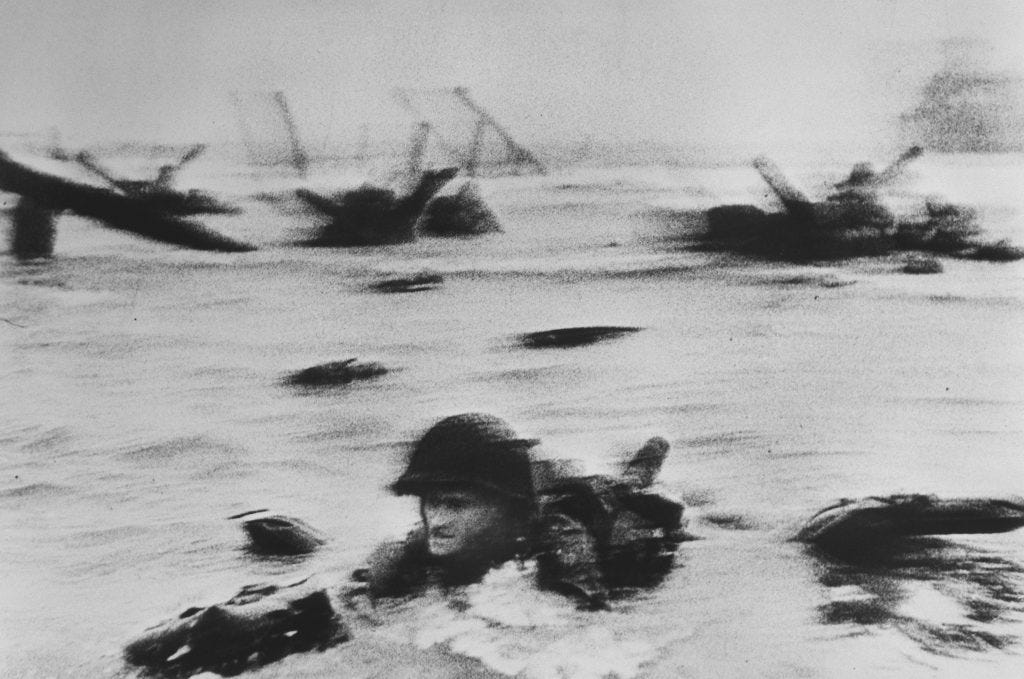
The investigation that blew up the Capa D-Day myth was led by the photography critic and historian A. D. Coleman and his team, which included the Pulitzer Prize-winning photojournalist J. Ross Baughman who’d himself seen combat. Both found the standard story suspicious and decided to get to the bottom of it. Between 2014 and 2019, they worked at systematically taking apart the narrative that had been repeated as fact for seventy years.
Let’s start with the official timing because that’s what is the easiest to check against army records. According to the standard story, Capa landed in the first wave at 06:30 and spent ninety minutes on the beach. But the US Coast Guard history of the Omaha Beach assault says different: their records show the LCVPs carrying the 16th Infantry Regiment left the USS Samuel Chase in several waves. Capa was with the command group of Colonel George Taylor’s Company E, part of the thirteenth wave. They arrived at the Easy Red sector at 08:15, a full hour and forty-five minutes after the first assault wave arrived on the beach and thirty minutes after the last of the regiment’s nine rifle companies had made it to shore.
Colonel Taylor was the man who famously on seeing his men stuck on the beach, walked the shoreline shouting: “Two kinds of people are staying on this beach. The dead and those who are going to die. Now let’s get the hell out of here”. Capa travelled with that man.
The first wave had taken the worst of it from 06:30. By 08:15, the German defensive positions WN-62 and WN-64 were still active. There is no doubt that the carnage was still ongoing. But the engineers of the 5th Engineer Special Brigade had begun clearing paths through the beach obstacles for the waves that came behind them. The situation was still nightmarish and soldiers were still dying, but the unimaginable horror of the first thirty minutes, when the assault crafts were being shredded by machineguns and men were drowning under the weight of their equipment, had passed.
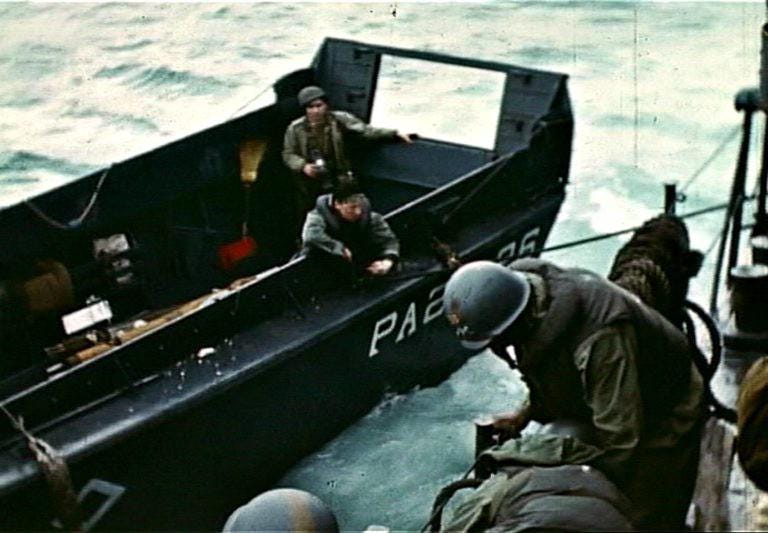
Next, how long was Capa actually on the beach is also part of the legend. It says ninety minutes, but once again the evidence suggests fifteen to thirty minutes at most. He boarded LCI(L)-94, which departed around 09:00. David T. Ruley, a Coast Guard cinematographer, was on that same vessel, and his colour footage shows Capa photographing casualty transfers on his way back.
Now, the contents of the images also needs to be looked at. The claim that the engineers in Capa’s photographs were terrified riflemen taking cover was made by LIFE’s editors. Capa never provided caption notes for his D-Day photos. The editors guessed wrong or made up a good story better for sales. In reality, the soldiers in those frames are members of Combined Demolitions Unit 10, a Gap Assault Team composed of Naval Combat Demolition Unit and Army Engineer Special Task Force personnel. Their insignias, identified by Coleman and Herrick cross-referencing with US Army Engineer records, show them as engineers in charge of blowing up beach obstacles. These engineers suffered the highest casualty rate of any class of troops on Omaha Beach. For seventy years, the story turned the most dangerous job on the beach into a story about frightened riflemen hiding behind obstacles; that’s unfair to them. The men behind the hedgehogs were the ones who’d been sent to blow up those hedgehogs.
So if Capa was there later, stayed less long, and photographed engineers instead of infantrymen, what about the pictures themselves?
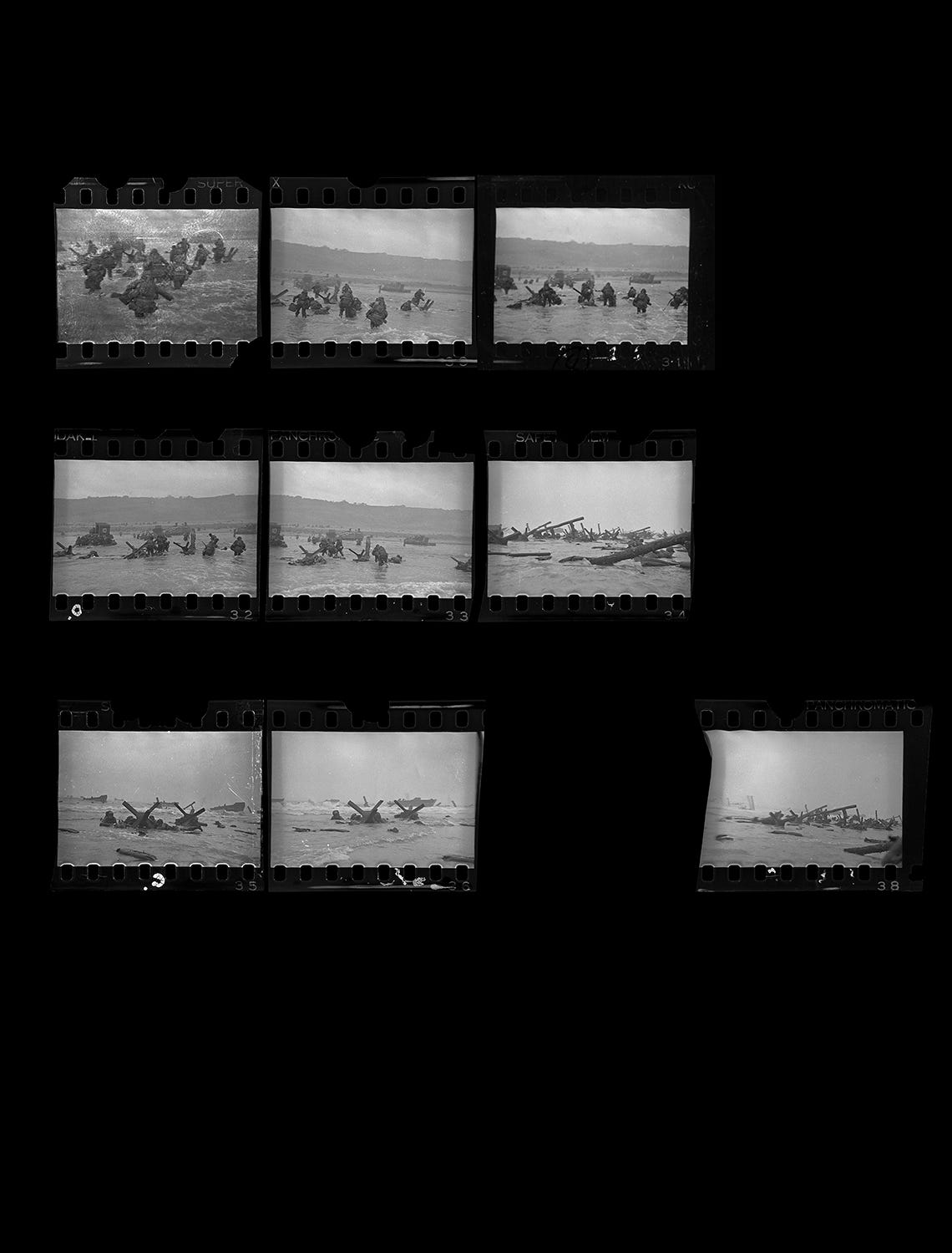
Only ten 35mm negatives exist from Omaha Beach. Though Capa claimed he shot one hundred and six across four rolls. Coleman’s team counted the negatives in the ICP archive: ten. Of those ten, the first five were taken while he stood on the LCVP ramp for almost two minutes before jumping into the water. Another was taken from behind a mined hedgehog. A final group of four came from behind Armoured Assault Vehicle 10, a wading Sherman tank. That’s the entire known photographic record of Robert Capa on Omaha Beach.
The darkroom story about the apprentice who closed the drying cabinet doors and melted the emulsion on three of the four rolls, is a fabrication. Those who have looked into it say it’s technically impossible. The coil heaters in 1944 wooden drying cabinets didn’t generate enough heat to melt film emulsion. Black and white film emulsion of that era doesn’t melt from brief high heat. Film drying cabinet doors were normally kept closed anyway to prevent dust sticking to wet emulsion so that was entirely normal (anyone having processed film knows how much of a pain dust can be). Both Capa and his brother Cornell started their careers as darkroom assistants. They knew this.
The sprocket hole intrusion into the image area, which was often used as proof that the emulsion had been sliding sideways from heat, is actually a known mechanical mismatch between Kodak film cassettes and the Contax II rangefinder. According to Coleman and Herrick’s research, Richard Whelan, Capa’s authorised biographer, and Cynthia Young, the ICP curator, both knew this and neither of them corrected the record. I wonder why.
John Morris was LIFE London’s picture editor, the one who received Capa’s films and the keeper of the negatives. For seventy years, he was the story’s most authoritative source because he was there when they arrived and nobody would dispute his recollection. The images were imperfect, blurred, grainy, slightly tilted, but they were the only civilian photographs taken from inside the Omaha Beach assault. LIFE published them on the 19th of June 1944, five of them spread across the magazine’s pages under the headline “Beachheads of Normandy: The Fateful Battle for Europe is Joined by Sea and Air”.
Morris maintained the darkroom story for decades, telling it in his book Get the Picture, in lectures, and in interviews. But in November 2014, on Christiane Amanpour’s CNN show, Morris recanted and admitted that he’d never actually seen heat-damaged negatives. Two years later, the day before his hundredth birthday, he told the New York Times Lensblog: “He may have stayed on Omaha Beach only long enough to make them”. Finally.
And where there is a financial interest, institutions will do anything for the bottom line. Founded by Cornell Capa, Robert’s brother, the ICP’s mission is to champion the work of photographers. Its most valued asset is the Robert Capa archive, and the ICP has a vested interest in the myth (like Cornell, who changed his name to follow Robert Capa, does). It’s a good myth: it sells exhibitions, books, and the brand.
In 2002, British military historian Alex Kershaw tried to write an unauthorised biography of Capa. The ICP refused him access to the Capa Archive. They refused to grant his publishers permission to reproduce any Capa images. In 2004, French documentary filmmaker Patrick Jeudy made a film called Robert Capa: The Man Who Wanted to Believe His Legend that suggested some of the same conclusions as Coleman’s team. Cornell Capa persuaded John Morris to sue Jeudy in France in an unsuccessful attempt to block the film’s distribution. This isn’t the behaviour of an organisation that cares about truth.
As Coleman’s team published its findings through the mid-2010s, ICP was still repeating the old claim on its Facebook page. On the 6th June 2016, the 72nd anniversary of D-Day, the page said that Capa shot four rolls of 35mm film and that only eleven frames survived. It can’t be a mistake at that point, information was out, at least doubts needed to be addressed, it’s a deliberate choice.
None of this makes Capa himself a fraud. He was a Hungarian Jewish refugee who’d fled Europe, who’d built a career on being close to the action (“If your pictures aren’t good enough, you’re not close enough”), and who found himself on a beach where men around him were dying. His own account in his autobiography Slightly Out of Focus, which he described as “accidental” and having “something to do with the truth”, shows a level of psychological distress that’s expected given the circumstances. He writes about his hands shaking, about hiding behind a half-burnt tank. It doesn’t matter whether every detail is factual. What is important is that he was there, that he made the images, and that they survived.
The blur and grain that make the Magnificent Eleven so haunting weren’t caused by a darkroom accident. A more likely explanation is camera movement from a photographer who was under fire, combined with low light and fast film pushed hard in development. The accident story gave them a neat narrative about dramatic rescue from a disastrous destruction, but the images didn’t need their own heroic story. The images are things and only carry the message. The truth gives them something better: authenticity. And authenticity is way more valuable than some kind of story about how a rare few survived a darkroom disaster.
The final word should go to John Morris, who spent seventy years telling the wrong story and then, at the end of his life, told the right one. “He may have stayed on Omaha Beach only long enough to make them. Only long enough”.
Sources:
- “Debunking the Myths of Robert Capa on D-Day”, A.D. Coleman, PetaPixel, February 16, 2019, https://petapixel.com/2019/02/16/debunking-the-myths-of-robert-capa-on-d-day/
- “Alternate History: Robert Capa on D-Day”, A.D. Coleman, Exposure magazine / Medium, https://medium.com/exposure-magazine/alternate-history-robert-capa-on-d-day-2657f9af914
- US Coast Guard official history of Omaha Beach landings
- International Center of Photography archive cataloguing
- ICP Facebook post, June 6, 2016
- John Morris recantation, CNN Amanpour show, November 2014, https://www.cnn.com/videos/world/2014/11/11/intv-amanpour-john-morris-robert-capa-war.cnn
- John Morris, New York Times Lensblog, December 6, 2016, Morris on his 100th birthday
- Colonel George Taylor quote, “Two kinds of people are staying on this beach. The dead and those who are going to die. Now let’s get the hell out of here.” From US Army records of the 16th Infantry Regiment, 1st Division, cited across multiple sources.
- Slightly Out of Focus, Robert Capa, 1947 memoir
- Blood and Champagne: The Life and Times of Robert Capa, Alex Kershaw, 2002
- Get the Picture, John Morris, 1998 memoir
- Robert Capa: The Man Who Wanted to Believe His Legend, Patrick Jeudy, 2004 French documentary
- “Photographer Robert Capa: Debunking the Myth”, Deutsche Welle, overview of the controversy, https://www.dw.com/en/wwii-photographer-robert-capa-debunking-the-myth/a-54852196
- “The true story behind Robert Capa’s iconic D-Day photo”, National Geographic, https://www.nationalgeographic.com/premium/article/robert-capa-d-day-photograph
- “The Magnificent Eleven”, Wikipedia, https://en.wikipedia.org/wiki/The_Magnificent_Eleven
- “Conflict of Interest, Cubed: Robert Capa’s D-Day Photos, John Morris, and the NPPA”, iMediaEthics, https://www.imediaethics.org/conflict-interest-cubed-robert-capas-d-day-photos-john-morris-nppa/view-all/
#Photography #Opinion #PhotographerFocus #RobertCapa